DbcultAccessing Vault...
5.2/10
Senior Film Conservator
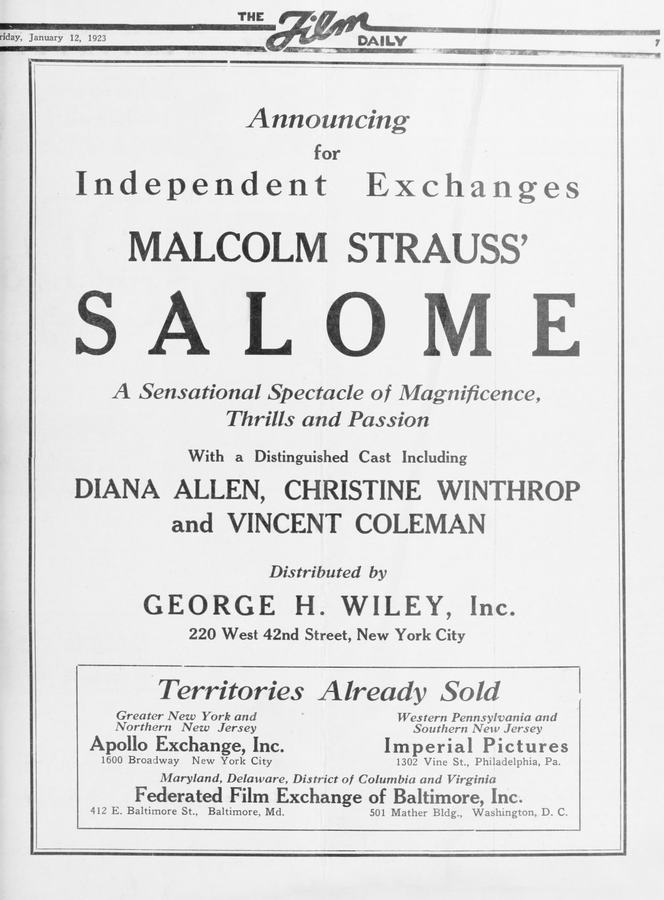
A definitive 5.2/10 rating for a film that redefined the boundaries of cult cinema. Salome remains a cornerstone of transgressive art.
The 1923 cinematic rendering of Salome, featuring the luminous Diana Allen and the formidable Christine Winthrop, stands as a staggering monument to the expressive potential of the silent frame. Unlike the more celebrated, avant-garde experiments of the same era, this production leans heavily into the psychological rot of the Herodian court, presenting a world where every shadow is a confession and every glance is a death warrant. It is a film that breathes through its textures—the heavy silks, the damp stone of the dungeon, and the flickering torchlight that seems to lick at the edges of the characters' sanity.
At the heart of this narrative deviation is the figure of the Egyptian prince, portrayed by Ben Probst with a stoic vulnerability that contrasts sharply with the frantic energy of the palace. The decision to introduce this specific catalyst—a spurned romantic overture from Herodias—recontextualizes the entire biblical myth. Here, the demand for the Baptist’s head is not merely a whim of a spoiled girl, but the calculated extortion of a mother using her daughter’s allure to settle a personal score. Christine Winthrop delivers a performance of chilling precision; her Herodias is not a caricature of evil, but a woman whose social standing is her only armor, and whose rejection by the prince triggers an atavistic need to destroy the beauty she cannot possess.
The cinematography utilizes a chiaroscuro palette that rivals the gloom of The Crucible, though it swaps Puritan austerity for a decadent, almost suffocating opulence. The dungeon sequences, where the prince and the Baptist are held in agonizing proximity, serve as a brilliant metaphor for the film’s dualities: the secular versus the sacred, the flesh versus the spirit. Vincent Coleman’s Baptist is a figure of quiet, terrifying intensity, his stillness acting as the gravitational center around which the chaotic lusts of the court revolve.
Diana Allen’s Salome is a revelation of nuance. In many contemporary works like Anya Kraeva, the female lead is often trapped in the binary of victim or temptress. Allen, however, navigates a middle path. Her Salome is a pawn who gradually realizes the lethality of her own board position. When she is forced to choose between the life of her lover and the life of the prophet, the internal fracture is visible in the very set of her shoulders. It is a performance that demands the viewer acknowledge the systemic weight placed upon women in this patriarchal hothouse.
"The film does not merely depict a dance; it depicts the dismantling of a soul, where the rhythm of the music is the ticking clock of a pending execution."
The pacing of the film is deliberate, almost agonizingly so, mirroring the slow-motion collapse of a dynasty. It shares a certain thematic DNA with My Mistake (1922) in its exploration of irrevocable choices, yet Salome operates on a much grander, more mythic scale. The screenplay manages to weave the personal vendetta of Herodias into the larger tapestry of religious upheaval without losing the intimacy of the central conflict. The prince’s fate becomes a secondary concern to the moral corruption of the court, a shift that elevates the film from a simple romance to a profound tragedy.
Technically, the film is a marvel of its time. The use of deep focus in the banquet scenes allows the viewer to observe the secret exchanges between Herodias and her guards while Salome occupies the foreground, creating a sense of multi-layered treachery. This complexity is often missing in more straightforward narratives like The Bashful Suitor or the domestic dramas of Should a Husband Forgive?. Instead, Salome leans into the theatricality of its setting, using the palace as a labyrinth where the characters are perpetually lost.
The lighting design deserves particular mention. The sea blue (#0E7490) tones of the night scenes, achieved through tinting, create an underwater atmosphere, as if the characters are drowning in their own desires. This visual choice emphasizes the inescapable nature of the Baptist’s prophecy. When the yellow (#EAB308) glow of the morning finally breaks, it does not bring enlightenment, but the harsh clarity of a crime that cannot be undone. It is a visual journey that parallels the psychological descent seen in L'essor, yet with a far more visceral impact.
When comparing this to the slapstick energy of Hampels Abenteuer or the light-hearted social commentary of Have You Heard of Schellevis-Mie?, the sheer weight of Salome becomes even more apparent. It is a film that refuses to offer the audience an easy exit. Even the more polished productions of the era, such as Trix, der Roman einer Millionärin, lack the raw, jagged edges of this tragedy. There is a sense of genuine danger in the interactions between Tom Cameron’s Herod and the rest of the cast; his portrayal of the king is one of a man paralyzed by his own power, a theme that resonates through other international works like Amor e Boemia.
The film’s preoccupation with the cost of survival and the vanity of wealth brings to mind Lost Money and Justice d'abord, yet it filters these themes through a lens of ancient myth. The Prince’s imprisonment is the ultimate expression of 'lost money'—a loss of human capital and potential to the whims of a narcissistic elite. The maritime isolation of Ebb Tide is mirrored here in the stone-walled isolation of the Judean palace.
The final act, dominated by the threat of the Prince’s execution, is a masterclass in suspense. The editing becomes more rhythmic, almost frantic, as the deadline approaches. Herodias’s ultimatum to Salome is the ultimate subversion of the maternal bond. In the world of this film, love is not a sanctuary but a weapon. This cynicism is perhaps more akin to the gritty realism of Carmen (1915) or the dark explorations of the human psyche in Die Bestie im Menschen.
When the final demand is made, it is not just for the Baptist's life, but for the destruction of the Prince's innocence. The tragedy is twofold: the death of a holy man and the corruption of a young woman's soul. The film ends not with a resolution, but with a lingering sense of dread. The palace remains, the torches continue to burn, but the moral center has been completely hollowed out. It is a haunting conclusion that stays with the viewer long after the screen has faded to black.
In the final analysis, this 1923 version of Salome is an essential piece of cinematic history. It challenges our perceptions of a well-worn story and asks difficult questions about the nature of power and the limits of revenge. The performances, particularly those of Winthrop and Allen, are among the finest of the silent era, providing a psychological depth that was rarely achieved in the early twenties. For any serious student of film, this is a required viewing—a dark orange (#C2410C) flame of creativity in a sea of black and white conformity.
Review by the Editorial Staff - A deep dive into the archives of 1923's most provocative cinema.
IMDb —
1917
Community
Log in to comment.