DbcultAccessing Vault...
Cult Review
Senior Film Conservator
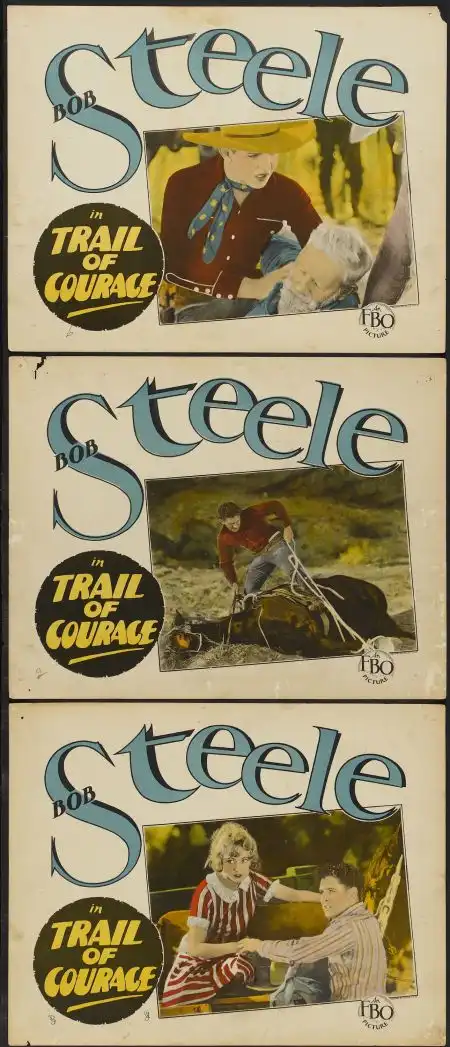
Okay, so "Trail of Courage." If you’re here looking for something with a grand narrative sweep or deep character studies, turn back now. Seriously. This is a Bob Steele picture, plain and simple, and it delivers exactly what that implies: a brisk, unpretentious B-western. You’ll probably enjoy it if you have a soft spot for the era, for actors who look like they actually rode horses for a living, and for plots that don’t try to outsmart you. For anyone else, especially those who find old black-and-white westerns a bit… slow, or perhaps a little too earnest in their good-versus-evil setup, you’ll likely be checking your watch.
Steele plays a drifter, naturally, who rides into a town where things are, you guessed it, not quite right. There’s a land dispute, a pretty girl, and a gang of heavies making life difficult. Standard stuff. What’s interesting, or maybe just endearing, is how utterly committed Steele is to this persona. He’s got that lean, almost wiry energy, and he sells every punch and every quick draw with a kind of no-nonsense conviction. Even when the dialogue feels lifted straight from a dusty playbook, his delivery manages to keep it from completely falling flat.
There's a scene early on where Steele's character, Bob Reynolds, confronts a couple of the gang members in a saloon. The lighting in that saloon is just... flat. Everything's evenly lit, like they just flipped on all the house lights. It drains any sense of atmosphere right out of the room. But then the fight breaks out, and it's surprisingly kinetic for its time. Steele moves fast, maybe a little too fast for the camera to always catch cleanly. You get a quick sense of the chaos, then suddenly everyone's on the floor. It’s effective, even if the sound design is just a generic thud-thud-thud.
Marjorie Bonner, as the love interest, feels a bit underwritten. She's mostly there to be worried, or to deliver some exposition. There's one moment where she's supposed to look distraught after her father is threatened, but her expression is more like she just remembered she left the stove on. It’s not a terrible performance, just… a little muted when the scene really needs her to sell the emotional stakes. The chemistry between her and Steele is there, I guess, but it’s more of a polite acknowledgement than any real spark. They smile at each other, and that’s about it.
The film’s pacing is something else. It gallops along for about ten minutes, then slows to a trot for another fifteen, then suddenly it’s a full-on chase again. There’s a sequence where Bob is tracking some rustlers, and it just goes on. Shot after shot of him riding, then dismounting to look at tracks, then riding again. You almost expect a voiceover to pop up and say, "And still, he rode." It feels like padding, honestly, stretching out the runtime before the next fistfight or shootout.
And speaking of shootouts, the final confrontation is a bit of a mixed bag. There's a decent setup, with the bad guys holed up, but then it becomes a lot of people just popping up from behind rocks and firing. The actual aiming seems optional for most characters. One guy, a henchman played by Jay Morley, takes what feels like five bullets to the chest before finally going down. It's almost comical. You start to think, "Is this guy secretly invincible?" He just keeps stumbling around. It’s a moment that pulls you out of the tension, making you wonder if they just ran out of takes.
Thomas G. Lingham plays the main heavy, and he’s pretty good at being slimy. He has this way of smiling that doesn't quite reach his eyes, which is a nice touch. It's not a nuanced villain, but he gets the job done. You want to see him get his comeuppance, and that’s really all you need in a movie like this.
The outdoor shots are generally solid, though. The wide open spaces, the dusty trails – they give a good sense of the frontier. You can almost feel the grit in your teeth. But then you’ll get an interior shot that looks like it was filmed in someone’s garage, with props that feel like they were borrowed from a local antique shop just for the day. That contrast can be jarring, pulling you from the immersive feeling of the West back into the reality of a low-budget production.
There's a scene near the end, a sort of quiet moment after the big climax, where Bob and Marjorie are talking. It’s supposed to be the wrap-up, the promise of a future. But the dialogue is so clunky, so on-the-nose about their feelings, that it loses all impact. "I guess this is goodbye," she says, even though they’ve just established they like each other. And he just nods, with that same stoic Bob Steele expression. It feels less like a heartfelt parting and more like they're reading lines off cue cards. You almost wish they’d just ended it with a final gallop into the sunset, without the awkward chat.
So, is Trail of Courage a lost classic? Absolutely not. Is it a perfectly executed western? Not even close. But for what it is—a quick, honest-to-goodness cowboy flick from an era that produced hundreds just like it—it's got a certain charm. It’s the kind of movie you put on a rainy afternoon, not expecting much, and end up having a perfectly decent time with. Just don't expect any courage from its script, or any real trail-blazing in its narrative. It sticks to the path, and sometimes, that’s all you need.
IMDb 6.5
1925
Community
Log in to comment.