DbcultAccessing Vault...
Cult Review
Senior Film Conservator
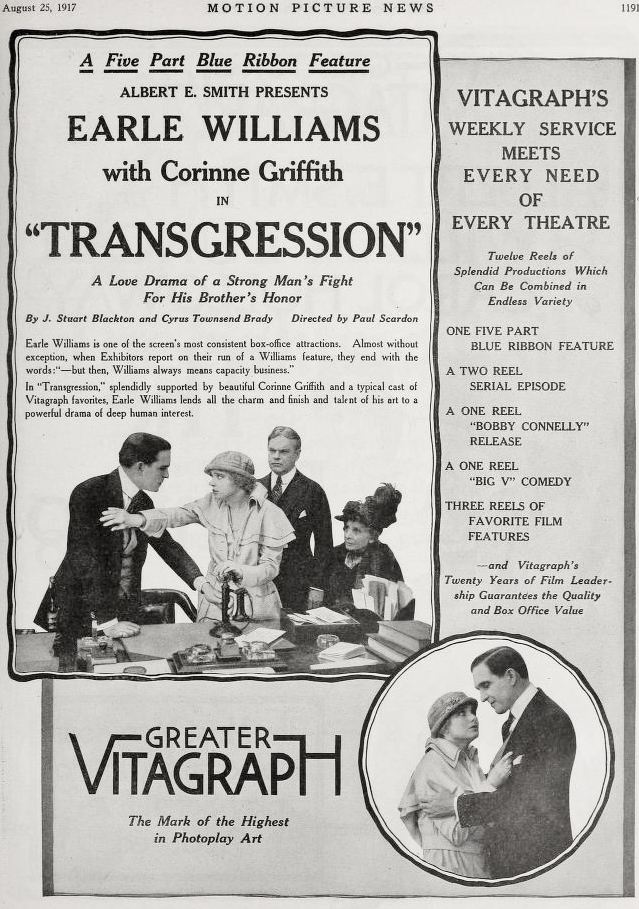
The flickering shadows of early cinema often conceal narratives of profound human drama, stories that, despite their antiquated presentation, resonate with timeless themes of morality, desire, and the intricate dance of consequence. 'Transgression', a 1917 cinematic offering, stands as a testament to this enduring power. It's not merely a film; it's a meticulously crafted study of character erosion and eventual, hard-won redemption, wrapped in the guise of a gripping melodrama. To approach 'Transgression' is to peel back layers of societal expectation and personal frailty, revealing a core narrative that feels as relevant today as it did over a century ago. The film, in its quiet intensity, challenges its audience to consider the true cost of deceit and the often-circuitous path to atonement.
At the heart of 'Transgression' lies the tumultuous relationship between its principal players, a quartet whose lives become inextricably linked by a single, violent act. Hal Page, portrayed with a nuanced vulnerability, is initially presented as the antithesis of his formidable brother, Stephen. Stephen, the town mayor, embodies civic responsibility and a certain stoic authority, a stark contrast to Hal's perceived weakness and susceptibility. This sibling dynamic forms the bedrock of the narrative, establishing a clear power imbalance that Carline Shrefton, the film's enigmatic femme fatale, exploits with chilling precision. Carline is not merely a love interest; she is a catalyst, a force of nature whose self-serving ambition drives much of the plot's tragic momentum. Her calculated abandonment of Burt Staley for the more impressionable Hal is the first domino to fall, setting off a chain reaction of jealousy, violence, and ultimately, a desperate cover-up.
The ensuing confrontation, culminating in Staley's death by Carline's own gun, is a pivotal moment, not just for its immediate dramatic impact, but for the moral quandary it presents. Hal's confession, a seemingly noble act, is imbued with layers of complexity. Is it genuine remorse? A desperate attempt to protect the woman he loves, however undeserving? Or perhaps a deep-seated desire for validation, even if it means sacrificing his own freedom? Stephen's subsequent orchestration of Hal's exile to Spain speaks volumes about his character – a man willing to bend the rules to protect his family, yet fundamentally driven by a sense of order and reputation. This early act of familial loyalty, however tainted by deception, sets up Stephen's later trials when Carline re-enters his life with a new set of demands.
The narrative then deftly shifts gears, introducing a new layer of complexity with the engagement of Stephen to Marion Hayward, the daughter of the district attorney. This development is not merely a romantic subplot; it's a strategic move, intertwining the personal with the political. Marion's father, a figure of uncompromising justice, is actively prosecuting James Reed, a corrupt politician who, in a twist of fate, has become Carline's new husband. This convergence of storylines elevates 'Transgression' beyond a simple crime drama into a commentary on societal corruption and the insidious ways in which power can be wielded and abused. The film explores how personal relationships can be weaponized in the arena of public life, a theme not dissimilar to that found in Politik och brott, where the lines between personal ethics and political expediency are constantly blurred.
Carline, ever the opportunist, seizes upon this confluence of events. Her threat to expose Hal's supposed crime – and by extension, Stephen's complicity in the cover-up – is a desperate, yet cunning, maneuver to save her husband, Reed. This act of blackmail forces Stephen into an impossible position, pitting his familial loyalty and his own reputation against the demands of a woman who has already brought so much turmoil into his life. His refusal to bend to her demands underscores his moral fortitude, or perhaps a calculated gamble that the truth, however painful, will ultimately prevail. This tension, where past transgressions threaten to derail present aspirations, creates a palpable sense of suspense, keeping the audience on edge as Carline's deadline looms. The film masterfully builds this pressure, making Carline's impending revelation feel like an inescapable force of nature.
The dramatic re-entry of Hal Page into the narrative is the turning point, a moment of profound narrative catharsis. His year in Spain, initially a punishment, has clearly been a period of introspection and maturation. The 'weakling brother' returns not as a victim, but as an agent of truth, ready to confront the consequences of his past and the lies that have festered in his absence. His confession to Hayward, revealing Carline as the true killer, is a powerful act of self-liberation and a testament to his newfound moral courage. This arc, from a character defined by his weakness to one who actively seeks justice, is compelling. It mirrors, in a sense, the transformative journey often seen in narratives of personal growth and moral awakening, though perhaps less overtly spiritual than some, focusing instead on civic and familial duty. The film suggests that true strength is not merely the absence of fear, but the willingness to face uncomfortable truths.
Hayward's meticulous verification of Hal's story and his subsequent grilling of Carline are depicted with a satisfying sense of procedural justice. Carline's eventual admission of guilt, stripped of her manipulative power, provides a crucial moment of reckoning. It's a testament to the film's narrative economy that these intense emotional and legal confrontations are conveyed effectively within the constraints of silent cinema, relying heavily on performances and intertitles. The resolution brings a sense of order restored: Hal is not only absolved but also restored to his family, his journey from exile to redemption complete. Reed, the corrupt politician, is finally brought to justice, his ill-gotten gains and moral failings exposed. The film thus concludes with a satisfying, if somewhat conventional, triumph of truth and justice, reinforcing the idea that even the most elaborate deceptions eventually crumble under the weight of veracity.
In an era before synchronized sound, the burden of conveying complex emotions and intricate plot details fell squarely on the shoulders of the actors and the visual storytelling. The cast of 'Transgression', featuring names like Corinne Griffith, Mary Maurice, and Earle Williams, navigated this challenge with commendable skill. Corinne Griffith, in particular, as Carline Shrefton, must have delivered a performance of captivating duplicity, using facial expressions and body language to convey her character's manipulative charm and underlying ruthlessness. Her ability to shift from alluring to venomous would have been crucial in establishing Carline as the film's central antagonist. Earle Williams, likely in the role of Stephen Page, would have needed to project an aura of authority tempered by familial concern, a tightrope walk between duty and affection. The physical demands on silent film actors were immense; every gesture, every glance, had to speak volumes, compensating for the absence of dialogue. One can imagine the dramatic close-ups, designed to magnify the internal turmoil and external resolve of these characters.
The pacing of 'Transgression', as inferred from its detailed plot, appears to be a deliberate escalation of tension. It begins with a personal drama, rapidly spirals into a crime, and then expands into a broader political and legal struggle. The writers, Cyrus Townsend Brady, J. Stuart Blackton, and Edward J. Montagne, crafted a narrative that, while perhaps adhering to certain melodramatic conventions of the time, demonstrates a sophisticated understanding of dramatic structure. The introduction of new conflicts (Stephen's engagement, Reed's corruption, Carline's blackmail) at opportune moments keeps the plot from stagnating, constantly raising the stakes. This multi-layered approach ensures that the audience remains invested, not just in the fate of Hal, but in the broader implications of truth and justice within the community. The film's ability to maintain narrative drive without spoken words is a testament to the power of visual storytelling and well-constructed intertitles, which served as crucial narrative bridges.
Beyond the immediate thrills of its plot, 'Transgression' delves into profound thematic territory. At its core, it is a meditation on guilt – both the guilt of the perpetrator and the guilt of those who enable or cover up crimes. Hal's initial confession, though false, burdens him with a profound sense of responsibility, driving his exile and subsequent transformation. Stephen's complicity, however well-intentioned, places him in a precarious moral position, forcing him to confront the limits of his authority and his personal ethics. The film also explores the destructive nature of ambition, personified by Carline, whose relentless pursuit of self-interest leaves a trail of ruined lives. Her character serves as a stark warning about the corrupting influence of unchecked desire and the lengths to which individuals will go to protect their perceived advantages.
'Transgression' might not be as widely remembered as some of its contemporaries, but its narrative sophistication and thematic depth deserve closer examination. It showcases the burgeoning capabilities of early cinema to tell complex, character-driven stories that grapple with serious moral questions. The film's ability to interweave personal drama with political intrigue, and to explore the nuanced motivations behind human actions, speaks to a maturity in filmmaking that was rapidly evolving during this period. It predates the classic noir narratives but contains many of their foundational elements: a vulnerable protagonist, a manipulative woman, a crime, and a web of deceit that threatens to ensnare everyone involved. While not a direct precursor, one can see the thematic seeds of later, more explicit crime dramas. The intricate plotting and moral ambiguities could be compared to the complex familial and criminal entanglements in films like On Dangerous Ground, albeit without the hardboiled cynicism of the later genre.
The film serves as a valuable artifact, offering insights into the social mores and narrative preoccupations of its time. It highlights the importance placed on reputation, the pervasive nature of political corruption, and the enduring belief in the eventual triumph of justice. For cinephiles and historians alike, 'Transgression' offers a window into the narrative craftsmanship of early 20th-century filmmaking, demonstrating how compelling stories could be told with visual artistry and the raw power of human emotion. It is a reminder that even in the absence of spoken dialogue, the human experience – with all its flaws, desires, and aspirations – can be conveyed with profound impact. The film, in its quiet power, invites reflection on the timeless struggle between good and evil, truth and deception, and the enduring quest for personal and societal justice. It's a compelling watch for anyone interested in the evolution of cinematic storytelling and the enduring power of a well-crafted dramatic narrative.
IMDb —
1927
Community
Log in to comment.