DbcultAccessing Vault...
Cult Review
Senior Film Conservator
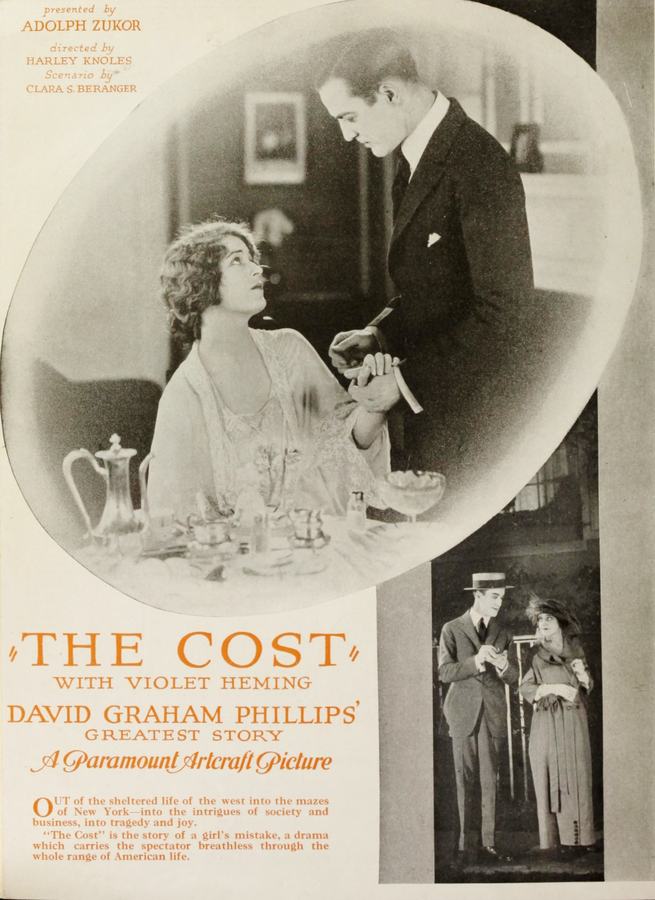
In the annals of early cinema, some narratives resonate with a particular intensity, their themes of human frailty and resilience transcending the limitations of their silent medium. David Graham Phillips and Clara Beranger’s screenplay for 'The Cost' is precisely such a work, a profound exploration of personal choices and their far-reaching repercussions. It plunges us into the tumultuous life of Pauline Gardner, a woman whose idealism clashes with the harsh realities of a world often indifferent to noble intentions. From the outset, the film establishes a compelling tension, as Pauline, against the sagacious counsel of her father, commits to a future with John Dumon, a man whose charm thinly veils a deeply ingrained philandering nature. Her conviction, predicated on Dumon’s hollow promises of reform, sets in motion a chain of events that will demand an exorbitant emotional and personal toll.
The initial chapters of Pauline’s marriage to Dumon are a study in disillusionment. The facile vows of fidelity and transformation, once so potent to Pauline’s hopeful heart, quickly unravel. Dumon’s inherent profligacy reasserts itself with merciless predictability, his dalliances becoming an open secret, culminating in a devastating public display that shatters Pauline's world. This pivotal moment, witnessing her husband's infidelity firsthand, serves as the undeniable catalyst for her departure. The decision to separate and return to her parents out West is not merely a retreat but a decisive act of self-preservation, a desperate attempt to reclaim a semblance of dignity from the wreckage of her marital aspirations. This early segment of 'The Cost' echoes the societal pressures and limited options faced by women navigating marital strife in that era, a predicament explored with similar nuance in films like The Divorcee, where the quest for autonomy often came at a significant personal sacrifice.
As Pauline endeavors to reconstruct her life amidst the familiar comforts of her familial home, the narrative deftly pivots, revealing the expansive reach of John Dumon's ambition. He resurfaces not as a reformed husband, but as a formidable industrial magnate, assuming leadership of a powerful wool trust. This new corporate titan sets his sights on dominating the Western state where Pauline’s parents reside, and more significantly, where her former suitor, Hampton Scarborough, is campaigning for governorship. The film brilliantly intertwines Pauline’s personal tragedy with a broader socio-political struggle, portraying Dumon’s relentless pursuit of power as an extension of his character flaws – a lack of integrity and an insatiable desire for control. His attempts to subvert the democratic process and gain undue influence underscore the film’s critique of unchecked capitalist ambition, a theme that might find resonance with the moral quandaries presented in a film like Who's Your Neighbor?, which similarly scrutinizes the ethical boundaries of societal influence.
Scarborough, portrayed with a quiet rectitude by Edward Arnold, emerges as the antithesis to Dumon's opportunistic machinations. His integrity and commitment to public service offer a stark contrast to Dumon’s self-serving agenda. The political subplot, though ultimately unsuccessful for Dumon, serves to highlight the protagonist’s enduring capacity for disruption and his inability to operate within ethical bounds, whether in personal relationships or public office. This section of the film expands its scope beyond domestic drama, commenting on the insidious nature of corporate power attempting to dictate political outcomes, a surprisingly modern concern for a film of its vintage.
Time, a relentless sculptor of destinies, marches on, bringing with it yet another devastating revelation for Pauline. The insidious tendrils of Dumon’s infidelity reach even further, ensnaring Leonora Fanshaw, Pauline’s closest friend. This betrayal, a double-edged sword piercing both trust and friendship, escalates the emotional stakes immeasurably. Leonora’s husband, a man of considerable influence and, as it turns out, profound vengeful spirit, engineers Dumon's spectacular downfall on Wall Street. This act of calculated retribution is a masterstroke of narrative design, demonstrating that the 'cost' of Dumon’s actions is not merely emotional but also financial and reputational. The intricate web of personal relationships and their powerful, often destructive, consequences is drawn with remarkable clarity, showcasing the writers' keen understanding of human psychology and the domino effect of moral transgressions.
The dramatic irony here is palpable: Dumon, the architect of so much pain, now finds himself utterly ruined, a victim of his own moral bankruptcy and another’s desire for justice. His financial collapse on Wall Street is a metaphorical mirror to the collapse of his character, a public humiliation that dwarfs his earlier private indiscretions. This moment of financial cataclysm provides a stark parallel to the personal ruin he inflicted upon Pauline, underscoring the film's central thesis about the inescapable nature of consequence. One might draw thematic lines to films like Pay Dirt, where characters often face the harsh realities of their past catching up to them, though perhaps with less direct, orchestrated vengeance.
In a move that defines her character’s remarkable depth and capacity for compassion, Pauline, despite all the pain and betrayal, steps in to bail Dumon out of his financial quagmire. This act is not born of rekindled romantic love, but perhaps a complex admixture of lingering obligation, a desire for a clean slate, or a profound empathy for the human condition, even in its most flawed manifestations. It is a moment of immense self-sacrifice, highlighting Pauline’s inherent goodness and moral fortitude. However, the emotional and financial strain of this intervention proves too great for Dumon, ultimately claiming his life. His demise, a consequence of accumulated stress and the weight of his own misdeeds, is a somber, yet inevitable, conclusion to his tumultuous existence. It’s a powerful narrative choice, demonstrating that even redemption, or an attempt at it, can have fatal repercussions, an idea that resonates with the heavy moral burdens explored in Saints and Sorrows.
Dumon’s death clears the path for Pauline’s eventual return to Hampton Scarborough. Their marriage, occurring after such a protracted and arduous journey, feels less like a sudden romantic culmination and more like a hard-won peace, a quiet affirmation of enduring love and stability forged in the crucible of profound personal suffering. It’s a resolution that acknowledges the scars of the past while looking towards a future built on genuine affection and mutual respect, a stark contrast to the tumultuous beginning of Pauline's adult life. The film masterfully portrays the idea that true happiness often comes at a significant, often unexpected, price.
Violet Heming’s portrayal of Pauline Gardner is nothing short of captivating. In an era where nuanced emotion had to be conveyed through gesture, expression, and the subtle shift of the body, Heming delivers a performance of remarkable depth and authenticity. Her Pauline is not merely a victim of circumstance, but a woman of agency, capable of both profound love and resolute self-preservation. Heming conveys the initial youthful optimism, the crushing weight of betrayal, the quiet dignity of her resilience, and the eventual, hard-earned serenity with a grace that elevates the entire production. Her ability to communicate complex internal states without uttering a single word is a testament to her skill and the power of silent acting.
Clifford Grey, as the charming yet ultimately reprehensible John Dumon, provides the perfect foil. His performance, while perhaps less overtly sympathetic, is crucial to the film’s dramatic tension. He embodies the seductive allure of a philanderer, making Pauline’s initial choice understandable, even if misguided. His descent into political and financial ruin is depicted with a believable blend of arrogance and eventual despair. Edward Arnold, as Hampton Scarborough, offers a steadying presence. His character serves as a moral anchor, representing the steadfast loyalty and integrity that contrasts so sharply with Dumon’s volatility. The supporting cast, including Jane Jennings, Ralph Kellard, and Carlotta Monterey, each contribute to the rich tapestry of the narrative, adding layers of authenticity to the various societal and personal interactions depicted.
The narrative strength of 'The Cost' is undeniably rooted in the sophisticated screenplay penned by David Graham Phillips and Clara Beranger. Phillips, known for his incisive social critiques, brings a keen understanding of human nature and societal pressures to the story. Beranger, a prolific screenwriter of the era, expertly translates these complex themes into a compelling cinematic structure. Together, they craft a narrative that avoids simplistic morality tales, instead presenting characters with genuine flaws and motivations. The progression from personal romantic disillusionment to large-scale political and financial intrigue is handled with a deft touch, ensuring that the stakes continually escalate without ever feeling forced or melodramatic. Their writing ensures that every twist and turn feels earned, contributing to the overall sense of tragic inevitability and eventual, hard-won peace.
The intricate plotting, particularly the intertwining of John Dumon’s personal failings with his public ambitions and ultimate downfall, showcases a sophisticated approach to character development and thematic exploration. The writers dared to explore the long shadow cast by poor choices, not just on the individual, but on all those within their orbit. This depth of character and plot is something that distinguishes it from more straightforward melodramas of the period, inviting comparisons to the richer narratives found in films like The Heart of Nora Flynn, which also delves into the complexities of moral compromise and societal judgment.
Beyond its compelling plot and stellar performances, 'The Cost' endures as a powerful testament to the timeless nature of its themes. It is a film about the true price of idealism, the corrosive power of unchecked ambition, and the profound resilience of the human spirit in the face of profound adversity. Pauline’s journey is one of immense suffering and eventual, if bittersweet, triumph. Her capacity for forgiveness and her ultimate decision to extend grace to the man who caused her so much pain speak volumes about the film’s deeper philosophical underpinnings regarding empathy and the cyclical nature of human relationships. The resolution, while offering a sense of closure, subtly reminds us that the 'cost' of such a journey leaves indelible marks, shaping one’s identity in profound ways.
The film’s exploration of societal expectations placed upon women, the corrupting influence of power, and the intricate dance between personal morality and public life, remain remarkably pertinent even today. It serves as a stark reminder that while the trappings of society may evolve, the fundamental struggles of the human heart and the consequences of our actions are eternal. The silent era, often underestimated in its narrative sophistication, produced gems like 'The Cost' that continue to provoke thought and stir emotions, proving that powerful storytelling transcends the spoken word. It’s a film that asks us to reflect on our own choices and consider the long-term reverberations of every decision, a poignant and powerful cinematic experience that leaves a lasting impression.
In a cinematic landscape often dominated by grand spectacles, 'The Cost' offers a deeply personal drama, a character study wrapped in layers of social commentary. It’s a film that deserves to be rediscovered and appreciated for its artistry and its unwavering commitment to depicting the complex moral landscape of human existence. The journey of Pauline Gardner is a poignant reminder that while love can be fleeting and betrayal devastating, the human spirit's capacity for resilience and eventual peace can, indeed, overcome even the most exorbitant 'cost' of life's trials.
IMDb 6
1918
Community
Log in to comment.