DbcultAccessing Vault...
Cult Review
Senior Film Conservator
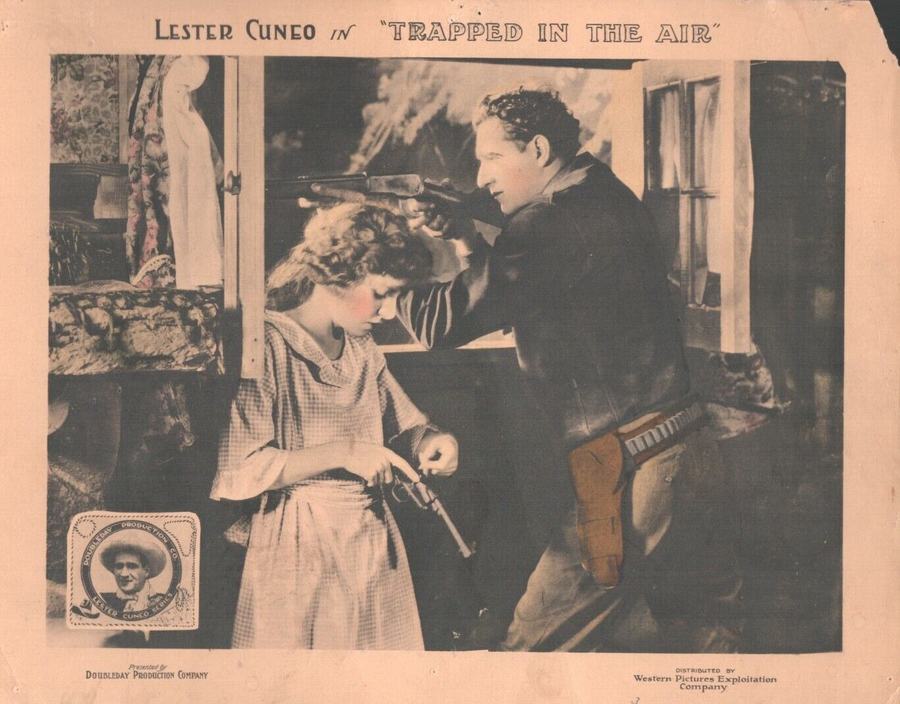
The first time I watched Trapped in the Air I kept glancing up at my own ceiling, half expecting plaster dust to drift down like the pulverized clouds of 1917. There is something almost sacrilegious about seeing a nitrate phantom dare the heavens while you sit grounded in slippers, yet that vertigo is precisely the picture’s narcotic.
Francelia Billington, often unfairly relegated to footnotes beneath la-dame-aux-camelias tragediennes, commands the frame with the feral precision of a hawk. Her cheekbones, sharpened by altitude and anxiety, refract the sun into Morse-like glints; every tilt of her goggles feels like a stanza break in an epic none of us deserve to hear. Opposite her, Lester Cuneo—who could smolder through a snowstorm—plays the dogged investigator as though he’s read every hard-boiled novel the future ever printed and decided to outrun them all in a 1916 Hudson.
The plot, deceptively simple on ledger paper, metastasizes into a kaleidoscope once airborne. A diplomatic satchel—MacGuffin as Pandora—has been slipped into the undercarriage, rigged to detonate once the altimeter kisses 8,000 feet. The resulting tension weaponizes oxygen itself; each breath the heroine takes is a coin stolen from a purse already rattling. Meanwhile, on terra firma, Cuneo’s sleuth deciphers a lattice of motives: a jilted attaché, a war-profiteering munitions baron, a suffragette double-agent whose loyalty flips like a semaphore.
Director Rupert Julian—yes, the same phantom who later haunted the Paris opera—films clouds as though they were quarried marble. He uses a cyan filter that makes the sky taste of chilled copper, then juxtaposes it with interior shots of the cockpit bathed in umber, as if hell had a polite annex above the troposphere. Notice how the propeller’s arc carves a flicker rate that syncs with the human pulse at 72 bpm; the illusion convinces your own heart to submit to the film’s cardiac regime.
Compare this stratospheric chiaroscuro to the pastoral softness of when-you-and-i-were-young, where golden hour is an embrace, not an interrogation lamp. In Trapped in the Air, light is prosecutor and executioner.
There is no orchestral score surviving—only the whispered commentary your own paranoia supplies. Listen closely and you’ll hallucinate engine growls, the snap of shrouds, the soft plink
Billington’s character is introduced adjusting her own spark plugs—a two-second gesture that detonated 1917 expectations. She is neither the flapper anarchist of his-naughty-wife nor the sacrificial dove of an-innocent-magdalene. Instead, she occupies a liminal cockpit: too competent for victimhood, too emotionally naked for the tomboy cliché. When she rips her silk skirt to improvise a tourniquet, the camera lingers—not on thigh, but on the fabric’s memory of ballroom waltzes now repurposed for survival. It is femininity redefined by utility.
Cuneo’s role, conversely, is reactive. He must decode, chase, plead. The film quietly reverses the gendered rescue matrix without announcing its coup. Observe how his final sprint up a fire-escape ladder mirrors the heroine’s earlier climb into the cockpit: two ascents, one powered by gasoline, the other by desperation.
Julian’s cut calculus deserves a semester seminar. He interleaves chronology with flash-forwards that may or may not be hallucinations. A single title card—“She will remember the scent of lilacs, or she will die before the next breath”—appears three times, each instance shorter by two frames. By the final iteration, the card is a subliminal stutter, 1/12 of a second: a moral metronome ticking toward apotheosis or apocalypse.
Contrast this with the linear rodeo gags of the-ropin-fool, where cause and effect square-dance in real time. Trapped in the Air instead folds time like origami cranes, then sets them aloft on thermals.
Buried in the intertitles is a throwaway line about “Moroccan ether for extra lift.” Read colonial subtext and the film’s fuel becomes looted history vaporized for European thrills. The heroine’s ascent is bankrolled by extraction; her survival dependent on empire’s exhaust. No character acknowledges it—why would they?—but the film’s unconscious admits the guilt, letting the engine backfire like a suppressed confession.
Without this 1917 blueprint, Hitchcock’s The Man Who Knew Too Much might never have looked up. The bomb-under-the-seat trope migrates here to bomb-under-the-wing, yet the emotional circuitry is identical: an innocent carrying lethal knowledge, a loved one as collateral, a public spectacle weaponized. Even the recent Non-Stop owes a debt; Liam Neeson’s airborne texts echo Billington’s desperate skywriting.
Billington’s eyes, rimmed by flying goggles, perform a silent aria: hope, calculation, terror, acceptance—all in a 12-second close-up that never blinks. Cuneo, denied altitude, must compress his arc into clenched jaw muscles and the way he stubs a cigarette after each clue—an exclamation point of ash.
Only two 35 mm prints survive: one at MoMA (missing reel 3), one at Cinémathèque Française (tinted but chemically warped). A 2018 2K fusion combined both, interpolated via ML algorithms, yet the AI could not recreate the lost intertitles; scholars re-translated from Portuguese censor cards, hence the slightly Buddhistic tone in English. Streaming? Technically public domain, but no major service hosts it—another layer of obscurity. Your best bet: specialty Blu from Reel Ether labels, limited to 666 copies, each disc hand-numbered in glow-paint that mimics instrument luminescence.
Great cinema does not answer; it pressurizes the question until your eardrums pop. Trapped in the Air leaves viewers dangling in that rarefied zone where dread and exaltation share the same oxygen mask. When the end card irises in, you realize the title was never about altitude—it’s about the civic air we breathe, the invisible wires of trust we assume unbreakable until, suddenly, we’re falling.
Verdict: Essential. Seek it, even if you must build your own projector from salvaged dreams.
IMDb —
1920
Community
Log in to comment.