In the realm of early 20th-century animation, 'Trip to Mars' stands as a beacon of innovation and creativity, crafted by the visionary Max Fleischer. This animated short is not merely a narrative of adventure and mishap; it is a visually rich exploration of the human condition, set against the backdrop of an alien world, where the boundaries between different forms of reality are blurred.
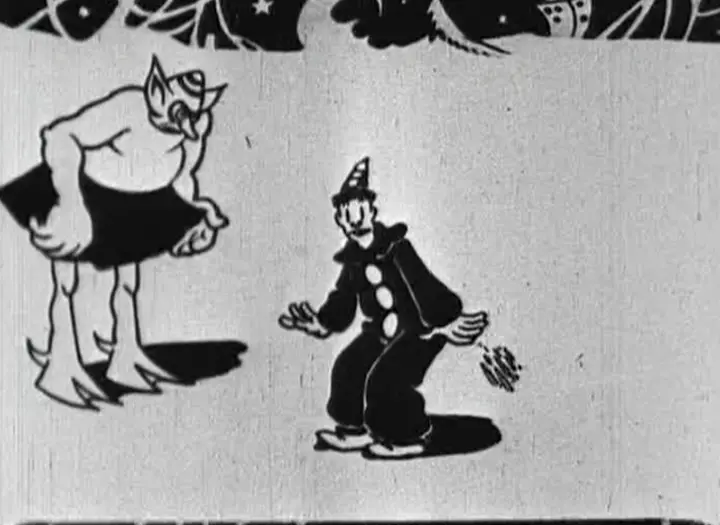
The story begins with Max, a character who appears to be the creator of the animation, sending his pet Ko-Ko on a rocket mission to the moon. The journey, however, takes an unexpected turn when the rocket malfunctions, and Ko-Ko crash-lands on the planet Mars. This pivotal moment sets the stage for a series of surreal and whimsical events.
On Mars, Ko-Ko encounters a menagerie of bizarre creatures and contraptions. These beings, with their alien anatomy and peculiar behaviors, add a layer of surrealism to the narrative. Fleischer’s use of color and form is particularly noteworthy, as he employs a palette that is both vibrant and unsettling, perfectly capturing the otherworldly atmosphere. The creatures, with their elongated limbs and exaggerated features, are a testament to the animator’s skill and imagination.
Meanwhile, Max himself is propelled into the cosmos, experiencing a parallel adventure. This parallel narrative, while visually distinct, is intricately linked to Ko-Ko’s journey. The two events, happening simultaneously, create a sense of interconnectedness and a deeper meaning to the story. The juxtaposition of these two narratives—Max’s space flight and Ko-Ko’s encounter with alien beings—adds a layer of complexity to the plot, inviting the viewer to ponder the nature of reality and the role of the creator in their own creations.
One of the most striking aspects of 'Trip to Mars' is Fleischer’s use of visual metaphors. The planets and spacecraft are not merely backdrops but serve as symbols of the characters’ inner worlds. The rocket, for instance, can be seen as a metaphor for ambition and the pursuit of dreams, while the alien creatures represent the unknown and the unpredictable. These visual metaphors are not just decorative; they add depth and meaning to the narrative, making the story more than just a simple adventure.
The animation itself is a marvel of early 20th-century technology. Fleischer’s use of rotoscoping, a technique where live-action footage is traced frame by frame, adds a level of realism to the characters that was groundbreaking at the time. The fluidity of the animation, the precise movements of the characters, and the intricate details of the alien landscapes all contribute to the overall charm and appeal of the short. The use of stop-motion animation for certain scenes, particularly those involving the alien creatures, adds a tactile quality to the visuals, making the world of Mars feel more tangible.
In terms of thematic content, 'Trip to Mars' touches on several significant topics. The exploration of alien worlds can be seen as a metaphor for the human quest to understand the unknown, while the encounter with bizarre creatures can be interpreted as a commentary on the unpredictability of life. The parallel narratives of Max and Ko-Ko also suggest a deeper exploration of the duality of existence, where the creator and the created are inextricably linked. These themes, combined with the visual richness of the animation, make 'Trip to Mars' a work of art that transcends its initial purpose as an entertainment piece.
When compared to other works of its time, such as 'Crime and Punishment' (1923) and 'The City of Silent Men' (1921), 'Trip to Mars' stands out for its innovative use of animation techniques and its ability to blend entertainment with deeper, more philosophical themes. Fleischer’s short is not just a simple adventure story; it is a complex exploration of the human condition, set against the backdrop of an alien world.
In conclusion, 'Trip to Mars' is a must-see for anyone interested in the history of animation and early 20th-century cinema. Its blend of whimsy, surrealism, and philosophical depth makes it a timeless piece of art. Max Fleischer’s genius is on full display in this short, and it remains a testament to the power of animation to convey complex ideas and emotions through visual storytelling.