DbcultAccessing Vault...
Cult Review
Senior Film Conservator
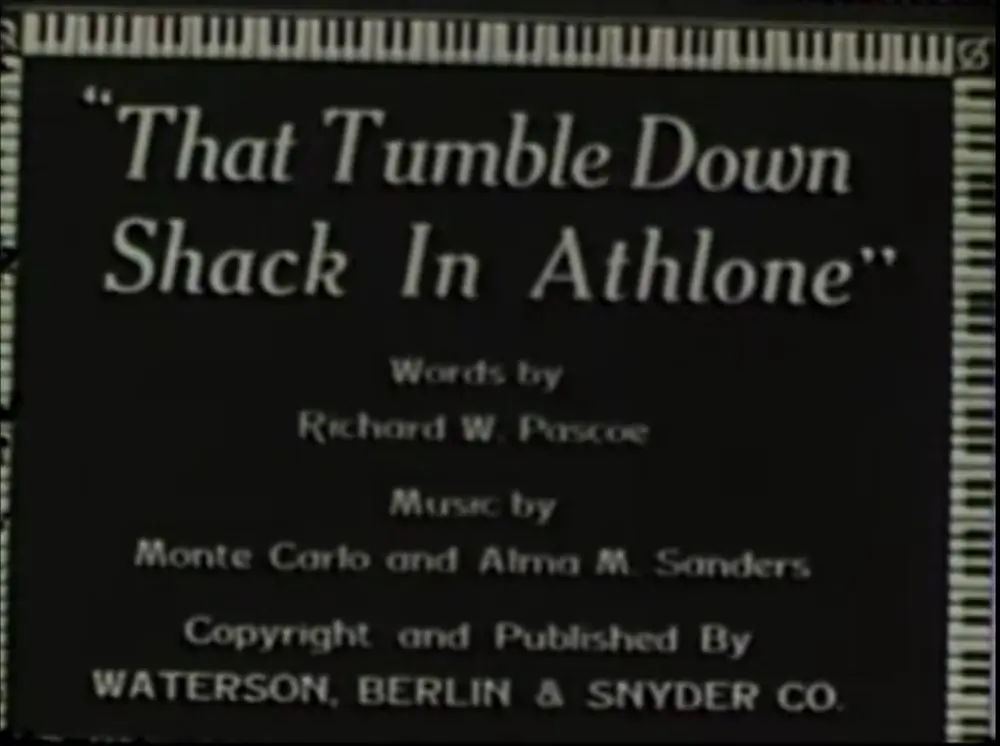
Is Tumbledown Shack in Athlone worth watching today? Short answer: yes, but only if you view it as a historical artifact rather than a modern entertainment piece.
This film is for animation historians, fans of the Fleischer legacy, and those interested in the evolution of audience participation. It is certainly not for anyone seeking a narrative plot, character development, or high-definition thrills.
This film works because it pioneered the 'bouncing ball' technique, creating a bridge between silent film and the synchronized sound era. It turned the cinema into a communal hall, which was a radical shift in 1924.
This film fails because, outside of its historical context, it is visually repetitive and lacks the anarchic energy seen in later Fleischer works like Betty Boop or Popeye. It is a functional tool for a sing-along, nothing more.
You should watch it if you want to understand the origins of the music video or the technical ingenuity of Dave Fleischer before he became a household name. It is a three-minute window into the past.
In 1924, the concept of synchronized sound was still a laboratory dream for many. Yet, Dave Fleischer found a way to synchronize an entire room of people without a single speaker. The 'bouncing ball' in Tumbledown Shack in Athlone is more than a gimmick; it was a UI/UX masterstroke for the silent era.
By timing the ball to hit the lyrics exactly when the live theater organist played the notes, Fleischer created a primitive form of interactive media. It’s fascinating to compare this to Tramp, Tramp, Tramp the Boys Are Marching, which utilized similar mechanics but with different thematic weight.
The animation itself is sparse. We see the 'shack' of the title, rendered with the shaky, hand-drawn charm typical of early 1920s ink-and-pen work. The lines are thin, and the backgrounds are static. It lacks the depth of The Devil's Circus, but it wasn't trying to compete with feature-length dramas.
It works. But it’s flawed. The simplicity is the point, yet for a modern viewer, that simplicity can feel like a lack of effort. We must remember that in 1924, seeing lines move on a screen was still a minor miracle.
The choice of song is telling. 'Tumbledown Shack in Athlone' was a sentimental ballad that appealed to the massive Irish-American population of the time. It’s a song about the 'Old Country,' a theme that resonated deeply in urban centers like New York where the Fleischers operated.
While films like Felix Gets the Can were pushing the boundaries of surrealism and character-based humor, this short was playing it safe with cultural nostalgia. It was a crowd-pleaser designed to evoke a collective 'aww' and a loud chorus from the stalls.
I find it fascinating that the Fleischers, known for their gritty, urban, and often surrealist style, chose such a traditional piece. It shows their versatility as businessmen. They knew that to keep the 'Song Car-Tune' series viable, they needed to mix the avant-garde with the familiar.
"The bouncing ball didn't just teach people how to sing; it taught them how to watch film together as a singular, breathing organism."
The pacing is dictated entirely by the music. There is no room for the 'squash and stretch' animation that would later define the industry. Instead, we get a steady, metronomic progression. Every frame is a slave to the beat.
The tone is surprisingly somber for a cartoon. There are no slapstick gags here. No one gets hit with a mallet. Instead, the animation serves the melancholy of the lyrics. It’s a rare example of early animation being used for something other than a laugh.
Compare this to the frantic energy of Revenge or the survivalist themes in Fighting the Flames. Tumbledown Shack in Athlone is almost meditative. It asks the viewer to slow down, which is a bold choice for a medium that was, at the time, obsessed with speed and movement.
If you are a casual viewer looking for a movie night, the answer is a hard no. You will be bored within sixty seconds. However, if you are a student of cinema, it is an essential watch. It represents the moment animation stopped being just 'funny pictures' and started becoming a tool for broader cultural engagement.
It’s a short film, usually clocking in under four minutes. You spend more time waiting for a coffee than you will watching this. In that context, the 'cost' of watching it is incredibly low compared to the historical insight gained.
1. Historical significance as an early 'Song Car-Tune'.
2. Charming, hand-drawn aesthetic that feels personal and raw.
3. A rare look at how silent-era audiences interacted with the screen.
1. Extremely repetitive visual loop.
2. The song itself may feel dated or overly sentimental to modern ears.
3. Minimal creative risk-taking compared to other Fleischer shorts.
Dave Fleischer was a tinkerer. While Walt Disney was focusing on narrative and 'illusion of life,' Dave was focused on the mechanics of the medium. Tumbledown Shack in Athlone is a testament to that mechanical focus.
He wasn't trying to make you cry over a character; he was trying to make you sing with a ball. This distinction is vital. It’s why Fleischer films often feel more 'modern' in their self-awareness than contemporary Disney films. They acknowledge the screen as a flat surface, a playground for ideas rather than a window into a pretend world.
In the grand scheme of his career, this short is a minor note. But even a minor note in a Fleischer symphony is worth a listen. It paved the way for the sophisticated sound synchronization of the 1930s.
Tumbledown Shack in Athlone is a skeleton of a film. It provides the bare bones of what would become a massive industry. It is not 'beautiful' in the way we think of animation today, but it is 'brilliant' in its execution of a single, powerful idea: collective joy.
Watch it once. Appreciate the ball. Then move on to the more complex works of the 1930s. It is a stepping stone, and while you don't live on a stepping stone, you certainly need it to cross the river.
Final score: A historical must-see, but a narrative vacuum. It serves its purpose with a quiet, humble efficiency that is rare in the loud world of animation history.

IMDb 4.9
1926
Community
Log in to comment.