DbcultAccessing Vault...
Cult Review
Senior Film Conservator
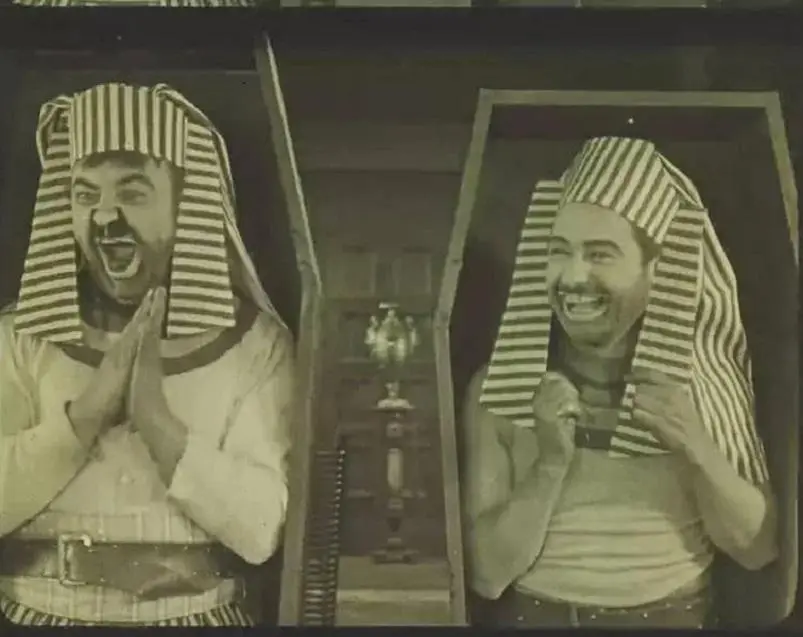
When the flickering reels of Tut! Tut! King sputter to life, the audience is thrust into a frenetic tableau of deception, desperation, and pseudo‑scientific folly. The film, penned by William Watson and headlined by Neily Edwards and Robert McKenzie, is a masterclass in visual gag construction, a testament to the era’s capacity for narrative economy without sacrificing wit.
Ned, a slick‑tongued hustler, convinces a bustling market crowd that his humble stall can restore the delicate mechanisms of their fountain pens—a device that, in 1920s cinema, instantly signals both class aspiration and the vulnerability of the modern consumer. The valet, ever the faithful sidekick, mirrors Ned’s gestures, amplifying the farcical rhythm. Their scheme unravels as the aggrieved patrons, incensed by the obvious fraud, coalesce into a menacing mob, their faces a blur of indignation.
In a stroke of cinematic brilliance, the chase pivots from the bustling streets to the hushed, dimly lit interior of a municipal museum. Here, the duo’s desperation finds a temporary sanctuary within two empty mummy cases—an absurdly perfect hiding spot that underscores the film’s love of visual irony. The camera lingers on the claustrophobic interiors of the sarcophagi, the darkness inside contrasting starkly with the bright, almost theatrical lighting that bathes the museum hall.
"The museum, a temple of the past, becomes a stage for present‑day trickery—a juxtaposition that only silent comedy can render so delightfully absurd."
The narrative takes an even stranger turn when the curators, motivated by a blend of curiosity and the era’s burgeoning fascination with electricity, relocate the coffins to a makeshift laboratory. Here, a troupe of earnest scientists—clad in white lab coats that gleam against the black‑stone walls—begin to rig the ancient mummies with an array of copper wires, brass knobs, and humming generators. The visual comedy reaches a crescendo as Ned and his valet, still concealed, become entangled in the electrical web, their frantic gestures mirroring the scientists’ solemn incantations.
The film’s editing rhythm accelerates during this segment, cutting between close‑ups of sparking electrodes and wide shots of the duo’s panicked contortions. The juxtaposition of Victorian‑era charlatanism with early 20th‑century scientific optimism creates a layered satire, hinting at society’s simultaneous reverence for and fear of technological progress.
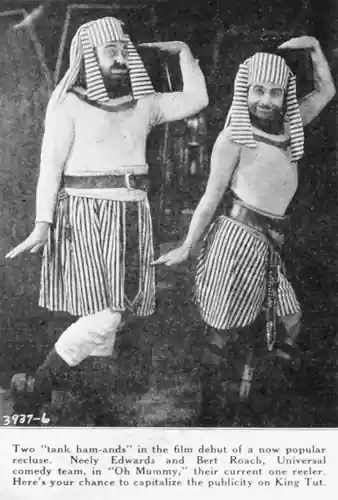
Neily Edwards, as Ned, delivers a performance that is as much a study in kinetic expression as it is in comedic timing. His lanky frame moves with a rubber‑like elasticity, each exaggerated gesture calibrated to elicit both laughter and empathy. Robert McKenzie, portraying the valet, provides a perfect foil—his stoic demeanor cracked only by moments of frantic desperation, allowing the audience to root for the underdog despite his obvious complicity.
Supporting actors Monte Clare and Bert Roach, though given limited screen time, enrich the tableau with their earnest portrayals of the scientists. Their dead‑pan seriousness, contrasted against the chaotic energy of the protagonists, amplifies the absurdity of the situation.
Director William Watson employs chiaroscuro lighting to great effect, especially within the museum’s vaulted chambers. The interplay of deep shadows and stark highlights not only underscores the tension of the chase but also frames the comedic set‑pieces with a theatrical grandeur reminiscent of German Expressionism. The use of intertitles is sparing yet purposeful; each title card delivers a punchline or a crucial plot cue, allowing the visual comedy to breathe.
The film’s set design—particularly the laboratory—draws inspiration from contemporary scientific exhibitions, featuring oversized dials, glowing bulbs, and a labyrinthine tangle of cables. This meticulous attention to period detail grounds the farcical narrative in a recognizable reality, making the eventual chaos all the more delightful.
While Tut! Tut! King stands alone in its unique blend of con‑artist caper and pseudo‑scientific parody, it shares thematic DNA with other silent era comedies. For instance, the frantic chase sequences recall the kinetic energy of The Primal Law, whereas the museum setting evokes the antiquarian curiosities of The Magic Skin. The film’s emphasis on visual gags over dialogue aligns it with the slapstick tradition of Real Folks, yet it diverges by injecting a layer of scientific satire absent in many of its peers.
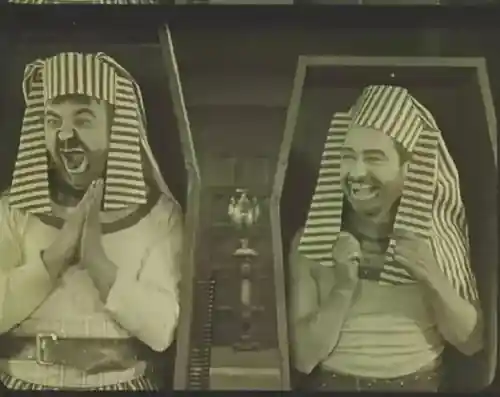
At its core, the film interrogates the fragile trust between consumer and vendor, a theme that remains startlingly relevant. Ned’s pen‑repair scam is a metaphor for the broader anxieties surrounding rapid technological advancement—an era where new gadgets promised convenience yet often delivered disappointment. The laboratory’s attempt to resurrect the mummies serves as an allegory for society’s obsession with reviving the past through modern means, a notion that foreshadows later cinematic explorations of the uncanny.
The visual motif of electricity—bright, uncontrollable, and transformative—mirrors the unpredictable nature of both human ambition and comedic timing. The film suggests that while progress can illuminate, it can also entangle, leading to unintended consequences that are as humorous as they are cautionary.
Though Tut! Tut! King did not achieve the commercial heights of Chaplin’s contemporaries, its inventive set pieces and daring blend of genres have earned it a cult following among silent film aficionados. Modern scholars often cite the film when discussing early cinematic experimentation with science fiction tropes within a comedic framework. Its influence can be traced to later works that juxtapose slapstick with speculative elements, such as the 1930s short Solomon in Society and the more overtly absurd The Second in Command.
In the pantheon of silent comedy, Tut! Tut! King occupies a niche that is simultaneously whimsical and intellectually provocative. Its ability to weave a narrative that critiques consumer gullibility, celebrates the spectacle of early scientific curiosity, and delivers relentless physical comedy makes it a film that rewards repeated viewings. For those seeking a glimpse into the inventive spirit of 1920s cinema—where a simple pen‑repair scam could cascade into an electrified escapade amidst ancient relics—this film offers a delightful, if chaotic, ride.
The film’s enduring charm lies in its unapologetic commitment to visual humor, its daring set design, and its subtle commentary on the perils of progress. Whether you are a seasoned cinephile or a newcomer to the silent era, Tut! Tut! King provides an experience that is as intellectually stimulating as it is uproariously funny.
IMDb —
1926
Community
Log in to comment.