DbcultAccessing Vault...
Cult Review
Senior Film Conservator
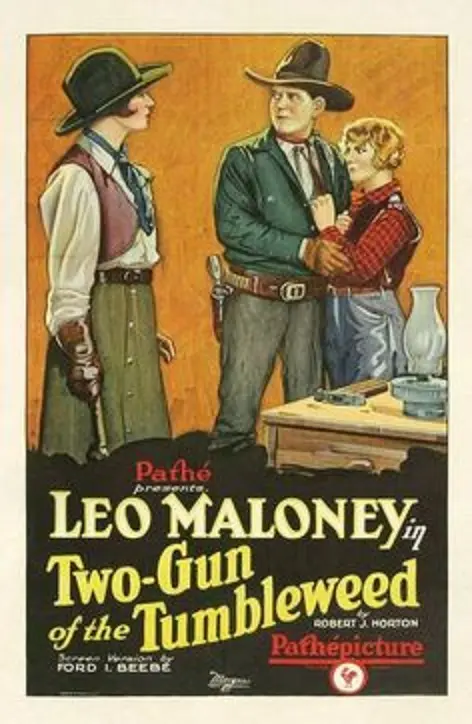
Is Two-Gun of the Tumbleweed a silent masterpiece that demands your attention in the modern age? Short answer: No, but it is an essential artifact for those who want to understand the DNA of the B-Western.
This film is specifically for the cinematic historian and the silent film obsessive who finds beauty in the grain and the unrefined stunts of the 1920s. It is absolutely not for anyone who requires a fast-paced plot or high-fidelity sound. If you can’t stand the silence, you’ll find this a long walk through a very dry desert.
1) This film works because it captures the raw, unvarnished physicality of Leo Maloney, an actor who understood the Western genre from the inside out.
2) This film fails because its narrative structure is remarkably thin, even by the standards of 1927, relying too heavily on generic tropes that were already becoming tired.
3) You should watch it if you have already exhausted the works of Tom Mix and William S. Hart and want to see how the 'other half' of the silent Western world lived.
To answer the question of relevance, we have to look at what Two-Gun of the Tumbleweed tries to achieve. It is a film that exists on the fringes of the major studio system. It doesn't have the sweeping budget of The Courtship of Myles Standish, nor does it possess the experimental flair of something like Sex. Instead, it is a meat-and-potatoes Western.
For a modern viewer, the value lies in the atmosphere. There is a specific kind of loneliness captured in these early outdoor shoots. When Maloney rides across the screen, it doesn't feel like a backlot. It feels like the edge of the world. If you appreciate the evolution of the genre, seeing Ford Beebe’s early writing work here is a fascinating precursor to his later success in serials.
Leo Maloney was never the biggest star in the firmament, but he had a grit that many of his contemporaries lacked. In Two-Gun of the Tumbleweed, his performance is stoic to a fault. He doesn't play to the rafters with the exaggerated pantomime often associated with silent cinema. He plays it cool. He plays it hard.
Take, for example, the scene where he first enters the saloon. There is no grand musical swell—obviously—but the way he carries his frame suggests a man who has spent more time with horses than people. It’s a physical performance that predates the 'Man with No Name' archetype by decades. He is a man of few words, and in a silent film, that’s a powerful stylistic choice.
Compare his work here to his role in Taming the West, and you see a consistent dedication to the 'rough rider' image. He wasn't interested in being a dandy. He was interested in being a cowboy. This authenticity is the film's strongest asset.
The writing by Ford Beebe is functional. That is the kindest way to put it. Beebe would go on to be a titan of the B-movie and serial world, and you can see the seeds of that efficiency here. Every scene exists to move the plot toward the next confrontation. There is very little 'fat' on this film, but there is also very little soul.
The plot follows a predictable path of betrayal and redemption. We’ve seen this story in The Pioneers and a dozen other films of the era. However, Beebe manages to inject a sense of urgency into the final act that keeps the film from becoming a complete slog. The pacing is deliberate, perhaps too much so for modern tastes, but it builds to a satisfying, if inevitable, conclusion.
Visually, the film is a product of its time, but that’s not a slight. The use of natural light in the exterior shots provides a stark contrast to the shadowy, often muddy interior scenes. The camera work is mostly static, but the framing of the landscapes is occasionally breathtaking. There is a shot of the horizon mid-way through the film that captures the sheer scale of the American West in a way that feels more authentic than many modern digital recreations.
The action sequences are handled with a surprising amount of clarity. In an era where editing could be chaotic, the gunfights in Two-Gun of the Tumbleweed are easy to follow. You know where the hero is, you know where the villains are, and you know exactly who is in danger. It lacks the maritime complexity of The Sea Tiger, but it makes up for it with raw, dusty intensity.
When placed alongside other films from the list, such as Wild Beauty, Maloney's film feels significantly more grounded. While Wild Beauty often leans into the romanticism of the wilderness, Two-Gun of the Tumbleweed is more interested in the dirt under the fingernails. It’s a cynical film in many ways, reflecting a post-WWI world where the hero isn't always purely heroic.
It also lacks the social commentary found in Ashamed of Parents or the melodrama of God's Law and Man's. This is a genre piece, through and through. It knows what it is, and it doesn't try to be anything else. There is a certain honesty in that lack of ambition.
Pros:
Cons:
One thing that modern critics often miss about films like Two-Gun of the Tumbleweed is the sound of the silence itself. While we watch these with modern scores or in total quiet, the original audiences would have had a live pianist or organist. There is a rhythmic quality to Maloney's movements that almost seems choreographed for a live accompaniment. When he draws his gun, you can practically hear the imaginary chord. It’s a form of 'ghost cinema' where the most important element—the sound—is missing, yet its absence is felt in every frame.
Two-Gun of the Tumbleweed is a tough watch for the uninitiated. It is dry. It is dusty. It is slow. But it is also a vital piece of the puzzle. It shows us a time when the Western was still finding its footing, moving away from the Victorian morality of The Cloister and the Hearth and toward the hard-boiled action of the 1930s.
Does it hold up? Not as a piece of entertainment, but as a piece of history. It works. But it’s flawed. It’s a film that demands you meet it on its own terms, in its own time. If you can do that, you’ll find a rugged charm that modern cinema simply cannot replicate. It’s not a masterpiece, but it’s a damn fine example of what a working-man's movie looked like in 1927.
"A dusty, unrefined snapshot of a genre in transition, Two-Gun of the Tumbleweed is the cinematic equivalent of a stiff drink in a quiet saloon."
IMDb 7.6
1936
Community
Log in to comment.