DbcultAccessing Vault...
Cult Review
Senior Film Conservator
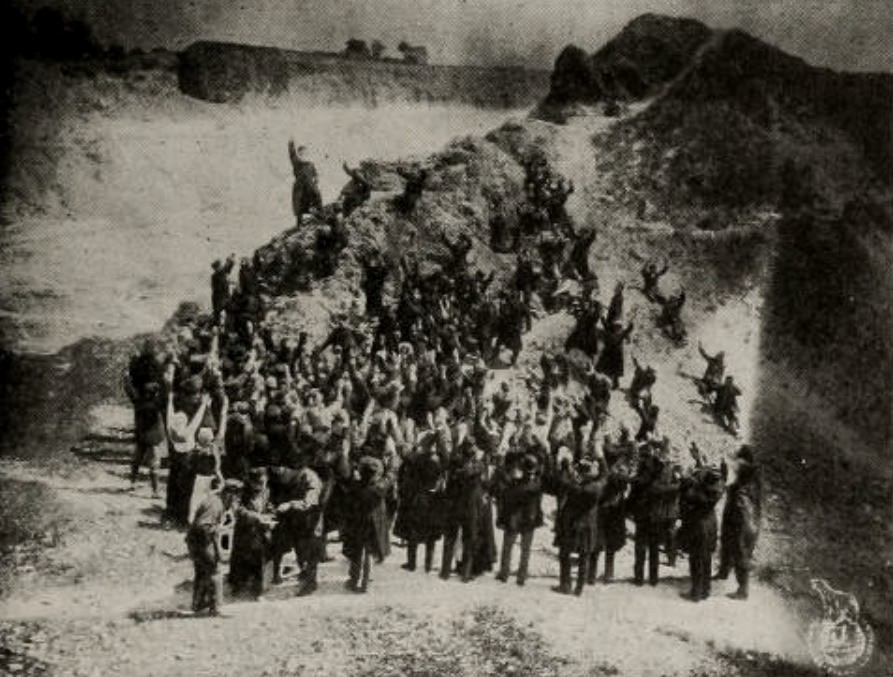
The nitrate reels of Uden Fædreland arrive like brittle runes from an alternate 1914: a year when Danish cinema, drunk on patriotic melodrama, suddenly flinched toward nihilism. Paul Sarauw’s screenplay—laconic yet barbed—condenses a nation’s paranoia into the microcosm of the Sidi, a sect whose very name hisses like a struck match. Watch how cinematographer Robert Schmidt frames their candle-lit conventicles: faces half-submerged in umbra, eyes glinting like obsidian needles, the camera itself seeming to hold its breath lest it be accused of heresy.
Judith Hurst, incarnated by the luminous Rita Sacchetto, glides through these tableaux like a sleepwalker clutching a dagger of desire. Her love for the Prince is never announced in intertitles; instead Sarauw lets the affair smolder in stolen glances, in the way her fingers linger on the royal seal of a crumpled letter. Compare this to the blunt pugilistic ballets of contemporary boxing actualities—here the combat is cardiac, not corporeal.
The film’s moral quicksand shifts the moment Gregory—played by Carl Schenstrøm with the twitch of a man forever straightening invisible neckties—unfurls the Chancellor’s letter. In a single iris-out the sect’s paranoia metastasizes into pogrom. Note the kinetic montage: a porcelain Star of David hurled against cobblestones, the shards freeze-framed like stellar cartography; a child’s spinning top clattering to silence, its momentum murdered mid-revolution. These fragments, spliced with the ferocity of tectonic aftershocks, foreshadow Soviet montage by half a decade.
When the Prince disperses the mob, director Carl Lauritzen refuses heroic low-angle shots; instead the camera cowers behind shutters, peeping through slats, implicating us as voyeurs of state violence. The royal cloak—dyed in the same indigo once reserved for criminal branding—becomes a floating signifier: protector or predator depending on the flicker of a kerosene lamp.
The elopement sequence, shot day-for-night with magnesium flares, feels smuggled from a pagan dream. Judith’s veil trails across fresh snow, engraving serpentine runes that the wind promptly erases—an apt epitaph for a love that must never enter official chronicles. Meanwhile Gregory, crouched like a gargoyle, functions as the film’s damaged superego; his unrequited hunger metastasizes into surveillance, presaging the surveillance capitalism that will one day commodify every heartbeat.
Act III detonates the fairytale. The Chancellor’s counter-coup is staged inside a cavernous armory where banners ripple like spilled blood. Sarauw’s intertitle—"The law is a blade that cuts both forward and backward"—bleeds across the screen in crimson tinting, a rare flourish that feels less like exposition than scarification. Soldiers march in diagonal phalanxes, their bayonets forming a metallic horizon that devours the screen’s upper third; the geometry anticipates Fritz Lang’s Weimar nightmares by a full decade.
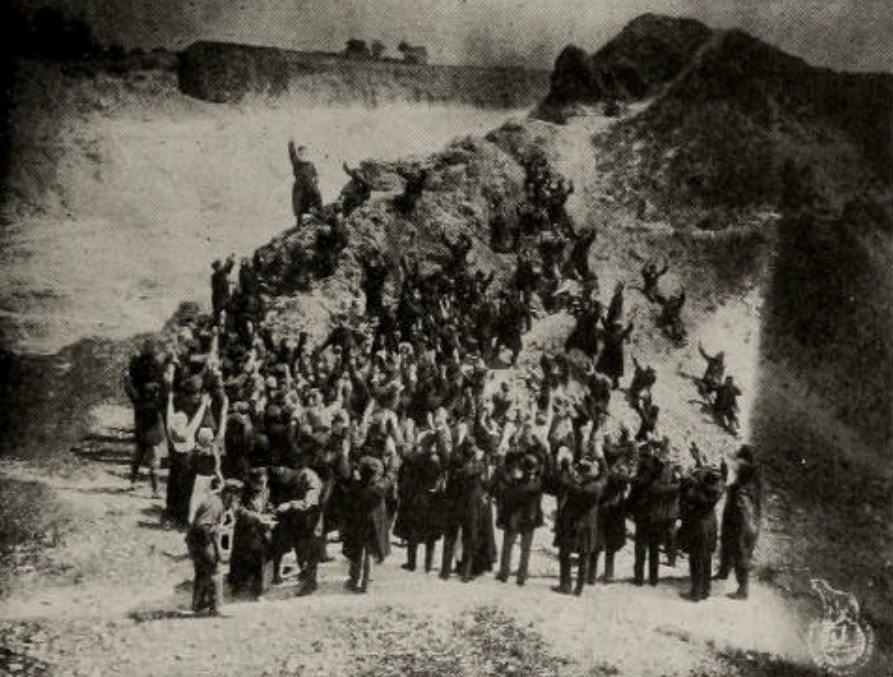
On the mountain peak, the film sheds every vestige of melodrama. The lovers’ suicide is filmed in a single, merciless long shot: two silhouettes dissolving into alpine vastness, their plunge signaled only by the sudden absence of bodies against snow. No splash, no fade—just void. The camera lingers on the vacated space until our eyes hallucinate ghosts. Compare this austerity to the baroque carnivals of American horror-comedies; here tragedy is not decorated but endured.
The final exodus unfolds like a negative nativity: thousands of Sidi trudging through drifts, their footprints the only testament to a civilization deleted by dawn. Samuel Hurst—portrayed by Cajus Bruun with the stooped gravity of a man carrying invisible millstones—discovers the frozen corpses of his daughter and the Prince entwined in a Pietà of ice. Lauritzen avoids close-ups; instead the camera retreats upward, ascending until the bodies become specks, then nothing—an ontological erasure that outstrips even Griffith’s monumental grief.
Technically the print survives in 1.33:1 aspect ratio, yet the Danish Film Institute’s 2018 restoration uncovered marginalia: hand-painted azure streaks on the Chancellor’s gloves, suggesting bruises from prior off-screen violence. The tinting schema—amber for interiors, viridian for nocturnes, desaturated umber for the mountain—operates like a synesthetic libretto. Listen to the restored score by Silence Compositorum: celesta motifs that fracture into dissonant brass each time the law is mentioned, a sonic prophecy of the sect’s legal dismemberment.
Contemporary critics, drunk on pugilistic nationalism, dismissed the film as "Teutonic gloom"; yet in 2024 its resonance is chilling. Swap Sidi for any modern diaspora—Uyghur, Rohingya, Syrian—and the plot tightens like a garrote. The Prince’s capitulation to love over legislature feels less romantic than quixotic, a suicide pact with history itself.
Performances oscillate between operatic and cadaverous. Sacchetto’s Judith never smiles once; instead she radiates the phosphorescence of decaying hope. The Prince—played by Nicolai Johannsen—has the bored eyes of a man who has read his own obituary in advance. Their chemistry is not erotic but forensic, as though each kiss were an autopsy of possibility.
If Uden Fædreland has a flaw, it is the elision of sect doctrine; we never learn what the Sidi believe, only that they are hated. Yet this absence is perversely potent—bigotry rarely troubles itself with footnotes. The film weaponizes ambiguity, forcing us to confront the mechanics of prejudice stripped of pretext.
In the pantheon of Nordic silent cinema—sandwiched between string-breaking sentimentality and moral rectitude—this film is the void between heartbeats. It offers no redemption, only the chill of recognition: that every border is a wound, every law a potential blade, every love a potential casualty. Watch it at 2 a.m. with the lights off; you will hear the celluloid itself praying for asylum.
IMDb —
1926
Community
Log in to comment.