DbcultAccessing Vault...
6.5/10
Senior Film Conservator
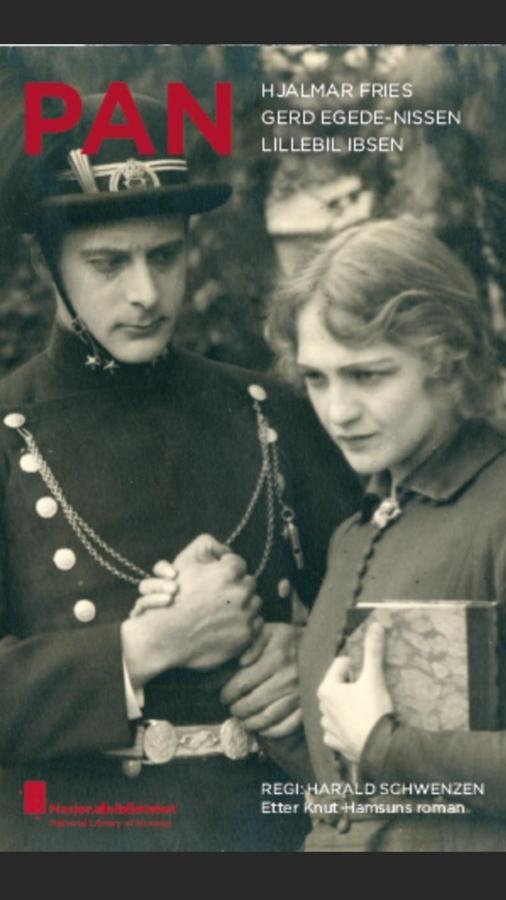
A definitive 6.5/10 rating for a film that redefined the boundaries of cult cinema. Pan remains a cornerstone of transgressive art.
Imagine the moment when Nordic mythmaking traded mead halls for the crackle of nitrate: Pan arrives not as goat-god revelry but as a shivering study in misaligned yearning. The film’s prologue—Glahn’s silhouette against a glacier-blue dusk—announces cinema’s newfound appetite for psychological realism, predating by a decade the interior monologues of John Heriot’s Wife and the social satire of If I Were King. Every frame feels dipped in pine resin: you can almost scent the damp wool of the lieutenant’s coat, hear the slow drip of snowmelt inside the cabin walls.
Gerd Egede-Nissen’s Edvarda pirouettes between coquetry and cruelty with such mercurial grace that contemporaneous critics mistook the role for autobiography. Watch her eyes in the midnight-sun picnic: they flicker from hazel to slate the instant Glahn admits he cannot read French verse, a microscopic betrayal that foreshadows the lovers’ continental divide. Opposite her, Hjalmar Fries lets silence do the heavy lifting; his Glahn is a man who has forgotten how to exhale, shoulders perpetually braced for an incoming shell that never lands. When he finally howls at the fjord, the sound is swallowed by distance, leaving only the echo of a soldier’s unspent rage.
Schwenzen’s adaptation retains Hamsun’s triune talismans yet renders them visceral. The loyal hound—part companion, part moral barometer—receives a low-angle close-up that rivals the human cast for soulfulness. Glahn’s rifle, cleaned with ritual slowness, becomes a phallic contradiction: tool of sustenance, promise of death, surrogate for conversation. Meanwhile Edvarda’s unposted letters accumulate like snowdrifts, each sealed with wax the color of arterial blood. Their eventual bonfire feels less catharsis than pagan sacrifice, spelling the death of language itself.
Cinematographer Rolf Christensen wields orthochromatic stock like a charcoal stick. Highlights blow out into chalky oblivion, shadows sink to obsidian, and skin becomes a battlefield of half-tones. The result is an imagistic grammar that later influenced the chiaroscuro of Love Never Dies and the nocturnal yearning of The Fire Cat. One shot—Edvarda’s veil snagged on spruce needles while the aurora unfurls overhead—deserves wall-space in any museum of modernist ache.
Forget meet-cutes; Pan proffes courtship as guerrilla warfare. Glahn gifts freshly killed ptarmigan, Edvarda responds with a book of Goethe bound in green morocco. He teaches her to load powder, she teaches him to dance a mazurka on mossy ground. Each exchange escalates the stakes without clarifying rules, so affection mutates into reconnaissance. Contemporary viewers raised on the straightforward melodrama of Straight from the Shoulder must have felt the ground tilt beneath their sensibilities.
Long before Scandinavian crime fiction weaponized snow, Pan discovered the thriller latent in solitude. The forest’s cathedral hush primes the ear for every cracked twig, every chambered round. When Glahn stalks Edvarda’s fiancé through the underbrush, suspense tightens not through cross-cuts but via the lengthening silence between footsteps. The sequence anticipates the existential standoffs later refined by The Country That God Forgot, yet remains uniquely Hamsun: man versus nature, man versus woman, man versus the mirror that refuses flattery.
1922 was not exactly a banner year for nuanced feminism, yet Edvarda emerges as more than siren or scold. Her restlessness—she rides bareback, rifles through imported fashion journals—hints at a proto-modern consciousness stifled by timber-town parochialism. The film’s refusal to punish her with conventional ruin feels quietly radical, edging toward the moral ambiguity that Babs would flirt with four years later but seldom grasp so firmly.
Archival records suggest original exhibitors accompanied Pan with Grieg miniatures and Hardanger fiddle laments. Today’s restorations often opt for stark silence, letting wind and fjord water provide diegetic chorus. Try both: the Gried version sentimentalizes, the silent version brutalizes. Either way, the absence of spoken dialogue intensifies bodily minutiae—the flare of Edvarda’s nostril, Glahn’s thumb rubbing brass shell casings—until the smallest gesture detonates like artillery.
Scan the genealogy and you’ll spot Pan’s genetic markers: the torpid eroticism rippling through Ihr großes Geheimnis, the liminal man-wilderness dialectic powering The War Correspondents, even the fatalistic velocity of The Speed Maniac owes a debt to Hamsun’s belief that momentum alone can outrun heartbreak. Bergman, too, kept a 16 mm print in his private archive; watch Edvarda’s final stare-down with the sea and tell me it doesn’t prefigure the close-ups of Persona.
The only known 35 mm restoration resides at the Norwegian Film Institute, digitized in 4K with optional English intertitles. Streaming rights bounce between Mubi and Criterion Channel each winter—set calendar alerts for November, when Nordic distributors traditionally loosen their icy grip. For further excavation, pair your viewing with Hamsun’s 1894 novella to appreciate how Schwenzen pruned the author’s torrential prose into haiku-like captions. Then chase it with Die Frau mit den Karfunkelsteinen for a continental counterpoint on gem-lust and disillusion.
Great films brandish time like a weapon; Pan wields it like a scalpel, excising romantic fallacy until only raw nerve remains. Nearly a century on, its central paradox—two people shouting love across a chasm of mutual incomprehension—feels more universal than ever. Stream it on a frost-bitten night, laptop balanced on wool-blanketed knees, and when the last frame fades to white, resist the urge to check your phone. Let the hush settle, the room grow cold, the dog outside your window bark once, twice. Then decide: are you Glahn, Edvarda, or the fjord itself, indifferent and endlessly reflecting?
IMDb 6.5
1936
Community
Log in to comment.