DbcultAccessing Vault...
Cult Review
Senior Film Conservator
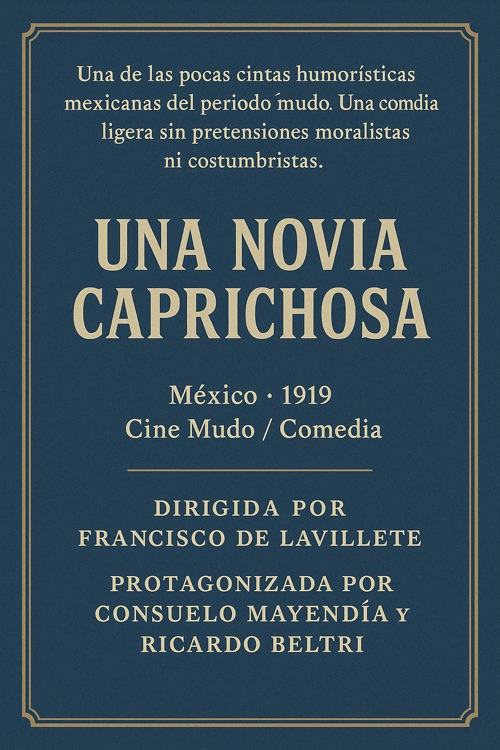
In the annals of cinematic history, certain films transcend their immediate context, offering profound insights into the human condition that echo across generations. Una Novia Caprichosa, a work of remarkable emotional depth and narrative ingenuity, stands as a testament to this enduring power. Far more than a mere romantic drama, it is a nuanced exploration of wealth's corrupting influence, the arduous journey of self-discovery, and the ultimate triumph of genuine character over superficial allure. The film, a masterclass in character study, invites viewers to scrutinize the gilded cage of privilege and the transformative potential of authentic human connection.
At its core, Una Novia Caprichosa orbits around the formidable figure of Elena, brought to breathtaking life by the incomparable Consuelo Mayendia. Mayendia’s portrayal is a tour-de-force, capturing the mercurial essence of a woman whose immense inherited fortune has insulated her from the mundane realities of consequence. Elena is not simply spoiled; she is a product of an environment where every desire is instantly gratified, fostering a worldview where others exist primarily to fulfill her elaborate whims. Her caprices are not mere childish tantrums but rather meticulously crafted trials, designed to test the mettle of her numerous suitors, each discarded with a chillingly casual indifference once they fail to meet her arbitrary, often absurd, standards. This systematic vetting process reveals a deeper, perhaps unconscious, yearning for something authentic, something that cannot be bought or easily manipulated. It’s a desperate, if misguided, search for intrinsic value in a world saturated with superficiality.
The narrative’s inciting incident—Elena’s audacious decree that only the man who retrieves the fabled "Flor del Cielo" from the treacherous Sierra Nevada peaks will earn her hand—elevates the film from a drawing-room comedy of manners to an epic quest. This challenge is not merely a plot device; it is a profound metaphor for the arduous path to true understanding and self-worth. The mythical orchid, inaccessible and dangerous to acquire, symbolizes the rarity and fragility of genuine affection, contrasting sharply with the easily obtainable luxuries that define Elena’s existence. It forces a physical and moral journey, not just for the suitors, but, crucially, for Elena herself, as she becomes an unwitting observer of her own carefully constructed charade. This dynamic, where the protagonist orchestrates her own awakening through external trials, is a narrative stroke of genius, reminiscent of the often self-imposed exiles or challenges seen in character-driven dramas like The Toll of Mammon, where moral choices dictate destiny. Elena’s journey, in many ways, reflects the broader societal shifts occurring in her era, where the roles and expectations of women, particularly those of means, were beginning to be subtly questioned and redefined within the burgeoning tapestry of modern life.
The film masterfully introduces two antithetical figures who embody the opposing forces at play within Elena’s romantic arena. Ricardo Beltri, in his understated yet powerful performance as Ricardo, embodies the quiet dignity of genuine merit. Ricardo is a botanist, a man deeply attuned to the rhythms of nature, whose appreciation for life’s intrinsic beauty extends beyond its monetary value. His pursuit of the Flor del Cielo is not driven by ambition or a desire for wealth, but by a sincere, if initially unrequited, admiration for Elena’s deeper self, a self he intuitively senses lies beneath her capricious exterior. His journey up the perilous mountain is characterized by meticulous preparation, unwavering perseverance, and a profound respect for the natural world. Beltri imbues Ricardo with an integrity that is both compelling and deeply empathetic, making him a moral compass in a world often swayed by superficial charms. His quiet stoicism stands as a powerful counterpoint to the societal pressures that often demand outward displays of wealth or bravado, suggesting that true worth resides in a more profound, internal reservoir.
In stark contrast stands Cristobal Sanchez’s Cristobal, the flamboyant adventurer whose charisma initially captivates Elena’s attention. Sanchez delivers a wonderfully nuanced performance, portraying Cristobal not as a caricature of villainy, but as a man whose ambition and self-assuredness border on arrogance. He sees the quest for the Flor del Cielo as another opportunity to burnish his already glittering reputation, a spectacle to be conquered through bravado and cunning, rather than genuine effort. His intent to circumvent the arduous journey, perhaps even fabricating the orchid's discovery, highlights the stark chasm between his superficial approach and Ricardo’s profound authenticity. This dramatic tension, expertly woven throughout the narrative, provides the foundational conflict that propels Elena’s internal transformation. It's a classic foil dynamic, echoing the moral quandaries presented in films where protagonists face competing ideologies, such as the stark choices in The Dance of Death, albeit with a romantic rather than existential bent. The societal backdrop of the era, one perhaps still grappling with the lingering echoes of Victorian propriety contrasted with emerging modernism, provides fertile ground for such a clash of characters, where outward respectability could easily mask inner duplicity.
The film’s brilliance lies in its refusal to simplify these characters. Elena’s caprice, while initially grating, gradually reveals itself as a shield, a defense mechanism against a world that likely values her fortune more than her person. Ricardo’s quiet strength, though initially overshadowed by Cristobal’s flash, slowly emerges as the more compelling force. Cristobal, for all his bluster, is not inherently evil, but rather a product of a society that rewards outward success over inner virtue. The unfolding drama is not merely about who wins Elena’s hand, but about Elena’s evolving perception of what truly constitutes a valuable partner and, by extension, a valuable life. This journey of shifting perspectives and evolving values is a hallmark of truly resonant storytelling, allowing for a multifaceted character study that avoids simplistic archetypes. Mayendia, in particular, navigates Elena’s transformation with exquisite subtlety, her expressions conveying a rich internal monologue even without spoken dialogue, a testament to her profound artistry.
The directorial vision, even in its possibly early cinematic form, undoubtedly played a crucial role in framing these intricate performances and thematic explorations. One can envision a deliberate use of visual contrast: the opulent, perhaps suffocating, interiors of Elena’s estate juxtaposed with the stark, unforgiving beauty of the Sierra Nevada. The meticulous attention to detail in set design and costume would have underscored the class distinctions and the artificiality of Elena's world. The visual language would have been paramount in conveying Elena’s gradual disillusionment with her materialistic world and her burgeoning appreciation for the raw, unadulterated reality of Ricardo’s quest. The camera, acting as a silent observer, would have lingered on Mayendia’s expressions, charting the subtle shifts from haughty amusement to pensive introspection, a testament to the power of non-verbal storytelling that defined much of early cinema. The pacing, too, would have been critical, allowing moments of quiet reflection to breathe amidst the dramatic tension of the orchid quest, ensuring that Elena’s internal journey felt earned and authentic, rather than rushed. The director's keen eye for composition would have highlighted the isolation of Elena's existence, even amidst lavish surroundings, before opening up to the expansive, liberating landscapes of the mountain, mirroring her internal liberation.
The expedition itself becomes a powerful narrative device. Ricardo’s methodical ascent, his respect for the mountain’s dangers, and his scientific approach to finding the elusive Flor del Cielo underscore his character. It is a journey of physical endurance but also of moral fortitude. He faces genuine peril, not manufactured obstacles, and his triumph is therefore hard-won and deeply resonant. This segment of the film, even if depicted through intertitles and evocative visuals in an earlier era, would have been crucial in establishing Ricardo’s unshakeable integrity. One might compare the sheer grit and determination required to the protagonists' struggles in adventure narratives like The Lone Star Rush, where character is forged in the crucible of formidable challenges, though Una Novia Caprichosa grounds its adventure in a romantic, rather than purely survivalist, context. The sheer cinematic scope of such a depiction, even with the technological limitations of the time, would have been ambitious, aiming to convey both the grandeur of nature and the vulnerability of man, thereby amplifying the human drama at its core.
Cristobal’s contrasting approach—his reliance on shortcuts, his willingness to deceive—serves to highlight the moral bankruptcy of his character. His attempt to present a counterfeit orchid is swiftly exposed, not merely as a plot point, but as a symbolic unmasking of his entire persona. This moment is pivotal, as it strips away the veneer of charm and bravado, revealing the hollowness beneath. Elena, having quietly observed these divergent paths, is presented with a clear choice, one that transcends the superficial considerations that once governed her life. Her transformation is not a sudden epiphany but a gradual dawning, a slow accumulation of insights gleaned from witnessing authentic effort versus facile deception. This nuanced character arc is what elevates Una Novia Caprichosa beyond a simple romantic comedy, imbuing it with the gravitas of a moral fable. The film, in this crucial aspect, acts as a mirror to its audience, challenging them to consider where true value lies in their own relationships and societal interactions.
The climax of the film is not a grand, romantic gesture in the traditional sense, but rather a quiet, profound act of recognition. Elena, now stripped of her former illusions, rejects Cristobal’s artifice with a newfound clarity. Her choice of Ricardo is not merely a selection of a suitor, but a profound affirmation of her own growth. It signifies her embrace of authenticity, integrity, and genuine affection over the ephemeral allure of wealth and superficial charm. Mayendia’s final scenes would have been particularly poignant, conveying a sense of hard-won wisdom and humility, a woman transformed not by external circumstances, but by the internal reckoning her own demands inadvertently triggered. The ending, therefore, is not merely a happy resolution but a powerful statement on the nature of true value, both in relationships and in life itself, a message that continues to resonate with audiences who seek more than just escapism in their cinematic experiences.
The enduring legacy of Una Novia Caprichosa lies in its timeless exploration of themes that remain perennially relevant. It critiques a society that often prioritizes outward appearances and material possessions over intrinsic worth. It champions the quiet strength of character, the perseverance of genuine affection, and the transformative power of self-awareness. The film’s ability to weave a compelling romantic narrative around such profound philosophical questions is a testament to its masterful storytelling. One might draw parallels to the subtle social commentary embedded within seemingly lighthearted narratives like The Kid Is Clever, where character and wit often expose societal absurdities, or the emotional depth found in Heart of Juanita, which similarly delves into the complexities of human relationships and personal sacrifice. The film's commentary on the societal pressures faced by women of means, expected to marry for status rather than love, adds another layer of historical intrigue and enduring relevance, reflecting a nascent feminist consciousness within its romantic framework.
From a performance perspective, the ensemble cast, particularly Mayendia, Beltri, and Sanchez, elevate the material beyond mere melodrama. Their nuanced portrayals imbue their characters with a complexity that allows for multiple interpretations and sustained engagement. Mayendia’s Elena, in particular, remains a fascinating figure—a woman who, despite her initial flaws, embarks on a genuine journey of moral and emotional growth, ultimately becoming a more sympathetic and admirable character. The film doesn't just present a 'capricious bride' but unpacks the layers of circumstance and personality that create such a figure, then meticulously charts her path towards enlightenment. This intricate character development is a hallmark of truly great cinema, ensuring that the film resonates long after the credits roll. Its timeless appeal lies in its universal message: that authentic connection and integrity ultimately triumph over the fleeting illusions of wealth and status.
In conclusion, Una Novia Caprichosa is far more than a historical curiosity; it is a vibrant, insightful piece of cinema that continues to captivate and provoke thought. Its narrative ingenuity, compelling performances, and profound thematic explorations solidify its place as an essential viewing experience. It reminds us that true love is rarely found in the pursuit of fleeting desires or superficial challenges, but rather in the quiet recognition of integrity, perseverance, and the genuine spirit of another. It stands as a powerful artistic statement on the transformative capacity of the human heart, urging us to look beyond the glittering facade to discover the profound truths that lie beneath, making it a truly unforgettable and deeply moving cinematic achievement.
IMDb 6.6
1921
Community
Log in to comment.