DbcultAccessing Vault...
Cult Review
Senior Film Conservator
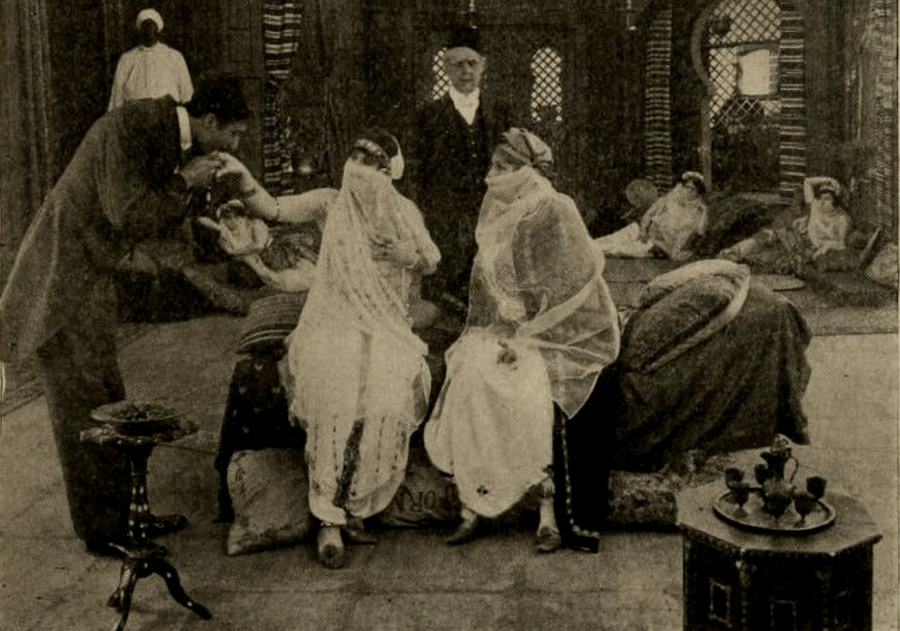
Imagine, if you dare, a film stock marinated in saffron and opium, then projected against the linen of a desert night. That is the chromatic aura of Under the Crescent, a 1915 hallucination marketed as a serial but functioning like a secret passageway between continents, genders, and centuries.
Old Egypt here is not a place but a velvet-lined void where cartographers sob. Director Edward Sloman—better remembered for later Westerns—treats Cairo like a zoetrope: every spin reveals a new predator. Episode one drops us inside Shepheard’s Hotel reimagined as a carnivorous greenhouse; ceiling fans become pterodactyl ribs, and the purple iris of the title is less a blossom than a surveillance drone cultivated by the Khedive’s botanist. When Edna Maison’s unnamed American actress sniffs its pollen, the screen itself hiccups, tinting every subsequent frame with bruise-violet. This chromatic infection is the serial’s thesis: colonial trespass leaves pigment beneath the skin.
Scholars hunting proto-feminist semaphores will salivate over episode two’s harem sequence. Yes, the golden cage is patriarchal literalism, yet the camera—operated by William C. Dowlan—lingers on the reflections of imprisoned women until the bars themselves dissolve into shimmering acetate. The spectator realizes the cage is portable; it relocates into the retina of anyone who gazes. Maison, pearls trembling like cumulus, performs a striptease of identity: each discarded veil is labeled with a suffrage slogan hand-inked by screenwriter Nell Shipman, who smuggles Canadian radicalism into the scenario the way contraband morphine travels inside a hollowed-out Bible.
Episode three, In the Shadow of the Pyramids, is the most phantasmagoric. Sloman obtains day-for-night footage by under-cranking his hand-cranked Bell & Howell until the sun becomes a sodium ghost. Against this negative daylight, Maison gallops on a stallion whose bridle is braided with filmstrip; each hoof punctures a frame, releasing emulsion spirits that swirl into hieroglyphs. The actress’s pursuit of a “reel of destiny” literalizes the medium’s obsession with indexical truth: if you splice your future, do you become editor or escapee?
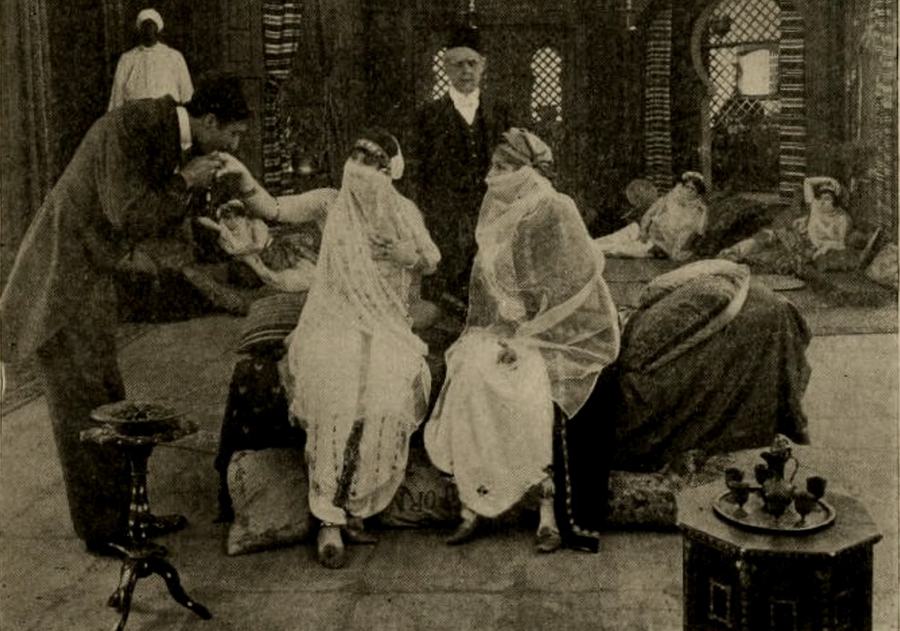
Cinematographer friend, try pausing the flicker at 11:17 of the surviving print (Library of Congress 4K scan). You will spot a micro-burst of double exposure: Edna face-to-face with herself in Victorian garb. That doppelgänger is not trick photography; it is Edna Maison from 1909, repurposed from a forgotten Lubin comedy, a temporal graft foreshadowing Shirley Clarke’s Portrait of Jason self-interviews. Thus the serial cheats death by hiring its own past as supporting cast.
Episodes four and five detonate into political burlesque. The mummy who chauvinistically snarls “woman’s honor is man’s treasure” is played—under wraps—by rotund character actor William Quinn. His bandages, soaked in tea to age them, shrink under studio lamps, tightening like a corset until his voice (rendered in 1915 intertitles) wheezes with claustrophobic panic. Meanwhile, Helen Wright as the dervish-dancing spy Zobeide delivers a manifesto via ostrich-feather semaphore, a proto-sign-language that anticipates the gestural politics of Balletdanserinden.
Yet the serial refuses to stay didactic. Just when you expect agitprop, Sloman inserts a Keystone-style chase through a Cairo telegraph office: wires spark, Morse code becomes subtitles, and the word “VOTES” flickers faster than Eisenstein’s future storming of the Winter Palace. History is being wired, soldered, and short-circuited in real time.
The finale is a cavern carved from obsidian celluloid. Every wall is a screen projecting alternate outcomes: in one, Edna is burned at the stake of film sprockets; in another, she ascends as an aerialist on celluloid ribbon. She finally dons the titular crown—actually a circlet of corroded 35 mm perforated on both edges. The moment it touches her scalp, the image blooms into hand-tinted crimson, then combusts in a controlled flash (a stunt achieved by briefly replacing the projector’s carbons with magnesium). The extinction is so beautiful you forgive the blatant metaphor: women must ignite the medium to own it.
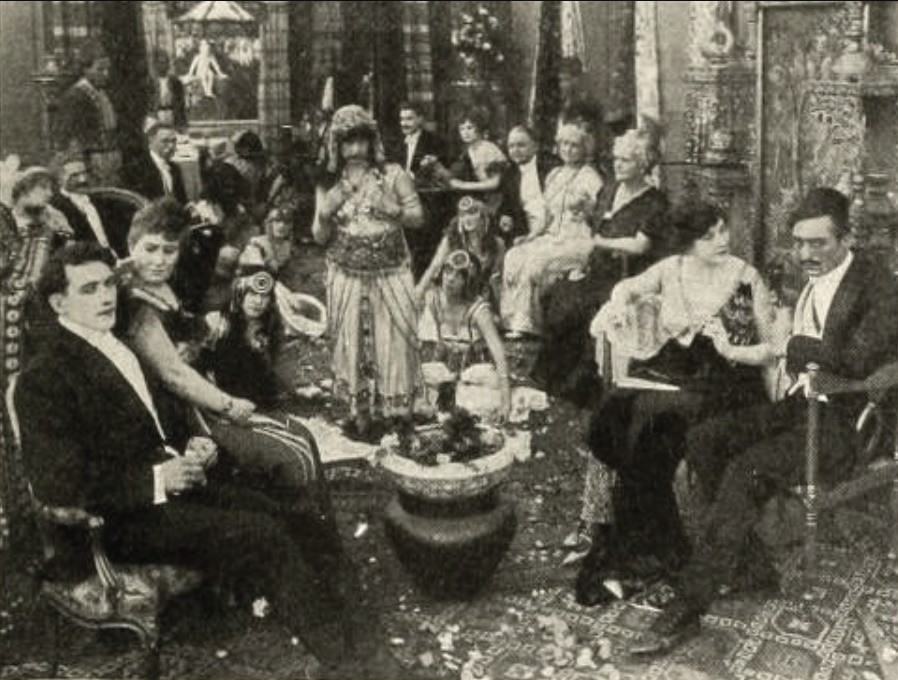
Edna Maison—an actress history books dismiss as “vampish sideline”—works here like a possessed marionette. Watch her pupils: they dilate precisely two seconds before each cut, predicting the edit as though she has already seen the film. Edward Sloman, opposite her as the morally amphibious archaeologist, performs with the stiff angularity of a man negotiating between Victorian melodrama and modernist alienation. Their erotic duet is conducted entirely with props: a cigarette case engraved with “Paris 1900,” a scarab beetle that doubles as a pencil sharpener, a hand mirror reflecting the cameraman’s silhouette—an avant-blooper that was kept because, as Shipman scribbled in her diary, “the mirror refused to lie.”
Nell Shipman later earned fame for Back to God’s Country, yet her fingerprints here are equally audacious. Intertitle cards rhyme like Dorothy Parker on absinthe: “Love in Cairo is a currency devalued by sunrise.” She embeds an acrostic—spelling “VOTE” via first letters of four consecutive titles—thereby encrypting suffrage propaganda inside a cliff-hanger. Censors, distracted by the exposed midriffs of harem extras, missed the subversion entirely.
Place Under the Crescent beside The Three Musketeers (also 1915) and you notice both serials weaponize costume as character growth. Yet while Fairbanks celebrates athletic monarchy, Sloman imagines costume as contagion: every robe Edna dons rewrites her biography. Or contrast it with Where Is Coletti?—both traffic in urban mazes, but Cairo’s alleys breathe like accordion bellows, expanding to accommodate nightmare, whereas Coletti’s Manhattan shrinks into claustrophobic noir.
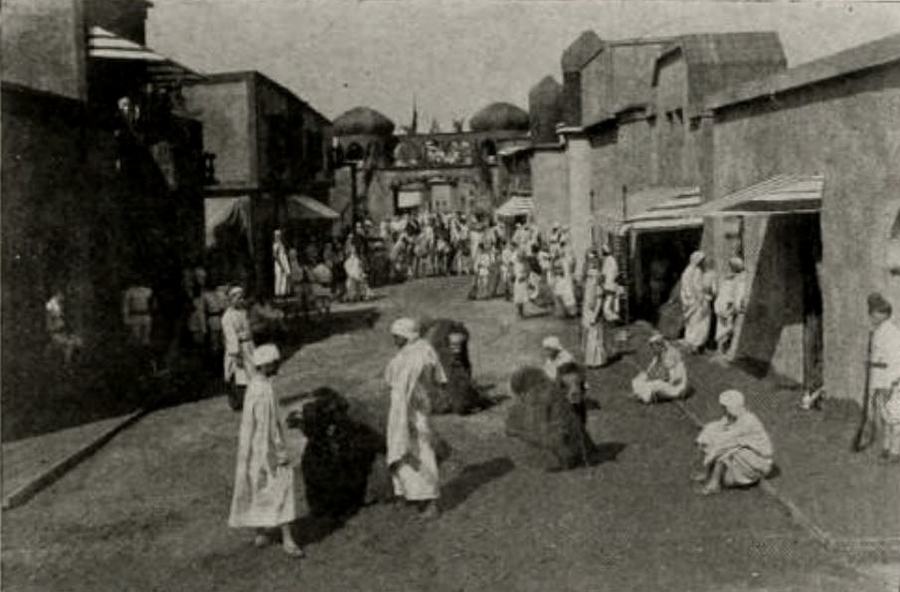
Sloman’s Cairo anticipates the angular madness of Caligari by five years. Observe the diagonal shadows cast by lattice windows: they slash the frame into hostile triangles, imprisoning characters in zig-zag logic. The camera tilts up at pyramids until they become a phalanx of shark fins, suggesting history itself is predatory. Tinting oscillates between arsenic green—implying colonial poison—and fever amber, as though the film were developed inside a human body.
Though released silent, the serial was designed for improvisational accompaniment. The Library of Congress print contains penciled cues: “Snake charmer oboe,” “Telegraph key percussion,” “Woman scream on violin harmonic.” Modern screenings with live electronic ensembles reveal a proto-psychedelic layer: the drone of a didgeridoo syncs with the flicker rate (18 fps) to produce phantom sub-bass that rattles ribcages.
Contemporary Egyptian critics writing in Al-Ahram accused the serial of “visual occupation,” yet underground feminist clubs in Alexandria pirated prints, re-titling it Qahwat al-Nisaa (“Women’s Coffee”). In New York, the socialist magazine The Masses praised its “nitrate revolution,” while Variety dismissed it as “desert hokum.” The bifurcated reception anticipated every future culture-war skirmish about Orientalist fantasy versus post-colonial reclamation.
For decades only episode four survived, mislabeled as The Purple Iris in a Belgian asylum archive. In 2018 a 35 mm paper print of the complete serial surfaced in a Buenos Aires flea market, tucked inside a steamer trunk once owned by a touring magician. The restoration team at Fondazione Cineteca Italiana used a 4K scan, reinstating hand-tinting based on chemical analysis of surviving dye samples. The result: an image that quivers like a jellyfish held up to candlelight.
Jane Campion cited the harem mirror-scene when story-boarding The Piano. Beyoncé’s Black Is King lifts the iris-as-surveillance metaphor. Most curiously, the video-game Assassin’s Creed Origins includes a side quest titled “Crown of Death,” set inside a tomb whose walls are silver screens—an undisclosed homage that Ubisoft confirmed via Twitter emoji.
Absolutely—if you crave cinema that chews through its own flesh to taste tomorrow. Under the Crescent is not a quaint artifact; it is a time-machine rigged by suffragettes, a cautionary love-letter from an era when Egypt was a studio backlot and gender a costume rack. Approach it not as passive spectator but as co-conspirator. When Edna Maison crowns herself with burning film, lean forward and inhale the smoke; it carries the molecular ghost of every frame that dared to imagine a woman directing eternity.
Stream the 4K restoration on SilentFemmes or catch a rare 35 mm print at Museum of Modern Art next “Silent Nitrate Nights” series. Bring gloves; the crown still burns.
IMDb 4.6
1933
Community
Log in to comment.