DbcultAccessing Vault...
Cult Review
Senior Film Conservator
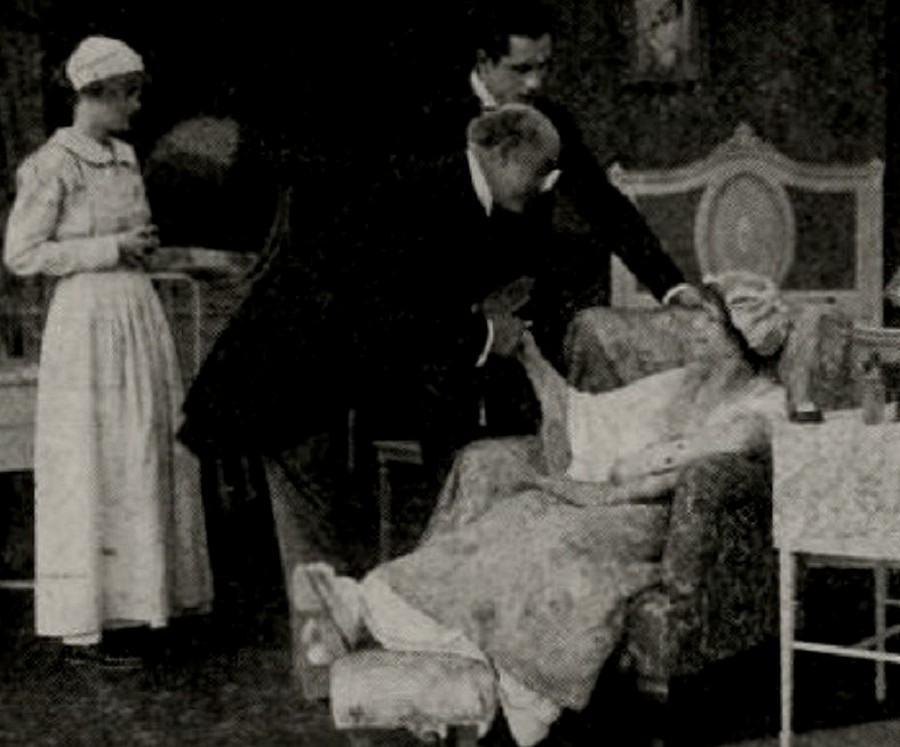
In the burgeoning landscape of 1915 cinema, where the medium was rapidly evolving from mere spectacle to a sophisticated vehicle for social commentary, Up from the Depths emerges as a striking, albeit agonizing, exploration of the human condition. Directed with a keen eye for the stratified layers of American society, this film transcends the typical melodrama of its era by weaving a complex tapestry of betrayal, urban decay, and the arduous path toward spiritual reclamation. It is a work that demands our attention not just as an archival curiosity, but as a visceral indictment of the hypocrisy inherent in the moral crusades of the early 20th century.
At the epicenter of this narrative is Davids, portrayed by Courtenay Foote with a chilling blend of charismatic fervor and calculating coldness. Davids is a revivalist, a man whose professional life is built upon the art of persuasion and the promise of salvation. However, his personal ethics are a void. When he persuades Daire Vincent (the luminous Gladys Brockwell) to elope, he is not seeking a partner, but a conquest. The speed with which he discards her—less than a year later—is a testament to his pathological ambition. Inspired by associates who see in New York a 'field of greater grafting possibilities,' Davids abandons the woman he never truly made his wife, seeking a more lucrative stage for his performative piety.
This betrayal is the catalyst for the film’s bifurcated structure. We see Davids ascending the social ladder of New York, eventually marrying into a respectable, albeit sterile, life. Conversely, we witness Daire’s harrowing descent. Unlike the protagonists in The Taint, who are often burdened by hereditary flaws, Daire is a victim of external circumstance and male perfidy. Her journey into the 'depths' is a slow, agonizing slide into the Mozart dive, a den of iniquity where she must sing for the amusement of the city’s underbelly to support her fatherless child.
The Mozart dive is rendered with a grit that rivals the most evocative scenes in Midnight at Maxim's. It is a space of shadows, smoke, and desperate revelry. For Daire, it represents both her survival and her shame. The writers—Robert Stodard, Mary H. O'Connor, and Charles Battell Loomis—expertly use this setting to highlight the irony of Davids’ new life. While he preaches purity from a gilded pulpit, his former 'associates' are the very people plotting to raid the Mozart. The collision of these two worlds is inevitable and serves as the film’s moral crux.
When Daire discovers Davids' whereabouts through his confederates, the film shifts from a tragedy of abandonment to a confrontation of conscience. The scene where she confronts him, child in hand, is a masterclass in silent era pathos. Brockwell conveys a world of weary resentment and maternal fierce-ness, while Foote’s Davids is forced to look upon the living evidence of his sin. The presence of his dying, childless wife adds a layer of cosmic irony; he has achieved the 'success' he craved, yet his legacy is a ghost, and his only true heir is hidden in the slums.
One of the most fascinating aspects of Up from the Depths is its portrayal of the Purity League. In many films of this period, such organizations are treated with uncritical reverence. Here, however, the League is an instrument of pressure, pushing Davids to lead a raid on the Mozart to bolster his public image. The raid is not an act of genuine moral concern but a tactical maneuver for social standing. This critique of organized morality aligns the film with the more subversive themes found in The Painted Soul, where the 'fallen' woman is often more virtuous than those who judge her.
The raid itself is a chaotic, violent affair. Davids is wounded, a physical manifestation of the internal damage he has wrought. It is in this state of vulnerability that he is finally reachable. The intervention of Father White (Thomas Jefferson), a slum worker who represents a more authentic, compassionate form of Christianity, provides the bridge for redemption. Unlike the Purity League, Father White listens to Daire’s story without judgment. He doesn't seek to punish; he seeks to 'legitimatize'—not just the child, but the broken lives of the parents.
The final act of the film, where Davids and Daire finally undergo a marriage ceremony, might seem like a convenient Hollywood ending to modern eyes. However, within the context of 1915, it is a radical act of restitution. The film doesn't suggest that the past is erased, but rather that it can be integrated into a 'fuller and better knowledge of life.' This echoes the redemptive arcs seen in On Dangerous Paths, where the journey through the fire is necessary for the refinement of the soul.
Gladys Brockwell’s performance remains the film’s greatest asset. Known for her ability to portray intense emotional suffering, she brings a dignity to Daire that prevents the character from becoming a mere object of pity. Her transition from the naive girl who elopes to the hardened singer of the Mozart dive, and finally to a woman rising from the depths, is a sophisticated arc that prefigures the great dramatic performances of the 1920s. She captures the essence of resilience that we see in other period pieces like East Lynne, yet with a modern edge that feels surprisingly contemporary.
Visually, the film utilizes the limited technology of the time to great effect. The contrast between the bright, airy spaces of Davids’ New York home and the claustrophobic, dimly lit interiors of the Mozart dive serves as a visual metaphor for the characters' moral states. While it may not possess the epic scale of Judith of Bethulia, its intimate focus on domestic tragedy and social hypocrisy gives it a different kind of power—a psychological weight that lingers long after the final frame.
The writing team of Stodard, O'Connor, and Loomis deserves credit for avoiding the more mawkish tendencies of the 'fallen woman' genre. By grounding the story in the specificities of the 'grafting' culture and the pressures of the Purity League, they provide a grounded reality that elevates the melodrama. The film functions as a precursor to the social realism that would eventually dominate American cinema in the decades to follow. It shares a certain DNA with The Family Cupboard, particularly in its exploration of how the secrets of the past inevitably disrupt the carefully constructed facades of the present.
In conclusion, Up from the Depths is a vital entry in the canon of early American cinema. It is a film that refuses to offer easy answers, choosing instead to dwell in the uncomfortable intersections of faith, ambition, and consequence. It reminds us that the 'depths' are not just a location in the slums, but a state of being—and that the climb back up is a grueling, necessary labor of the heart. For those interested in the evolution of narrative film and the timeless struggle for moral integrity, this 1915 gem is essential viewing.
Final Verdict: A hauntingly beautiful exploration of the price of success and the weight of redemption, anchored by a career-defining performance from Gladys Brockwell.

IMDb —
1923
Community
Log in to comment.