DbcultAccessing Vault...
Cult Review
Senior Film Conservator
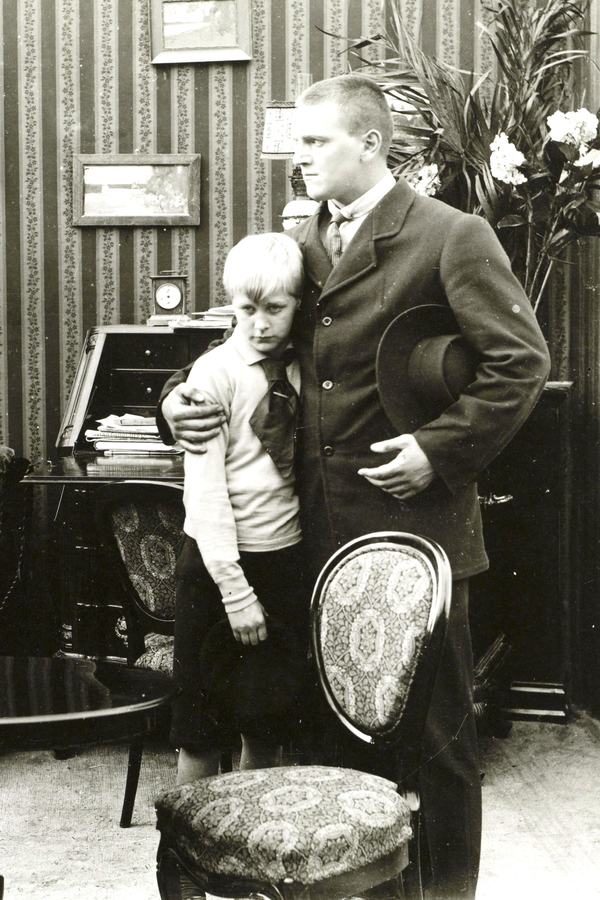
To witness Peter Lykke-Seest’s 1917 silent feature, De forældreløse (The Orphans), is to step into a bygone era of Norwegian cinema where the boundaries between social realism and gothic melodrama were porous and often indistinguishable. In the nascent years of the 20th century, cinema was grappling with its own identity, oscillating between the theatrical and the purely visual. Lykke-Seest, a writer of considerable narrative ambition, crafted a story that feels remarkably contemporary in its cynical view of the nuclear family. This is not merely a tale of loss; it is a surgical examination of how the vacuum left by death is rapidly filled by the suffocating pressure of greed.
The film’s inciting incident—a train accident—serves as a violent rupture in the lives of Beate and Jens. While modern audiences are accustomed to high-octane spectacle, the 1917 depiction of this catastrophe relies on the psychological weight of the aftermath. The loss of parents is not just an emotional blow; in the socio-economic context of early 20th-century Scandinavia, it is a total loss of legal and social standing. Beate, portrayed with a haunting fragility by Turid Hetland, finds herself thrust into a role of surrogate matriarch at seventeen, a precarious age where she is neither fully protected child nor fully empowered adult.
The antagonist force here is not a singular villain but a collective of relatives whose motivations are driven by the cold logic of land acquisition. Unlike the more stylized villainy found in The Exploits of Elaine, the malice in De forældreløse is grounded in the mundane. It is the evil of the ledger and the property deed. These relatives do not want to kill the children out of spite; they simply want them removed from the equation of ownership. This reflects a recurring theme in silent cinema where the vulnerability of orphans is used to critique the legal systems of the time, much like the social upheavals depicted in A Tale of Two Cities.
Visually, the film utilizes the stark contrasts of its environment to mirror the internal states of its characters. The remote family estate becomes a claustrophobic cage. The cinematography, while limited by the technology of the era, manages to capture the isolation of the Norwegian landscape, suggesting that the children are trapped not just by their kin, but by the very geography of their inheritance. The performances are characterized by the expressive physicality typical of the era, yet there is a restraint in Hetland’s performance that anticipates the shift toward naturalism.
"The land is a character that demands a blood sacrifice, and the orphans are the unwilling offerings on the altar of familial legacy."
In comparing this work to other contemporary pieces, one might look at The Unwelcome Mother. Both films deal with the displacement of the individual within a hostile family structure. However, where The Unwelcome Mother leans heavily into the pathos of maternal longing, De forældreløse is more concerned with the survival of the siblings as a unit. The relationship between Beate and Jens (Esben Lykke-Seest) is the emotional anchor that prevents the film from descending into nihilism. Their bond is the only pure element in a world corrupted by the prospect of wealth.
The central conflict—the attempt by the extended family to 'get rid' of the children—is a chilling precursor to the psychological thrillers of the mid-century. There is a sense of inevitability that permeates the second act, as the machinations of the relatives become increasingly desperate. This is not the grand, operatic betrayal of Don Juan, but a quiet, insidious erosion of safety. The film asks: what is the value of a child when weighed against acreage? The answer provided by the antagonists is a damning indictment of the agrarian society's obsession with continuity.
The writing by Peter Lykke-Seest is particularly noteworthy for its pacing. In an era where many films felt like a series of disjointed tableaux, De forældreløse maintains a narrative tension that rivals the suspense of In the Nick of Time. The stakes are profoundly personal. When we see the relatives conspiring, the use of lighting—often casting long, distorted shadows—highlights their moral deformity. It is a visual shorthand for the 'rot' that has set into the family tree.
Released in 1917, during the height of the First World War (though Norway remained neutral), the film reflects a global anxiety about the stability of the future. The orphan as a symbol was particularly potent in a world where millions were being bereft of their fathers. While De forældreløse focuses on a domestic accident rather than a battlefield, the resonance would not have been lost on contemporary viewers. It shares a certain somber maturity with Autumn, eschewing the slapstick comedy of films like A Bunch of Keys or Come Robinet sposò Robinette.
The cast, including veterans like Hans Hedemark and Botten Soot, provides a solid ensemble that grounds the melodrama. Hedemark, in particular, brings a gravitas that balances the more heightened emotional beats of the younger actors. This ensemble approach prevents the film from becoming a mere star vehicle, allowing the thematic weight of the 'property vs. personhood' debate to remain front and center. It is a more grounded approach than the mythic storytelling found in Rebecca the Jewess or the exoticism of The Golden Lotus.
As the film reaches its climax, the desperation of the siblings culminates in a struggle that is both physical and existential. They are fighting for their lives, yes, but they are also fighting for the memory of their parents and the right to exist in their own home. This sense of 'rightful place' is a powerful motivator in early cinema, often appearing in films where social order is threatened, such as The Governor's Ghost or the revolutionary fervor of Mariano Moreno y la revolución de Mayo.
Ultimately, De forældreløse stands as a testament to the power of silent storytelling to convey complex moral quandaries. It doesn't need dialogue to explain the cruelty of the relatives or the terror of the children; the images of the isolated house, the predatory glances, and the desperate flight of the siblings tell the story with profound clarity. It is a film that demands to be remembered, not just as a piece of Norwegian history, but as a universal story of resilience against the overwhelming tide of human selfishness. It lacks the brute force of The Bruiser or the overt theatricality of Sapho, but it possesses a quiet, enduring strength that makes it a more profound experience than many of its more famous contemporaries like The Bigger Man.
In the pantheon of 1917 cinema, Lykke-Seest has carved out a space that is as cold and sharp as a Norwegian winter, reminding us that sometimes the most dangerous predators are those who share our blood.
IMDb —
1928
Community
Log in to comment.