DbcultAccessing Vault...
Cult Review
Senior Film Conservator
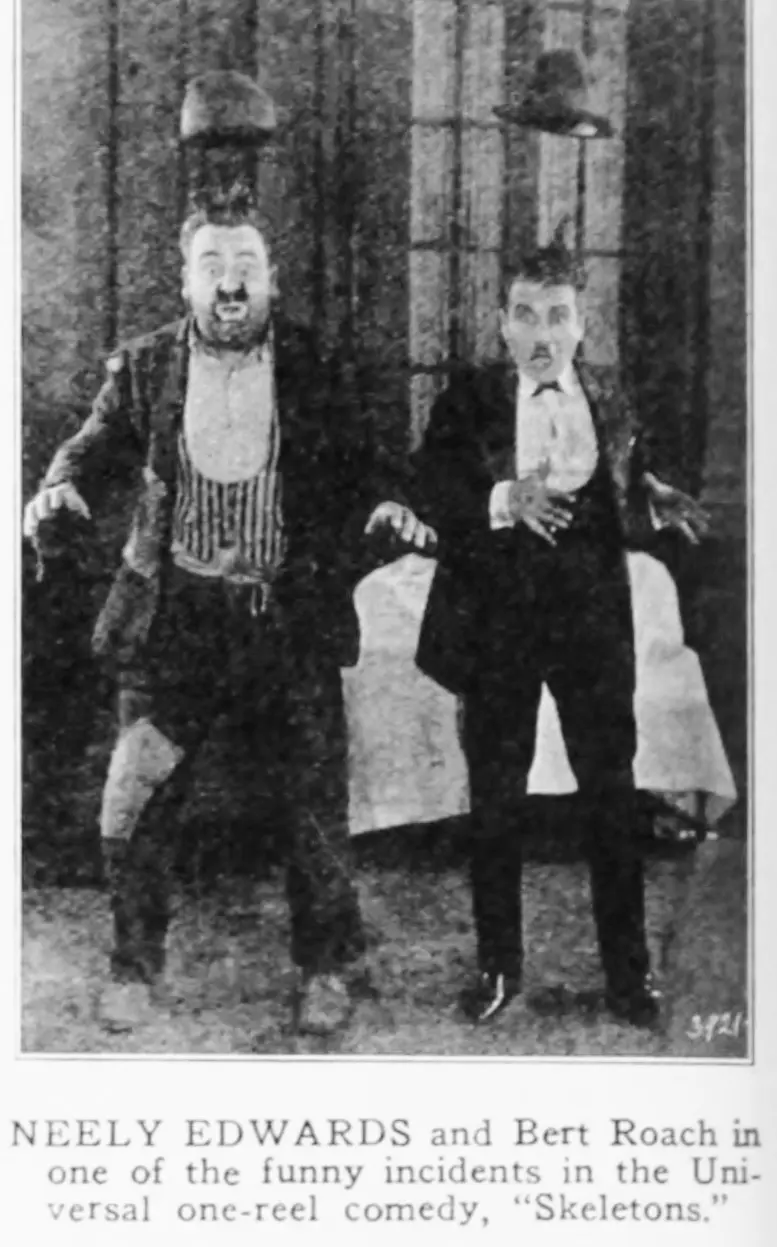
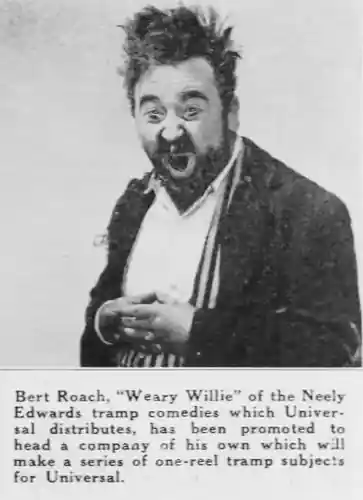
To analyze Skeletons is to engage with the very sinews of early 20th-century comedic structuralism. Directed by the prolific William Watson, this short film is not merely a relic of the silent era but a vibrant testament to the physical vocabulary of Neely Edwards and Bert Roach. In the pantheon of itinerant characters—a trope explored with varying degrees of pathos in works like The Waifs—the persona of Nervy Ned stands apart. He is not the tragic tramp of Chaplin, nor the stoic stone-face of Keaton; rather, Edwards imbues Ned with a caffeinated audacity that borders on the reckless. The opening sequence, featuring a carriage careening at the then-terrifying speed of forty miles per hour, establishes a tempo that the film maintains with relentless vigor.
The aesthetic of the 'road' in Skeletons serves as a liminal space where social hierarchies are momentarily suspended. When Ned and his valet witness the abduction of a beautiful girl, their intervention is framed not as a duty of their class, but as an instinctive, almost choreographic response to injustice. The clever use of a rope and the axle of the carriage provides a moment of Rube Goldberg-esque satisfaction, a precursor to the complex mechanical gags that would later define the genre. This sequence mirrors the tension found in Seeing It Through, where the protagonists must navigate immediate physical peril to achieve a moral victory.
As the action transitions from the sun-drenched country roads to the shadowy interior of the magnificent estate, Watson pivots the film’s tone from rural slapstick to a proto-horror farce. This transition is handled with a sophistication that rivals the atmospheric depth of The Lamplighter. The wardrobe, functioning as a 'convenient' source of disguise and social mobility, allows Ned and his valet to shed their hobo identities, if only superficially. The act of changing clothes is a recurring motif in silent cinema, symbolizing the fluidity of identity—a theme also central to Fräulein Raffke.
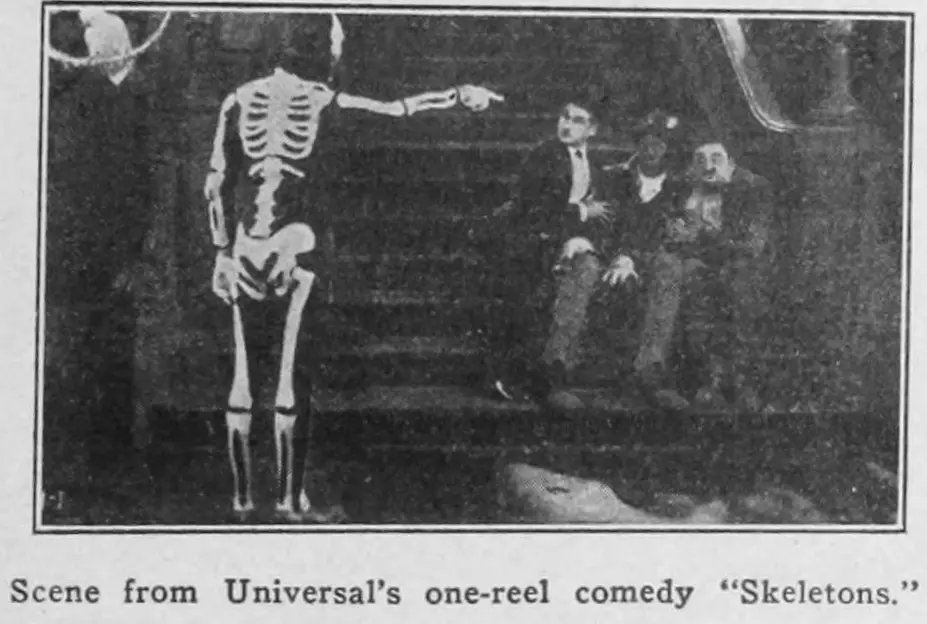
The arrival of the skeletons is the film's piece de resistance. In an age before digital artifice, the visual impact of five or six skeletal figures chasing the protagonists through a labyrinthine house relied entirely on costume design and the rhythmic editing of the era. These 'skeletons' are a brilliant metaphorical device. While they represent a physical threat within the diegesis, they also serve as a literalization of the 'skeletons in the closet' that haunt the upper echelons of society. Unlike the domestic innocence portrayed in The Innocence of Lizette, the world within this mansion is one of hidden dangers and masked intentions.
Bert Roach’s performance as the valet provides the necessary grounding for Edwards’ frenetic energy. The valet is the id to Ned’s ego—driven by the primal need for sustenance and safety. His disgust at Ned’s eventual refusal of a monetary reward is not merely a comedic beat; it is a poignant reminder of the material reality of their existence. While Ned lives for the romanticized 'smile' of the rescued girl, the valet lives for the next meal. This dynamic of the hungry companion is a staple of the genre, yet Roach elevates it with a series of expressive reactions that capture the absurdity of their situation. One might find echoes of this class-based struggle in Kick In, though handled there with more dramatic gravity.
The chase sequence through the house is a masterclass in spatial continuity. Watson utilizes every room, every doorway, and every staircase to create a sense of frantic claustrophobia. The choreography of the actors and the 'skeletons' is precise, ensuring that the humor arises from the near-misses and the escalating panic. This level of ensemble coordination is reminiscent of the grander spectacles seen in The Colosseum in Films, where the environment itself becomes a character in the conflict.
The resolution of Skeletons is surprisingly philosophical for a short-form comedy. When the girl's father arrives with the police, the supernatural threat is debunked—the skeletons are merely men in disguise, a revelation that strips the horror of its power and restores the social order. However, Ned’s refusal of the reward and his concluding remark—"Live in a box car and you'll have no family skeletons"—serves as a sharp critique of the burdens of wealth and property. It is a sentiment that resonates with the rugged individualism found in While the Billy Boils.
By choosing the smile of the girl over the gold of the father, Ned asserts his status as a modern knight-errant. He is a character who exists outside the traditional economy of favors and debts. This rejection of material gain in favor of an emotional or aesthetic experience is a recurring theme in silent romances like Love at First Sight and The Girl of Today. Yet, in Skeletons, it is framed with a cynical edge; Ned isn't just being noble, he is being practical. To accept the money is to enter the system that creates the very skeletons he just spent the afternoon fleeing.
From a technical standpoint, Watson’s direction is remarkably efficient. The pacing is tight, with no wasted frames. The cinematography captures the contrast between the expansive, sunlit exteriors and the high-contrast, shadow-heavy interiors of the mansion. This visual dichotomy reinforces the narrative shift from the freedom of the road to the entrapment of the house. The use of props—the rope, the carriage, the wardrobe—is integrated seamlessly into the plot, demonstrating a level of narrative economy that many contemporary features struggle to achieve. We see similar narrative efficiency in Shore Acres, where the setting is inextricably linked to the character's journey.
Furthermore, the film avoids the pitfalls of the 'scandal' genre, such as A Seminary Scandal, by maintaining a focus on the physical comedy rather than the salaciousness of the kidnapping. The maiden in distress is a catalyst for the action, but the heart of the film is the relationship between Ned, his valet, and their environment. The villain is a peripheral figure, a necessary obstacle to be overcome through wit and momentum rather than a deeply explored antagonist.
In the broader context of 1918 cinema, Skeletons represents a bridge between the primitive 'chase' films of the early 1900s and the sophisticated feature-length comedies of the 1920s. It utilizes the 'hobo' archetype to explore themes of heroism, class, and fear without descending into heavy-handed moralizing. The film’s ability to blend genres—comedy, action, and horror—is a precursor to the tonal fluidity of modern cinema. While it may not have the religious gravitas of The Golden Rosary or the political urgency of How Uncle Sam Prepares, it possesses a raw, unpretentious energy that remains infectious over a century later.
The performance of Neely Edwards in this film should be studied by any student of physical comedy. His ability to convey complex emotions—fear, bravado, attraction, and nonchalance—through gesture alone is a lost art. When he stares down the 'skeletons', his body language shifts from a frantic retreat to a defiant stance, illustrating a character arc that is as much physical as it is psychological. This is the same kind of transformative performance one might find in The Traitress, where the lead must navigate a world of shifting loyalties.
Ultimately, Skeletons is a celebration of the 'nervy' spirit. It suggests that while the world may be full of literal and metaphorical monsters, they can be outrun, outsmarted, and eventually unmasked. The valet’s hunger remains unquenched, the hero remains penniless, and the road continues to beckon. It is a cyclical narrative that mirrors the nature of the silent comedy industry itself—a constant movement toward the next gag, the next thrill, and the next smile.
As we look back at this 1918 production, we are reminded that the foundational elements of cinema—movement, conflict, and resolution—are executed here with a purity that is often obscured in the age of digital excess. Watson, Edwards, and Roach created a work that is both a product of its time and a timeless exploration of the human condition under pressure. Whether you are a scholar of the silent era or a casual viewer looking for a glimpse into the past, Skeletons offers a rich, multi-layered experience that rewards close attention and a sense of humor. It is a film that, much like its protagonist, refuses to be pinned down by the weight of expectations, choosing instead to run headlong into the next adventure.
"Live in a box car and you'll have no family skeletons." — A mantra for the minimalist, a punchline for the ages, and a perfect summation of the itinerant soul.

IMDb 6.1
1931
Community
Log in to comment.