DbcultAccessing Vault...
6.7/10
Senior Film Conservator
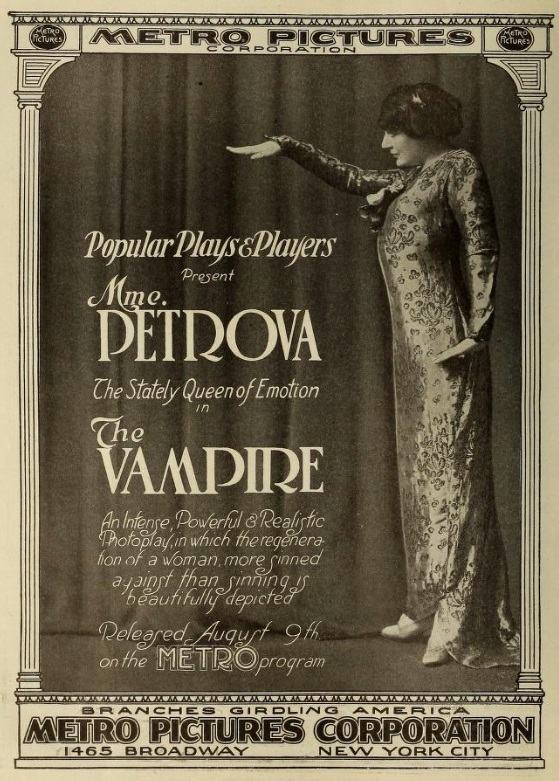
A definitive 6.7/10 rating for a film that redefined the boundaries of cult cinema. Vampire remains a cornerstone of transgressive art.
The film begins like a match struck inside a tomb: a woman—nameless, gloveless, merciless—steers her bleeding roadster into the gasping grandeur of an Adirondack resort circa 1913. In the age of celluloid infancy, when cameras still feared the dark, director Albert S. Howson drowns every frame in tenebrous chiaroscuro so that even daylight feels clandestine. Olga Petrova, billed only as “The Motorist,” arrives half dead yet fully weaponized, her cheekbones carving shadows sharp enough to neuter every stag head mounted in the lobby. From that first close-up—her pupils dilated like bullet holes in the night—she reframes the concept of the femme fatale from seductress to cosmic event: men don’t fall for her so much as they mislay their souls while glancing sideways.
The screenplay, a whisper-thin folio by Lee Morrison, dispenses with exposition the way a cardsharp palms aces. Instead of backstory we get meteorology: thunderclouds gather whenever she unpins her hat; lake water turns ink-black the instant her toe tests the pier. Dialogue cards appear sparingly, often mid-sentence, as though the film itself resists translating her siren frequency into crude block letters. When Lawrence Grattan’s coroner mutters “You remind me of a girl I dissected in ’98,” the intertitle cuts off before the noun, leaving only the scalpel gleam of implication. Such omissions infect the viewer with a participatory fever—everyone becomes an accomplice stitching motive from glances.
What elevates Vampire beyond its pulpy title is its refusal to literalize the supernatural. There are no capes, no fangs, no Eastern-European counts lamenting lost castles—only economics of desire. Petrova’s predator drains bank accounts, wedding vows, and future dynasties, yet the camera never once grants us the catharsis of seeing her feast. Instead, we witness aftermath: a groom slumped at the altar clutching a telegram that reads merely “Regret,” or a once-boastful hunter reduced to spooning caviar to his German shepherd while whispering her name like a banned prayer. The horror lies in how plausibly colonial masculinity folds before one unaligned woman.
Cinematographer William A. Morse shoots the resort as a cathedral of masculine decay: moose antlers cast cruciform shadows across Persian rugs; billiard balls freeze mid-break, forming planetary orbits around her cigarette ember. In one bravura sequence, the camera pirouettes 360 degrees through the ballroom while couples waltz, each rotation shaving a decade off their faces—youth sold wholesale without a single negotiation. By the time the spin concludes, the dancers are children in oversized tuxedos, their pockets stuffed with IOUs payable to her vanity. The effect, achieved with double exposures and hand-cranked variable speeds, predates Vertigo’s dolly zoom by forty-five years yet feels eerily digital, as though Netflix glitch-welded itself into 1913.
Olga Petrova, a Ukrainian émigré previously typecast as suffering governesses, weaponizes her accent here like a stiletto. She rolls Rs not for exotic spice but to elongate silence, forcing men to lean into the void she engineers. Watch her eyes in the shot where she removes a silk stocking: the iris flicker lasts perhaps six frames, yet it contains the entire history of securities traded on Wall Street the previous week—an insider-trading blink. Critics who dismiss silent acting as pantomime should be strapped to this scene; Petrova does not act so much as leak malevolence through the perforations of the film strip.
The male ensemble, a bouquet of clipped mustaches and latent gout, functions like a single hydra; each head believes himself the apex predator until she severs the neck with a smile. Vernon Steele’s railway magnate delivers a masterclass in capitalist hubris, signing over deeds while literally on his knees, inkwell balanced on his bald pate like a colonial-era dunce cap. Wallace Scott, as the resort physician, attempts to pathologize her power, diagnosing “acute moral neurasthenia,” yet ends the film barefoot in the snow, clutching a thermometer that perpetually reads 98.6°F—the temperature of mammalian surrender.
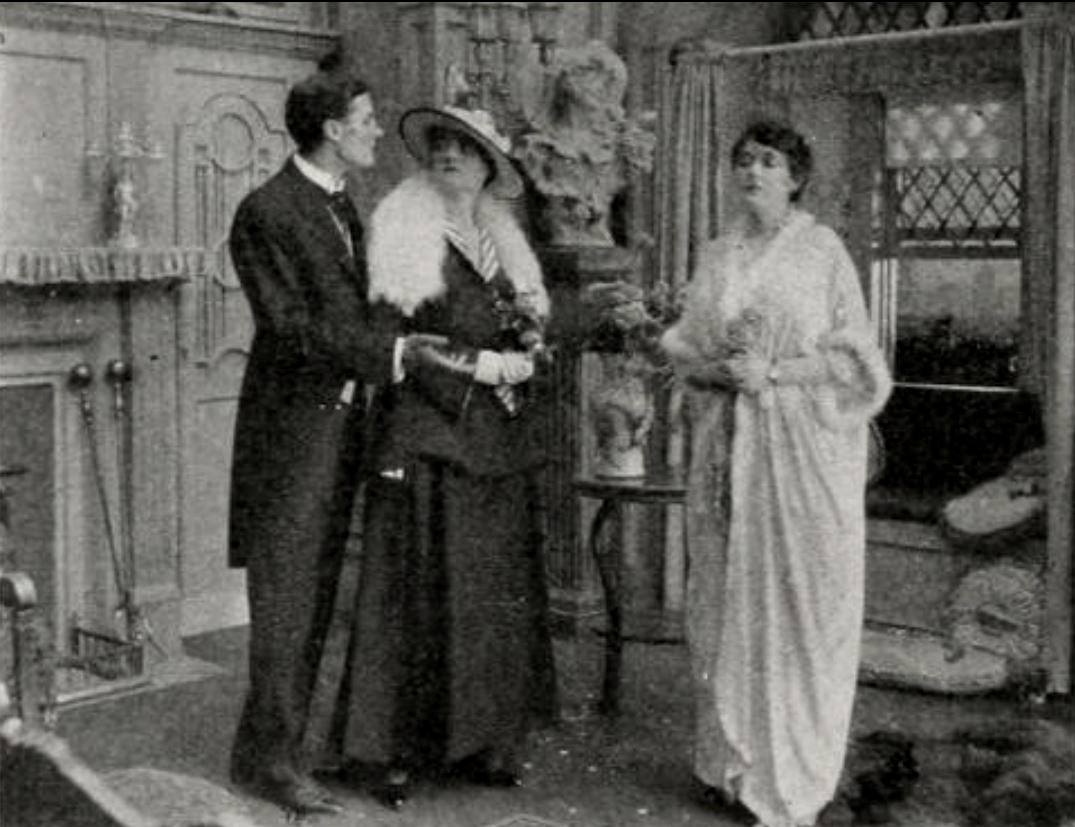
Comparisons to other 1913 releases prove instructive. Where The Murdoch Trial traffics in courtroom moralism and The Boer War sells jingoistic spectacle, Vampire opts for erotic nihilism. It shares DNA with The World, the Flesh and the Devil’s apocalyptic triads, yet predates that film’s cosmic scale by leaning micro—one hotel, one woman, a dozen egos, total obliteration. Likewise, fans of Stuart Webbs: Das Panzergewölbe will recognize the use of architecture as antagonist, though here the corridors breathe rather than merely entrap.
The score, lost for decades, survives only in a 1923 cue sheet discovered in a Newark basement. It calls for two pianos, a theremin, and a solo trap-drummer instructed to “play as if overhearing coitus through a hotel vent.” Modern restorations overlay a minimalist drone that swells whenever Petrova’s pupils eclipse the frame, creating a feedback loop between viewer and predator: the louder your heart, the more symphonic her triumph.
Scholars still debate the ending. Does she drive into the sunrise to infect the next resort, or does the lake finally swallow her taillights? A 1914 trade-paper clipping claims Petrova filmed an alternate finale—herself consumed by flames as the men cheer—yet preview audiences rioted, demanding the ambiguity that now feels postmodern. The existing print closes on an aerial shot: the mountain road unfurls like a black ribbon, her car a bead of mercury sliding toward immortality. No fade-out, no iris, just the film itself seeming to run from the projector’s sprockets in pursuit.
Restoration-wise, the 4K scan by Eye Filmmuseum reveals textures previously muddied: the granular shimmer of Petrova’s satin gown, the arterial map of ruptured capillaries in a drunkard’s nose, the dust motes that orbit her head like a personal galaxy. The tinting follows archival notes—amber for interiors, viridian for exteriors, rose for her close-ups—each hue calibrated to the emotional stock market of male desperation. Watching it today on a 4K OLED feels like eavesdropping on a séance where the ghosts haven’t realized you’re alive.
In the pantheon of silent cinema, Vampire occupies the liminal sofa between The Adventures of Kathlyn’s serial peril and The Last Days of Pompeii’s catastrophic grandeur. Yet its true heirs are neo-noirs like Basic Instinct and Under the Skin, where erotic threat collapses the binary of hunter and prey. Petrova’s unnamed motorist is the prototype for every subsequent screen siren who wields absence as aphrodisiac, every femme fatale who knows that to be misunderstood is the sharpest stiletto.
So, is it horror? Film noir? A meta-bourgeois satire? The refusal to choose is the film’s lifeblood. Like its protagonist, Vampire seduces taxonomy into a back alley and leaves it penniless, corset torn, begging for a classification that will never come. Stream it on criterion-channel, pirate it from archive.org, project it onto a bedsheet in your backyard—just ensure you lock the doors. Petrova’s pupils are still dilating somewhere, and your mortgage, your marriage, your meticulously curated Spotify playlists are all combustible currency in the economy of her gaze.
IMDb 6.7
1918
Community
Log in to comment.