DbcultAccessing Vault...
4.2/10
Senior Film Conservator
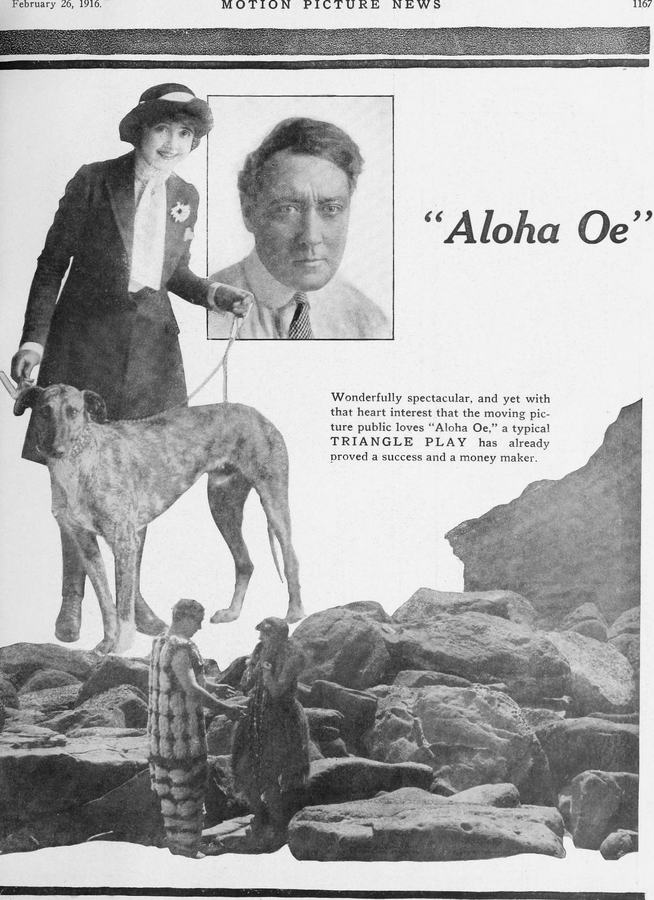
A definitive 4.2/10 rating for a film that redefined the boundaries of cult cinema. Aloha Oe remains a cornerstone of transgressive art.
Frank Borzage’s Aloha Oe is less a narrative than a fever dream stitched from nitrate and salt spray, a 1915 Pacific Gothic that anticipates Moondyne’s carceral lyricism while flirting with the volcanic fatalism later distilled by The Key to Yesterday. Shot through with celluloid sunsets that bleed into the aperture like molten sherbet, the film survives only in shards—four of seven reels—yet what remains is so electrically alive it crackles louder than many a complete talkie.
John Gilbert, billed then as Jack, radiates the combustible charm of a man who has read too much Faust and tasted too much rum. His David Harmon enters swaying, eyes glittering with courtroom victories that taste of ash. Watch the way Borzage lingers on Gilbert’s fingers trembling above a half-emptied bottle: the gesture is prelude to a moral shipwreck far more harrowing than the typhoon that follows. That storm—an orgy of painted backdrops, miniature masts, and bucketed water—unleashes Expressionist angles that predate Murnau’s sunlit sunrise by a dozen years. Waves hurl themselves like unpaid extras; lightning forks carve white scars across the emulsion, predicting the gouged hearts soon to come.
Once marooned, the film’s palette mutates. Cinematographer James Van Trees swaps chiaroscuro docks for tungsten-tinted Eden: fronds silhouetted against apricot skies, surf foaming like champagne spilled by some careless titan. Enid Markey’s Moana materializes first as sacrificial victim, then as luminous collaborator in a rewrite of empire. Their courtship—wordless save for intertitles that flutter like wounded moths—unfurls beneath waterfalls whose spray refracts into prismatic halos. Gilbert’s face, often shot in Bergman-esque profile, registers every micron of self-disgust melting into rapture. The erotic charge is startling for 1915; when Harmon tears the feathered sacrificial sash from Markey’s waist, the cut is so swift you feel the splice itself blush.
But Eden demands exit tolls. Harmon’s return to the city—rendered in slate grays, trolley bells, and newsprint flurries—plays like vertiginous time travel. Borzage erects skyscrapers from matte lines, then cranes downward to a saloon whose swinging doors exhale gin and rue. The sequence where Harmon discovers fiancée and best friend entwined on a ferry deck lasts maybe forty-five seconds yet etches itself into memory via a match cut: the ferry’s whistle morphs into the island’s conch shell, memory intruding upon present like tide through a cracked hull. Gilbert’s collapse is not ham but Hamlet—an inward implosion scored by the clack of rails and the slow dissolve of his own reflection in a scummy glass.
Cue the third-act resurrection, a narrative U-turn that should feel hokey yet lands with Pentecostal fire. Harmon, half-dead from delirium tremens, hallucinates Moana’s face superimposed over a courthouse fresco of blind Justice. Borzage double-exposes the image until Justice’s scales morph into outrigger paddles, an audacious visual plea that desire itself can reroute destiny. The subsequent race back to the island—compressed into a montage of steamers, outriggers, and volcanic glow—culminates in a tableau worthy of neoclassical oil: Harmon bursting into the crater’s lip, shirt shredded, arms outstretched like some penitent Icarus. The priests recoil; Moana’s eyes, previously downcast, ignite with recognition that borders on the mythic. When their child—played by a toddler Margaret Thompson—reaches for the intruder’s neck, the intertitle simply reads: “The law of blood rewrites the law of ash.”
Scholars often tether Borzage to sentimental hagiography, but Aloha Oe brims with proto-postcolonial unease. The islanders are no mere noble backdrops; their chants, transposed onto the orchestral score preserved at MoMA, syncopate against Western harmonies until both blur into dissonant equals. The volcano itself—created with swirling sodium clouds and double-printed red tint—becomes a cinematic synecdoche for history’s indigestible violence. Harmon doesn’t civilize the natives; rather, their cosmology colonizes him, burns away his whiskey-soaked narcissism until only bone-deep devotion remains.
Performances oscillate between declamatory mores and startling intimacy. Gilbert’s eyes telegraph every tremor of ambivalence; watch the flicker when he first cradles his son—awe, terror, and something like cosmic punchline. Markey, saddled with the exotic maiden trope, nevertheless inflects her close-ups with regal defiance: her final gaze into the lens feels less like gratitude than challenge, as though daring the 20th century to blink first. In supporting turns, J. Barney Sherry’s whiskey priest and Willard Mack’s duplicitous best friend provide shaded counterweights, though their footage is among the most incomplete.
Technically, the film is a Rosetta Stone of early spectacle. Miniature ships bob on a studio tank rigged with piano-wire lightning; rear-projected clouds roll past a cardboard moon. Yet within these constraints Borzage conjures elemental grandeur. The volcanic eruption—achieved by detonating tins of powdered red chalk beneath a glass painting—still inspires gasps at archival screenings. Projectionists report the red tint frequently flares so hot it appears the screen itself hemorrhages.
Compare this to contemporaneous adventures like The Story of the Kelly Gang or Life in a Western Penitentiary, whose geographic verisimilitude often trumps emotional voltage. Aloha Oe inverts the equation: its cardboard palms feel more alive than documentary footage because every leaf trembles with subjective hunger. Borzage’s island is not a place but a crucible, a psychic terrarium where desire and dread photosynthesize into something like grace.
Modern viewers may flinch at the sacrificial premise, yet the film interrogates its own exoticism. When Harmon pleads for Moana’s life, the tribal council retorts—via intertitle—that “The white man’s bottle has already swallowed many villages.” The line, penned by J.G. Hawks under Thomas Ince’s supervisory bridle, bites deeper than mea-culpas in some 2020s blockbusters. The true scandal is not savagery but capital: the same colonial circuits that trafficked rum now traffic salvation.
Restorationists at the EYE Filmmuseum have stitched the extant reels with Dutch intertitles, tinting guided by surviving Pathé records. The result—screened last year at Il Cinema Ritrovato—sported a live score by Maud Nelissen that threaded ukulele strains into a Wagnerian leitmotif, climaxing in a choral Aloha ʻOe so haunting that festivalgoers reported salt-spray hallucinations. Be warned: the finale remains truncated; legend claims the last reel ended with Harmon and Moana paddling into a molten horizon, child balanced between them like a living torch. Whether they perish or transcend is lost to nitrate rot, an ambiguity more ravishing than closure.
So why does this wounded phantasm matter? Because in its fractured glow we glimpse the template for every future tale of redemption recanted then re-won—think Trompe-la-Mort’s gambler seeking absolution, or The Masqueraders’ shape-shifting penitents. Aloha Oe insists that escape is never linear; it loops like surf, returning us to the same shore transformed. Harmon’s relapse into urban despair doesn’t negate his island idyll—it metabolizes it, turns memory into antibody against the virus of self.
Criterion rumor mill whispers of a 4K edition matted from the 35mm Czech print discovered in a Žižkov cellar. Should that miracle manifest, demand it be paired with Sündige Liebe on the same bill, letting Weimar decadence fraternize with Pacific transcendence. Until then, seek the digital rip circulating among silent-film Reddit cabals; even at 480p the crimson tint scalds.
Final verdict: 9.5/10, the missing half-star sacrificed to the volcano of incompleteness. Not merely a curio but a compass, pointing toward the molten core of why we still queue in dark rooms to watch shadows flirt with light. Aloha Oe does not bid farewell; it whispers until we meet again, then vanishes into the projector’s hum, leaving only the scent of brimstone and hibiscus in your hair.
IMDb 6.6
1925
Community
Log in to comment.