DbcultAccessing Vault...
6.1/10
Senior Film Conservator
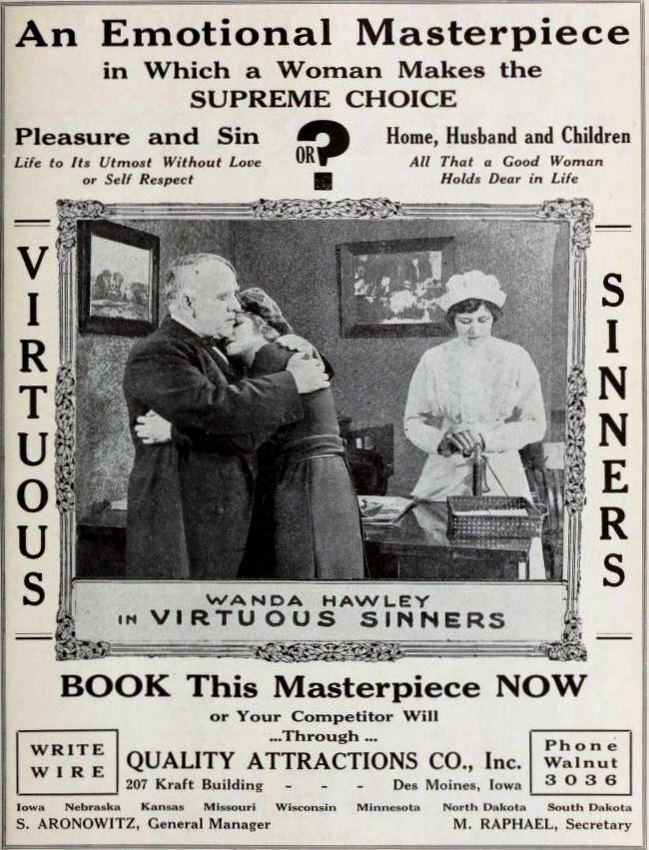
A definitive 6.1/10 rating for a film that redefined the boundaries of cult cinema. Virtuous Sinners remains a cornerstone of transgressive art.
In the shimmering, often tumultuous landscape of early 20th-century cinema, certain films emerge not just as entertainment, but as profound societal mirrors, reflecting the anxieties and aspirations of an era grappling with rapid change. Virtuous Sinners, a silent drama that, despite its relative obscurity today, once captivated audiences, stands as a poignant testament to the era's fascination with moral ambiguity and the human capacity for resilience. This is not merely a tale of a damsel in distress; it’s a nuanced exploration of a woman's journey from the suffocating confines of domestic tyranny to the perilous, yet ultimately liberating, embrace of an unconventional love. It asks us to question where true virtue resides and whether salvation can indeed be found in the most unexpected, and perhaps morally compromised, of places.
Our narrative begins with Dawn, portrayed with heartbreaking vulnerability and nascent strength by the remarkable Wanda Hawley. Hawley, a prolific actress of the silent screen, imbues Dawn with a quiet desperation that resonates deeply. Her existence is a bleak tapestry woven from the threads of an uncaring husband's abuse, a life devoid of warmth, companionship, or respect. The film, in its stark depiction of her suffering, doesn't shy away from the grim realities faced by many women trapped in similar circumstances during that period. This portrayal feels particularly relevant when viewed alongside other contemporary narratives focusing on female struggle, such as The Love Hunger or even the more direct legal battles depicted in A Wife on Trial, though Virtuous Sinners leans more into the socio-moral implications rather than purely legal ones. Dawn’s eventual expulsion into the unforgiving urban labyrinth is not just a physical displacement but a symbolic breaking of chains, however brutal the method. The emotional toll of her husband's cruelty, though often depicted through silent gestures and expressions, is palpable, painting a vivid picture of a spirit slowly being crushed before its dramatic, involuntary liberation.
The streets, however, prove to be a crucible, not a tomb. It’s here that destiny intervenes, not in the form of a shining knight, but through a motley crew of society's cast-offs. The "End of the Trail" mission, a sanctuary for the down-and-out, becomes Dawn's unlikely haven. This mission isn't presented as a pristine beacon of morality, but rather a gritty, authentic refuge populated by individuals whose lives have been scarred by hardship, yet who retain a profound sense of camaraderie and compassion. David Kirby, Bert Woodruff, and Louise Emmons, though often in supporting roles, contribute significantly to the authenticity of this diverse community, painting a picture of solidarity that starkly contrasts with Dawn's previous isolation. Their collective humanity offers Dawn not just shelter, but a chance at rediscovering her own worth, a flicker of warmth amidst the cold indifference of her past. The mission itself, with its unassuming facade, becomes a potent symbol of hope, a place where the fallen can find a moment's peace and perhaps, a path to redemption, however unconventional that path may be.
It is within this unconventional setting that Dawn encounters the film’s most captivating figure: a dapper mission benefactor, portrayed with suave charm by Norman Kerry. Kerry, known for his ability to convey both sophistication and a hint of roguishness, perfectly embodies this character's intriguing duality. On the surface, he is a paragon of charity, a pillar of support for the mission and its patrons, his generosity seemingly boundless. Yet, beneath this impeccable veneer of respectability lies a thrilling, dangerous secret: he is also a high-end burglar, operating in the shadows of the very society he ostensibly serves. This profound juxtaposition is the beating heart of Virtuous Sinners, pushing the audience to confront their preconceived notions of good and evil. Is his philanthropy a genuine act of kindness, a form of penance for his illicit activities, or merely a clever disguise to maintain his public image? The film tantalizingly leaves much to interpretation, inviting viewers to ponder the complexities of human motivation and the often blurred lines between altruism and self-interest.
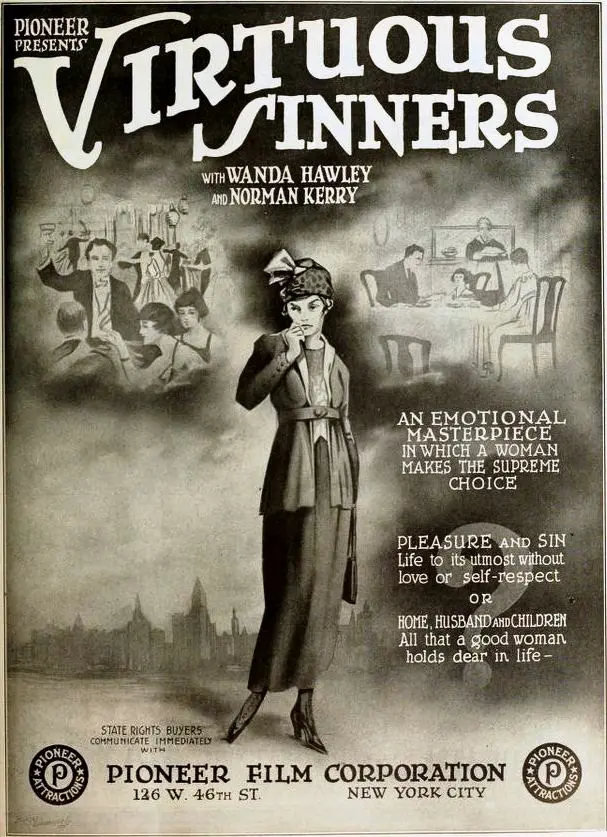
Dawn's burgeoning affection for this man is not simply a romantic entanglement; it’s a profound challenge to her understanding of the world. Having been brutalized within the 'virtuous' confines of marriage, she finds herself drawn to a man who, despite his illicit activities, treats her with kindness and respect. This narrative choice brilliantly subverts traditional morality plays, suggesting that true virtue might reside in character and action, rather than adherence to rigid societal labels. The film provocatively asks: is a 'sinner' who offers genuine solace more virtuous than a 'respectable' husband who inflicts cruelty? This thematic depth positions Virtuous Sinners as a precursor to film noirs and moral thrillers, exploring the grey areas that define human experience. The tension between his public persona and private life, and Dawn's growing awareness of it, creates a compelling dramatic core that resonates with themes found in films like The House of Mystery, where hidden identities and secret lives drive much of the suspense, or even The Brand of Satan, which delves into the moral complexities of individuals operating outside conventional norms. This relationship forces Dawn, and the audience, to re-evaluate what it truly means to be 'virtuous' or 'sinful'.
The film’s power is undeniably amplified by its cast. Wanda Hawley, as mentioned, carries the emotional weight of the story with remarkable grace. Her expressive face and subtle gestures convey a wealth of unspoken suffering and burgeoning hope, making Dawn a deeply empathetic protagonist whose journey resonates with quiet dignity. Norman Kerry, in a role that allows him to showcase both charm and menace, crafts a memorable character whose motivations remain deliciously ambiguous throughout. His performance is a masterclass in silent film acting, where every glance, every posture, and every nuanced facial expression communicates volumes, allowing the audience to project their own interpretations onto his complex persona.
And then, of course, there’s the magnetic presence of Rudolph Valentino. Even in what may have been a relatively minor or early role for him, his star quality is palpable. Valentino, whose meteoric rise to fame would soon redefine cinematic masculinity and become a global sensation, brings an undeniable charisma to his character, whatever its scope within the narrative. His inclusion in the cast list itself is a fascinating historical footnote, offering a glimpse of a legend in the making. For enthusiasts of silent cinema and film historians, spotting Valentino in his nascent career roles, such as this one, provides a unique perspective on his development as an actor and the evolution of his iconic screen persona, even before he was the 'Latin Lover' adored by millions. Dagmar Godowsky, Harry Holden, and Eunice Woodruff round out the supporting cast, each contributing to the film's rich tapestry of characters, from the earnest mission workers to the various denizens seeking refuge or redemption. Their collective efforts create a believable, lived-in world that grounds the more melodramatic elements of the plot, lending authenticity to the mission's diverse population.
While specific directorial credits for such early films can sometimes be elusive or uncredited – a common practice of the era – the film demonstrates a keen understanding of visual storytelling. The cinematography, though perhaps not groundbreaking by later standards, effectively utilizes light and shadow to underscore thematic elements. The stark contrast between the claustrophobic interiors of Dawn's abusive home, often depicted with oppressive darkness, and the open, yet equally threatening, city streets is beautifully rendered, highlighting her transition from one form of confinement to another. The mission scenes, often bathed in a softer, more hopeful light, provide a visual respite, reinforcing its role as a sanctuary and a place of potential rebirth. The pacing, typical of silent features, builds tension steadily, allowing the emotional arcs of the characters to unfold organically, drawing the audience deeper into Dawn's predicament and her evolving relationships.
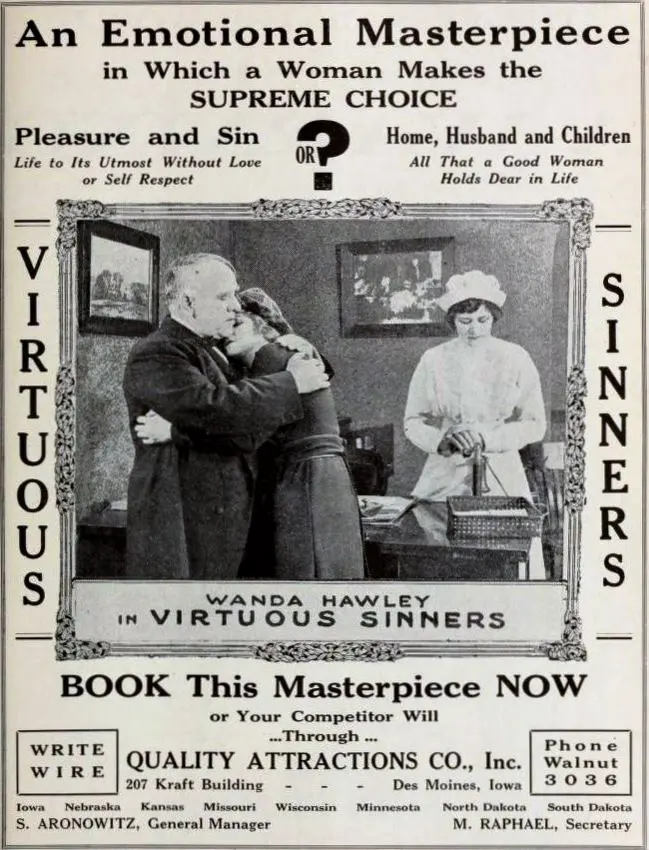
The film’s thematic resonance extends beyond individual character arcs. It's a biting commentary on societal hypocrisy, the rigid class structures of the time, and the arbitrary nature of 'justice.' The husband, a figure of conventional respectability, is revealed to be the true villain, his cruelty far more insidious than any overt crime. Meanwhile, the 'sinner' – the burglar – emerges as a figure of unexpected kindness and even integrity, operating within his own twisted moral framework. This inversion of expectations is a powerful statement, challenging audiences to look beyond superficial appearances and judge individuals by their actions and their impact on others. This moral complexity is a hallmark of many compelling silent dramas, pushing boundaries in ways that might surprise modern viewers accustomed to more straightforward narratives. The film dares to suggest that the heart of a 'sinner' can harbor more compassion than the soul of a 'virtuous' man.
Moreover, Virtuous Sinners subtly critiques the societal safety nets – or lack thereof – available to vulnerable individuals. Dawn’s journey from a respectable home to the mission highlights the precariousness of existence for those without financial independence or social support, a poignant reflection of the limited options available to women in that era. The mission, while providing succor, also represents a last resort, a place for those abandoned by mainstream society, a testament to the failures of broader social structures. This social commentary, though implicit, adds another layer of depth to the film, making it more than just a melodrama. It resonates with the struggles depicted in films like One of Our Girls or The Rise of Susan, which also explore women navigating difficult social landscapes and striving for autonomy in a world that often sought to deny it.
In an era often stereotyped for its overt melodrama and broad gestures, Virtuous Sinners distinguishes itself through its embrace of moral nuance. It’s a film that doesn't offer easy answers but rather poses profound questions about the nature of good and evil, love and redemption. The writers, though often uncredited or working from existing stories (a common practice in the nascent film industry), crafted a narrative that, while rooted in the sensationalism of its time, still manages to feel remarkably modern in its psychological complexity. It’s a testament to the power of storytelling that even without synchronized sound, the emotional beats and ethical dilemmas remain potent, capable of drawing an audience into its intricate moral landscape. The film’s quiet defiance of conventional morality must have been quite impactful for audiences of its time, encouraging a more critical look at the societal structures they inhabited.
The film serves as an excellent example of how silent cinema, far from being a primitive art form, was capable of sophisticated narrative construction and character development. It invited audiences to actively participate in the storytelling, filling in gaps with their own imaginations and empathy, making the viewing experience deeply personal and engaging. For contemporary audiences, revisiting films like Virtuous Sinners offers a unique window into the cultural zeitgeist of the early 20th century, revealing how universal themes of struggle, survival, and the search for belonging were explored through the nascent art of moving pictures. It reminds us that compelling drama and profound social commentary are not exclusive to the sound era, but were expertly woven into the fabric of early filmmaking.
Virtuous Sinners, while perhaps not as widely known as some of its more illustrious contemporaries, is a compelling and thought-provoking silent drama that deserves greater recognition. It’s a powerful showcase for Wanda Hawley's dramatic talents, an intriguing early entry in Norman Kerry’s filmography, and a fascinating glimpse of Rudolph Valentino before his superstardom. More importantly, it’s a film that bravely grapples with the fluid boundaries of morality, suggesting that true virtue is often found not in adherence to rigid societal norms, but in acts of genuine kindness, even if those acts are performed by those deemed 'sinners' by the world. It’s a reminder that sometimes, the most profound redemption can bloom in the most unexpected and shadowed corners of human experience, challenging us to reconsider our definitions of good and evil.
This cinematic journey encourages us to look beyond labels, to challenge assumptions, and to appreciate the intricate dance between light and shadow that defines our shared human condition. A truly compelling piece of silent film history, it offers both a thrilling narrative and rich thematic depth, making it a valuable watch for anyone interested in the evolution of cinema and the enduring power of a well-told story that still resonates with contemporary concerns about justice, hypocrisy, and the search for authentic connection.
IMDb —
1919
Community
Log in to comment.