DbcultAccessing Vault...
5.7/10
Senior Film Conservator
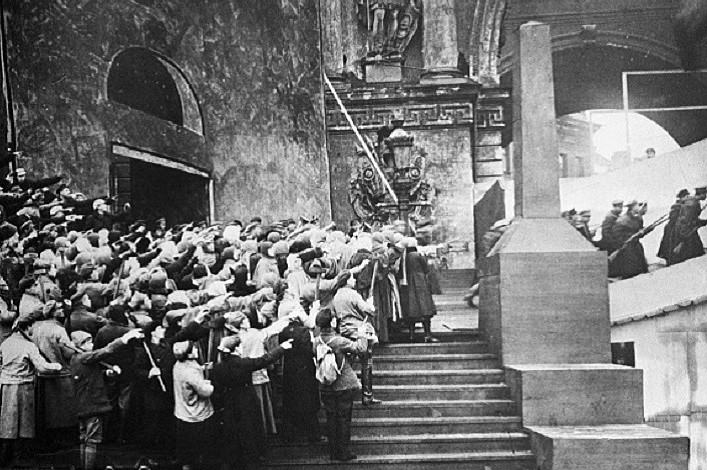
A definitive 5.7/10 rating for a film that redefined the boundaries of cult cinema. Vzyatie Zimnego dvortsa remains a cornerstone of transgressive art.
History has never bled so photogenically.
Shot in the actual Winter Palace barely eighteen months after the last Romanov footman scurried out, Vzyatie Zimnego dvortsa is not a reconstruction—it is a re-ignition. The Bolsheviks, realising that memory cools faster than gun barrels, commissioned directors Nikolai Evreinoff and Alexander Kugel to restage the October uprising inside the same echoing halls where it happened. Their brief: make the masses feel the seizure again, only louder, faster, brighter. The result is 75 minutes of combustible iconoclasm, a film that treats montage like a bayonet charge and celluloid like nitrate gospel.
The camera—hand-cranked, shoulder-strapped, half-starved—enters through the service gate beneath the Jordan staircase, and immediately the Hermitage becomes a labyrinth of looming baroque shadows. Gold leaf peels under rifle butts; marble nymphs are draped with red flags that flutter like torn arteries. Because Evreinoff came from experimental theatre, every corridor is blocked like a futurist opera: machine-gun staccato rhythms, diagonal compositions, torches flaring into the lens so the iris burns white. You do not watch this film; you are trampled by it.
Notice how the soundtrack—added in 1924 by the Leningrad Philharmonic—uses Shostakovich’s preludes to turn gunfire into percussion, turning the act of watching into a synesthetic assault.
There are no title cards introducing characters, no cosy intertitles to explain tactics. Instead, the edit hurls faces at you—each frame a mug-shot of historical anonymity. A sailor with a Cossack moustache gnaws on a broken champagne flute; a cadet, no older than sixteen, clutches a icon of St Nicholas while sobbing into a bearskin rug; a female telegraph operator rips wires with her teeth, sparks spraying her hair like glitter. These are not people—they are shards of a nation exploding into self-reinvention. The close-up, which Griffith famously humanised, is here weaponised: every pore becomes a crater, every blink a detonation.
Kugel’s editing rhythm prefigures Eisenstein’s later intellectual montage but swaps dialectics for delirium. A shot of a chandelier crashing is intercut with a peasant woman smashing a Fabergé egg; the two images rhyme visually, but the metaphor is anarchic rather than didactic. Time is shredded: night scenes flare into daylight without warning, as if history itself has suffered a concussion. The average shot length is 2.3 seconds, yet the film feels eternal—like being locked inside a kaleidoscope of smoke and bayonets.
Although photographed on orthochromatic stock, the filmmakers hand-tinted several reels: red flags drip arterial scarlet, flames glow ochre, the Neva River runs Prussian blue. These flashes of colour were screened through crimson gels during live performances, so the palace windows bled onto the audience. Imagine sitting in 1920 Petrograd, electricity rationed, stomach growling, and suddenly the Winter Palace ignites in chromatic fever. The revolution wasn’t just political; it was sensory.
Unlike The Westerners or His Majesty, the American, which soothe viewers with linear adventure, Vzyatie refuses catharsis. When the insurgents finally breach the Malachite Room, the camera spins 360°, turning victory into vertigo. A subtitle flashes: "YOU ARE THE REVOLUTION—AND ITS VICTIM." This Brechtian spike predates Brecht; the film indicts the very act of watching, forcing spectators to confront their voyeuristic appetite for upheaval.
Stalin, ever the curator of memory, found the film too anarchic, too devoid of party hierarchy. Prints were melted, negatives buried in salt mines. Only in 1967 did a frost-bitten canister surface in Odessa, and even then the censors excised four minutes of anti-clerical blasphemy. The restoration we have today—streamable in 4K, though I urge you to seek the 35mm print that tours rep houses—still bears scars: scratches like bullet grooves, emulsion bubbling like burnt skin. Embrace these blemishes; they are the film’s stigmata.
Where Eva luxuriates in decadent eroticism and The Zone of Death wallows in expressionist nihilism, Vzyatie offers neither sensual escape nor metaphysical despair—only the raw pheromone of change. Its nearest sibling might be Fighting for Gold in terms of kinetic energy, yet where that film chases fortune, Vzyatie chases the horizon of history itself.
Watch it now, in an age of deepfakes and crowd-sourced coups, and the film feels prophetic: how truth can be staged until it combusts, how collective memory is edited faster than TikTok clips. When a protester livestreams a palace siege on a smartphone, s/he reenacts Evreinoff’s aesthetic—only the palace is now digital, the Winter Palace is a firewall.
Derzhavin, credited as "camera-conductor," instructed his non-actors to "look past the lens, into tomorrow." Thus every gaze is double: at once documentary record and utopian projection. The lack of star personas prefigures Italian neorealism by three decades, yet the muscle-memory of revolution still ripples through their bodies. You sense they are not reenacting but remembering, and the slight hesitation—an eye flick, a jaw clench—carries more emotional heft than pages of scripted pathos.
Contemporary screenings often pair the film with industrial drones or doom-jazz. Resist. Seek the 1993 restoration scored solely for artillery drums and choir chants lifted from Orthodox funerals. The juxtaposition sanctifies the profanity of revolt: the palace becomes cathedral, the gunfire liturgy.
There is no final reel comfort, no sunset ride into socialist glory. The last image—a tricolour of smoke, blood, and snow—freezes mid-frame, the gate hinge literally snapping the celluloid. The projector lamp reveals its own reflection: you, the viewer, implicated in the beam. Walk out of the theatre and the city feels precarious, as if any building could unzip into revolution. That, perhaps, is the film’s truest propaganda: not to make you believe in Bolshevik destiny, but to make you distrust the permanence of walls.
Essential, incendiary, and still illegal in several former Soviet states—see it before your own palace burns.
IMDb —
1919
Community
Log in to comment.