DbcultAccessing Vault...
Cult Review
Senior Film Conservator

The year 1920 marked a pivotal juncture in the evolution of silent cinema, a period where the medium transitioned from mere spectacle to a nuanced exploration of the human condition. Captain Swift, directed with a keen eye for atmospheric tension, stands as a testament to this maturation. It is a film that grapples with the duality of man, the rigidity of class structures, and the possibility of reinvention in a world that rarely offers second chances. While contemporaneous works like The Burden of Proof dealt with the weight of legal evidence and moral culpability, Captain Swift pivots toward a more internal, psychological form of absolution.
At the heart of this production is James O'Neill, whose portrayal of the titular anti-hero is nothing short of magnetic. O'Neill navigates the character's transition from a desperate fugitive in the Australian bush to a polished socialite in London with a subtlety that was rare for the era. In the opening sequences, his movements are jagged, animalistic, reflecting the survivalist instincts of a man hunted by the law. As the setting shifts to the Seabrook estate, his posture softens, his gestures become measured, yet his eyes retain a flickering anxiety—a reminder that his identity is a precarious construct. This performance rivals the intensity found in The Reincarnation of Karma, though O'Neill’s focus is on the terrestrial rather than the metaphysical.
The cinematography in Captain Swift utilizes the contrast between the vast, untamed landscapes of Australia and the claustrophobic, ornate interiors of London to mirror the protagonist's internal struggle. The early scenes are characterized by a raw, almost documentary-like quality, emphasizing the harshness of the colonial periphery. In contrast, the London sequences are bathed in a softer, more diffused light, creating a sense of illusory safety. This visual dichotomy serves to underscore the theme of displacement—a theme also masterfully explored in Graziella, albeit in a more romanticized Mediterranean context. The director’s use of deep focus during the dinner parties at the Seabrook manor allows the audience to witness the encroaching threats from the background, heightening the suspense as Swift’s past literally walks through the door.
One of the most radical departures from standard 1920s melodrama is the film’s treatment of the robbed banker. In most narratives of this period, such as the stark morality play of Her Fatal Shot, the victim would be the instrument of the protagonist's downfall. However, in Captain Swift, the banker functions as a mirror. Upon recognizing Swift, he does not see a criminal to be punished, but a man who has successfully performed the labor of self-improvement. This act of forgiveness is the film's most profound moment, suggesting that identity is not a fixed state determined by one’s worst actions, but a fluid process of becoming. This narrative choice elevates the film above the standard 'gentleman thief' tropes found in A Phantom Fugitive.
The revelation that Swift is the son of Lady Seabrook adds a layer of Greek tragedy to the proceedings. It reframes his entire life of crime as a subconscious rebellion against a society that abandoned him. The scene where the truth comes to light is handled with a restraint that prevents it from descending into bathos. Adelaide Prince, as Lady Seabrook, conveys a lifetime of suppressed guilt and maternal longing with just a few carefully chosen expressions. This exploration of secret lineages and the haunting of the past is a recurring motif in the era's dramas, notably in The Call of the Soul, but here it serves a specific structural purpose: it legitimizes Swift’s place in the upper class, not through his assumed identity, but through his biological reality.
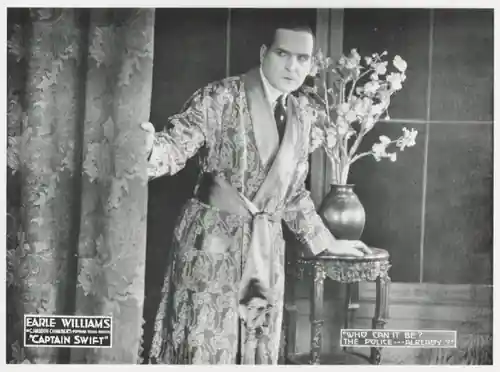
When comparing Captain Swift to other films of the time, such as She Hired a Husband or A Regular Girl, we see a stark difference in how class mobility is portrayed. While those films often treat the crossing of class boundaries with a comedic or lighthearted touch, Captain Swift treats it as a matter of life and death. The stakes are higher, the consequences more dire. The character of Stella Darbisher, played with a luminous sincerity by Florence Dixon, represents the moral compass of the film. Unlike the more cynical heroines in Woman and Wife, Stella’s love for Swift is unconditional, transcending the social scandals that threaten to erupt. Her devotion is the catalyst for Swift’s final redemption, proving that even a man born in shadows can step into the light.
The screenplay by C. Haddon Chambers and Lucien Hubbard is a masterclass in narrative economy. Every scene serves a dual purpose: advancing the plot while deepening our understanding of Swift’s fractured psyche. The dialogue (conveyed through intertitles) avoids the florid excesses of the time, opting instead for a directness that enhances the film's realism. This precision is reminiscent of the tight plotting in Suspense, where every frame is calculated for maximum impact. The writers also manage to weave in subtle critiques of the British class system, suggesting that the 'gentlemen' of London are often just as predatory as the bushrangers of Australia, merely operating under a different set of rules.
The production design of the Seabrook manor is a character in itself. The heavy drapes, the sprawling staircases, and the dimly lit corridors create an atmosphere of aristocratic stagnation. It is into this environment that Swift brings a sense of vitality and danger. The contrast between the rigid sets and O'Neill’s fluid movements creates a constant visual friction. This attention to detail is what sets Captain Swift apart from more generic productions like A Diplomatic Mission. The film also benefits from a sophisticated editing rhythm, particularly during the sequence where the banker first spots Swift. The cross-cutting between the banker’s recognition and Swift’s mounting panic is a precursor to the modern thriller.
In the broader context of silent film history, Captain Swift occupies a unique space. It is a bridge between the Victorian stage tradition and the burgeoning language of cinema. It anticipates the noir sensibilities of the 1940s, with its focus on the 'man with a past' and the impossibility of truly escaping one’s history. While films like A Law Unto Himself explored similar themes of individual autonomy versus social law, Captain Swift provides a more optimistic, albeit complex, resolution. It suggests that while the law may be rigid, the human heart is capable of a revolutionary grace.
To watch Captain Swift today is to witness a moment in time when cinema was discovering its power to tell deeply personal stories on a grand scale. It is a film of immense histrionic dexterity and visual sophistication. Whether compared to the European sensibilities of Ein Ehrenwort or the romantic grandiosity of The Battle of Love, Captain Swift holds its own as a compelling, thought-provoking piece of art. It reminds us that the masks we wear often reveal more about our true selves than the faces we were born with. For any serious student of the silent era, or for the casual viewer seeking a story of profound transformation, this film remains an essential experience.
Reviewed by the Editorial Staff - A deep dive into the archives of 1920s cinema.
IMDb 6.4
1923
Community
Log in to comment.