DbcultAccessing Vault...
Cult Review
Senior Film Conservator
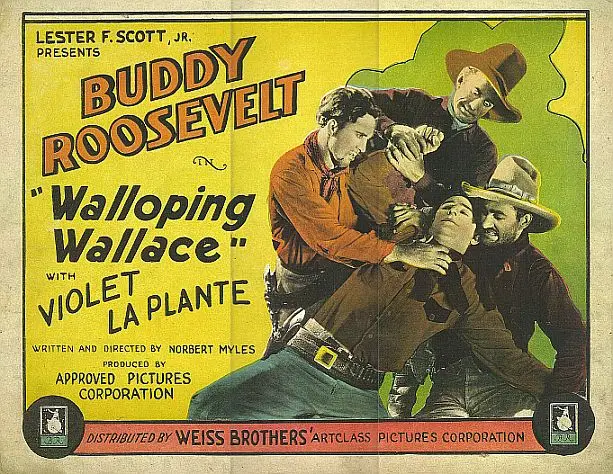
In the realm of cinematic narratives, few tales have managed to entwine the themes of retribution, redemption, and romance as deftly as 'Walloping Wallace'. This film, a veritable gem of the silent era, presents a riveting account of Buddy Wallace, the indefatigable foreman of Carol Grey's Lazy B Ranch, and his tumultuous journey towards vindication and love.
The saga commences with a dramatic flourish, as Buddy, embodied by Buddy Roosevelt, takes decisive action against Squinty Burnt, a malingerer whose lack of diligence threatens the very fabric of the ranch's operations. The ensuing physical confrontation between the two adversaries not only showcases Buddy's unwavering commitment to his duties but also serves as a catalyst for Squinty's Machiigenellian scheme of revenge.
Squinty, nursing a deep-seated grudge, orchestrates a complex web of deceit, which includes the forgery of Carol's signature on a bill of sale and her subsequent abduction. This dastardly plan sets the stage for a series of intense confrontations, death-defying stunts, and exhilarating horse races, as Buddy embarks on a perilous pursuit to rescue Carol and clear his name.
The narrative, penned by Betty Burbridge, Robert J. Horton, and Norbert A. Myles, exhibits a remarkable capacity for storytelling, replete with unexpected twists and turns that maintain an air of tension and suspense. The character development, though rudimentary by modern standards, is sufficient to invest the audience in the plight of Buddy and Carol, whose romance blossoms against the backdrop of adversity.
The performances of the cast, including Violet La Plante, Terry Myles, N.E. Hendrix, Lillian Gale, Lew Meehan, Olin Francis, Dick Bodkins, and Blackie Whiteford, lend an air of authenticity to the proceedings. Their portrayals, imbued with a sense of earnestness and conviction, serve to heighten the emotional impact of the narrative, rendering the ultimate resolution all the more satisfying.
In terms of cinematic craftsmanship, 'Walloping Wallace' exhibits a commendable level of proficiency, particularly in its use of action sequences and stunts. The film's pacing, though occasionally uneven, is generally well-balanced, allowing for a seamless transition between moments of high drama and those of relative levity.
For those acquainted with the works of other filmmakers of the era, such as those found in Beasts of Paradise or Are You a Mason?, 'Walloping Wallace' will likely resonate as a familiar yet engaging tale of heroism and perseverance. However, the film's unique blend of action, romance, and redemption sets it apart as a memorable viewing experience.
Upon reflection, it becomes evident that 'Walloping Wallace' shares certain thematic similarities with Those Who Pay and Höhenluft, films that also explore the complexities of human relationships and the consequences of one's actions. Nevertheless, the film's distinctive narrative voice and stylistic approach ensure that it remains a standout work within the broader cinematic landscape.
Ultimately, 'Walloping Wallace' is a film that will appeal to aficionados of classic cinema and those with a predilection for tales of derring-do and romance. Its enduring charm lies in its ability to transport viewers to a bygone era, one characterized by simplicity, elegance, and a deep-seated sense of morality.
In conclusion, 'Walloping Wallace' is a cinematic treasure that warrants attention from scholars and enthusiasts alike. Its intricate plot, memorable characters, and technical proficiency render it a compelling viewing experience, one that will undoubtedly leave a lasting impression on audiences.
For those interested in exploring the film's historical context, comparisons with other works such as A Bird of Bagdad, The Dentist, and Lilith and Ly may prove enlightening, offering insights into the evolution of cinematic storytelling during this period.
As a testament to the film's enduring legacy, 'Walloping Wallace' remains an essential work for researchers and film enthusiasts, providing a unique window into the early days of cinema and the artistic vision of its creators.
The film's influence can be seen in later works, such as From Two to Six and The Boy Girl, which, while distinct in their own right, owe a debt to the pioneering efforts of filmmakers like those involved in 'Walloping Wallace'.
In the final analysis, 'Walloping Wallace' stands as a landmark film, one that continues to captivate audiences with its blend of action, romance, and redemption. Its place within the pantheon of cinematic classics is well-deserved, and it remains a vital work for anyone seeking to understand the evolution of film as an art form.
IMDb 6.4
1937
Community
Log in to comment.