DbcultAccessing Vault...
Cult Review
Senior Film Conservator
In the vast, often overlooked archives of early cinema, certain films emerge not just as historical artifacts but as profound statements on the nature of their own medium. 'Wanted, a Story' is precisely one such gem, a work that transcends its seemingly simple premise to offer a sophisticated, self-reflexive commentary on the very act of narrative construction and audience engagement. It’s a fascinating spectacle, a cinematic Russian doll, where the film itself becomes a testament to the power of imagination, both for its characters and for us, the viewers.
The film opens not with a grand adventure, but with an intimate, almost theatrical scene: an authoress, the unseen architect of worlds, presenting her latest scenario to a select, critical assembly. This assembly is not merely a production team, but a microcosm of the entire filmmaking ecosystem: a director, the visionary who will translate words into images; a producing manager, the pragmatic gatekeeper of resources; and, most crucially, a youthful cast. These young actors are not passive recipients; they are active participants, their potential acceptance or rejection holding the narrative’s fate in their small hands. This setup immediately elevates 'Wanted, a Story' beyond a mere plot recounting; it’s an exploration of creative genesis, a vivid portrayal of the moment a story transitions from an abstract idea to a tangible, shared vision.
The authoress, though an internal character, functions as the film’s true auteur, her voice and presence driving the entire cinematic experience. Her reading isn't just a dry recitation of lines; it's a performance in itself, imbued with the passion and conviction necessary to ignite the imaginations of her listeners. As her words unfurl, a remarkable transformation occurs: the static setting of the production office dissolves, giving way to the vibrant, dynamic scenes she describes. This seamless transition from the literal act of storytelling to its visualized manifestation is nothing short of ingenious for its era, demonstrating a sophisticated understanding of cinematic language and its ability to transport an audience. It highlights the often-invisible labor of the writer, positioning them as the primary conjurer of worlds, a stark reminder that even the most elaborate visual spectacle begins with a single, compelling idea.
One could even draw a thematic parallel here to films that explore the power of suggestion or the mind's eye, albeit in vastly different contexts. While not directly comparable in genre, the way 'Wanted, a Story' externalizes an internal narrative can be seen as a precursor to films like Spiritismo, which, through its exploration of the supernatural, similarly plays with the boundaries of perception and reality. Here, however, the magic is not occult but purely imaginative, a testament to the human capacity for creation.
The story conjured by the authoress is one of classic adventure: a shipwreck, a perilous journey, and the ultimate refuge on a distant, exotic island. This segment, undoubtedly the visual centerpiece of the narrative, offers a stark contrast to the intellectual, contained atmosphere of the opening frame. We are plunged into the chaos of the sea, the vulnerability of the children, and then the quiet triumph of survival. The South Sea island setting, a popular trope in early cinema for its visual splendor and escapist fantasy, would have provided ample opportunity for stunning cinematography, even within the confines of silent film techniques. One can easily imagine sweeping shots of pristine beaches, lush tropical foliage, and the endless expanse of the ocean, all designed to transport the viewer to a world far removed from their own.
The children's activities on this isolated paradise form the emotional core of the adventure. Stripped of adult supervision and the trappings of civilization, they are forced to rely on their innate resourcefulness and nascent communal spirit. This segment would have likely showcased a range of childhood experiences: the initial fear and uncertainty, followed by the thrill of discovery, the development of makeshift shelters, the foraging for food, and the blossoming of friendships forged in adversity. It speaks to universal themes of resilience, adaptation, and the enduring human spirit, particularly as embodied by the innocence and boundless energy of youth. This part of the film, despite being a story-within-a-story, likely carries the most immediate emotional punch, engaging the audience with its dramatic stakes and charming portrayal of youthful ingenuity.
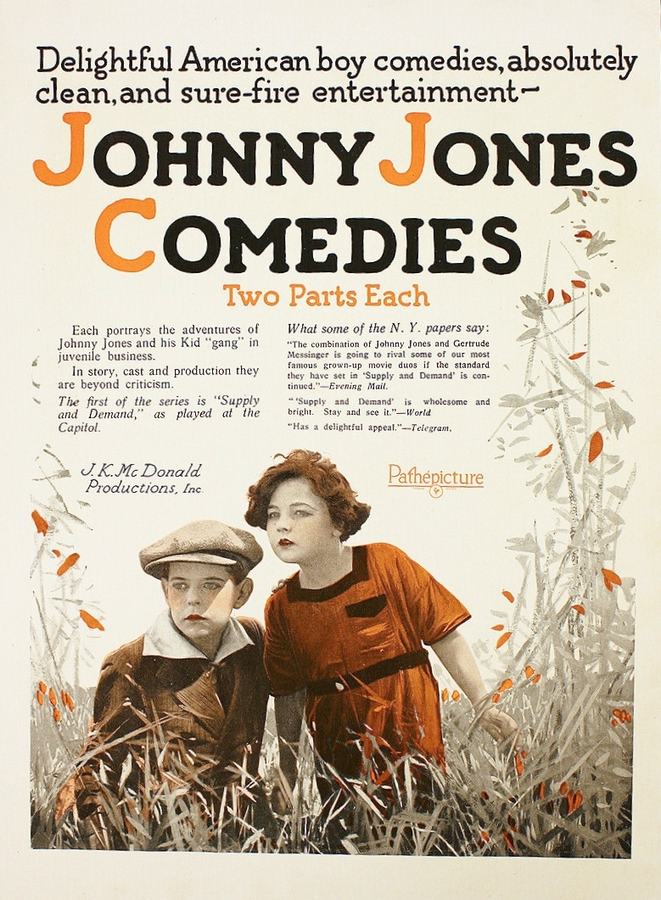
The casting of children in prominent roles, as seen with Gertrude Messinger, Ben Alexander, Turner Savage, Edward Peil Jr., and Kenneth Green, adds another layer of intrigue to 'Wanted, a Story'. Child actors in the silent era faced unique challenges, often requiring a natural expressiveness to convey emotion without dialogue, relying solely on gesture, facial expression, and physical comedy or drama. Gertrude Messinger, a prolific child actress of the period, would have brought a seasoned professionalism to her role, likely anchoring the youthful ensemble. Ben Alexander, another familiar face from early Hollywood, would have contributed his youthful charisma.
Their performances within the island narrative are critical. They are the eyes through which the audience experiences the wonder and peril of the South Sea adventure. The authenticity of their reactions — their fear during the shipwreck, their awe at the island's beauty, their collaborative spirit in building a new life — would have been paramount to the story's success. The film's meta-narrative structure suggests that their on-screen reactions during the reading are as important as their performances within the story itself. Their eventual "pleased acceptance" of the scenario is not just a plot point; it's a validation of the story's inherent appeal, a testament to its ability to resonate with its intended audience: children themselves.
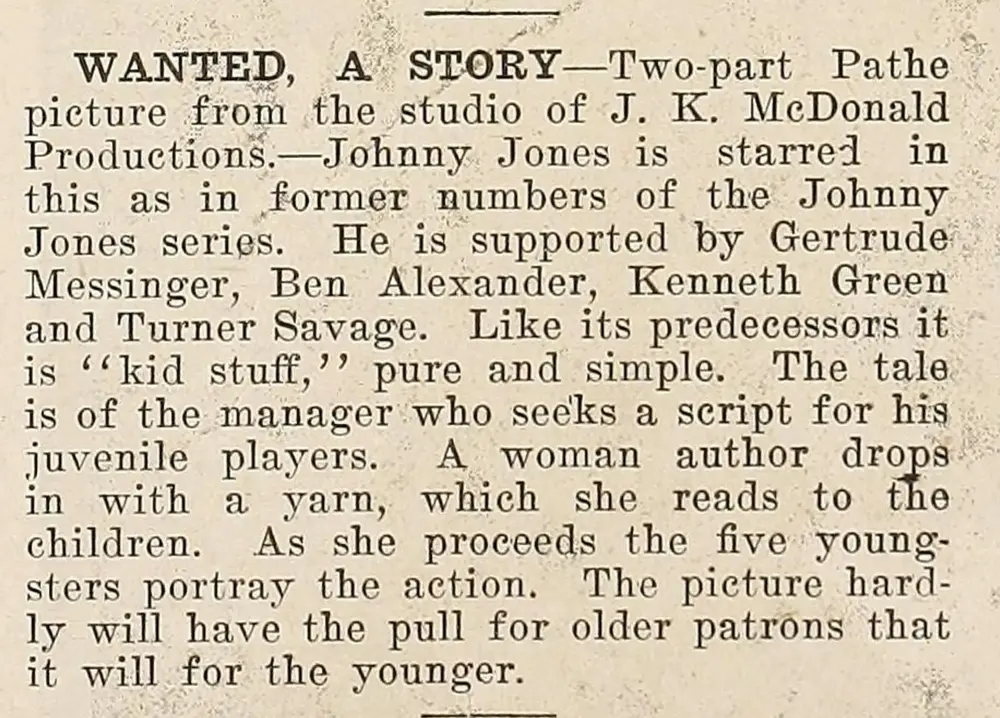
This emphasis on the children's perspective and their ultimate judgment is quite progressive. It places the emotional truth of the story above mere commercial viability, suggesting that the most authentic critique comes from those for whom the narrative is ostensibly created. It’s a subtle but powerful statement on the democratization of artistic appreciation, even in a nascent film industry driven by studio executives.
The film's denouement, returning us to the production office, is both satisfying and insightful. The final shot, depicting the children's pleased acceptance of the story, serves multiple purposes. On a narrative level, it provides a conclusive resolution to the framing device, confirming the authoress's success. More profoundly, it acts as a symbolic endorsement of the power of storytelling itself. The director and producing manager, initially perhaps more concerned with logistics and budget, are swayed by the pure, unadulterated joy of the young cast. Their enthusiasm is infectious, a powerful argument for the story's intrinsic worth. This moment encapsulates the magic of cinema: its ability to captivate, to transport, and to elicit genuine emotion from its viewers, regardless of age.
The film, in essence, becomes a celebration of its own medium. It implicitly argues that a good story, well told, is its own reward and its own justification. The children's smiles are the ultimate box office, the most coveted critical acclaim. It's a charmingly optimistic view of the creative process, one that foregrounds inspiration and emotional resonance over purely commercial considerations. This simple ending elevates the film from a mere adventure tale to a thoughtful meditation on art and audience.
'Wanted, a Story' stands as a fascinating artifact of early cinema, demonstrating a playful and sophisticated approach to narrative structure that was perhaps ahead of its time. While the specific writers are uncredited, a common occurrence in this nascent period of filmmaking, the conceptual elegance of the piece speaks volumes about the creative minds at work. The meta-narrative, or story-within-a-story, was not entirely new in literature, but its application in early film, especially with such fluid transitions, marks it as an innovative endeavor. It forces the audience to consider the layers of reality and fiction, to appreciate the craft that goes into creating cinematic illusion.
Compared to some of the more straightforward dramas or action serials of the era, such as The Devil's Trail or Silent Strength, 'Wanted, a Story' exhibits a contemplative quality. It doesn't just present a narrative; it dissects the very mechanism of its presentation. This self-awareness is a hallmark of more mature storytelling, suggesting that even in its infancy, cinema was capable of complex structural experimentation. The film also provides a glimpse into the early studio system, albeit through a romanticized lens, showing the collaborative (and occasionally critical) environment where films were born. It's a world away from the starker realities often depicted in films like The Strange Case of Mary Page, which often grappled with social issues and personal turmoil, yet both contribute to the rich tapestry of silent film's diverse offerings.
Despite its age and the inherent limitations of silent film, 'Wanted, a Story' possesses an enduring charm. Its themes — the power of imagination, the joy of adventure, the validation of artistic creation — are timeless. It reminds us that at its heart, cinema is about shared dreams, about conjuring worlds and inviting others to inhabit them, if only for a fleeting moment. The film's unique structure ensures its memorability, setting it apart from countless other productions of its time. It’s a testament to the idea that innovation isn't solely about technological advancement, but also about narrative ingenuity.
For modern audiences, 'Wanted, a Story' offers more than just historical curiosity. It's a gentle reminder of the fundamental allure of storytelling, stripped down to its purest form. There are no elaborate special effects, no booming soundtracks, only the power of a compelling narrative and the expressive faces of its performers. It evokes a sense of wonder that resonates with the simple pleasures of childhood tales, yet it does so with an intellectual elegance that belies its apparent simplicity. The film's title itself, 'Wanted, a Story', becomes a meta-commentary: it's not just the characters within the film who want a story, but also the audience, and the film itself provides that need, satisfying on multiple levels.
The film's narrative structure, where the story's acceptance by the young cast is pivotal, subtly critiques the often-cynical world of artistic production. It champions the pure, unadulterated joy that a good story can bring, suggesting that this emotional impact is the ultimate measure of success. In a landscape where films like The Man Who Had Everything might explore the complexities of desire and material wealth, 'Wanted, a Story' returns to a fundamental human craving: the desire for narrative, for escape, for the shared experience of imagination. It's a delightful and significant piece of cinematic history, inviting us to appreciate the foundational elements that continue to make movies such a powerful and beloved art form.
IMDb —
1924
Community
Log in to comment.