DbcultAccessing Vault...
6.8/10
Senior Film Conservator
A definitive 6.8/10 rating for a film that redefined the boundaries of cult cinema. Wedding in Poetic Karjala remains a cornerstone of transgressive art.
Wedding in Poetic Karjala is not a film to be watched—it is an experience to be felt through the bones. U.T. Sirelius, the enigmatic auteur behind this Soviet-era allegory, has crafted a work that defies categorization. Part ethnographic documentary, part political thriller, and part poetic lament, it thrums with the tension of a culture clinging to its soul while the world around it demands assimilation. The film’s setting—a fictionalized Karjala where the Finnish and Soviet worlds bleed into each other—is rendered in a palette of monochrome and muted reds, evoking both the austerity of state control and the warmth of subterranean resistance.
At its heart is Iira (Olga Tarpio), a Sami linguist whose quiet rebellion manifests in the preservation of her people’s oral histories. Tarpio’s performance is a masterclass in restraint; her eyes betray turmoil when she whispers endangered words into a typewriter, her hands trembling as they trace the contours of a forbidden marriage contract. The narrative unfolds like a folk tale, with Sirelius employing non-linear storytelling to mimic the fragmented nature of memory under threat. When we meet Iira, she is already a ghost in the Soviet archives, her existence reduced to a file marked “ethnic asset.” The film’s genius lies in its refusal to clarify whether this is past, present, or future—time becomes a weapon wielded by the state to erase identity.
“Language is the first thing they take from you,” Iira mutters to a younger activist, her voice a threadbare whisper. “But it’s also the first thing you give back.”
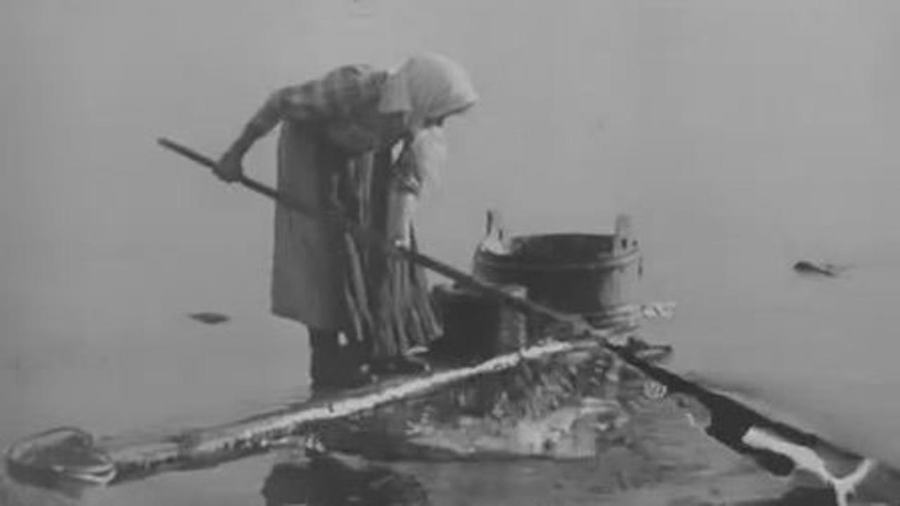
This line encapsulates the film’s thesis. Sirelius draws deliberate parallels to other oppressed cultures—see also Atavismo dell’anima or Il Ponte dei Sospiri—yet infuses the material with a specificity that is distinctly Sami. The wedding ceremony, central to the plot, becomes a site of both celebration and subversion. As the characters chant in a language the state deems “unofficial,” the camera lingers on their faces, capturing the duality of joy and dread. The cinematography, stark and unflinching, mirrors the harsh beauty of the landscape: a frozen lake becomes a metaphor for silence, a birch forest a cathedral of resistance.
Paul Trofimov’s portrayal of Comrade Vasnev, the Soviet ethnographer tasked with “correcting” Iira’s work, is chilling in its bureaucratic coldness. His interactions with Iira are a tango of power and vulnerability; he is both her captor and her mirror. In one pivotal scene, Vasnev forces Iira to transcribe a Sami folktale, his fingers hovering over her keyboard as if to claim ownership of her cultural output. Trofimov’s performance avoids the caricature of the villain, instead humanizing the oppressor—a choice that deepens the film’s moral ambiguity. This dynamic echoes the tension in Leon Drey, though with a more intimate scale.
The film’s score, composed of throat-sung motifs and dissonant strings, mirrors this duality. Traditional Sami instruments are layered with industrial noises, suggesting the encroachment of modernity. Sound design becomes another character, with the crunch of snow underfoot and the distant hum of a tractor serving as aural markers of surveillance. When the wedding’s secret is discovered, the music swells into a cacophony of voices, a sonic echo of collective memory refusing to be silenced.
Visually, Sirelius employs a technique reminiscent of Open Your Eyes—dreamlike sequences that blur the line between reality and myth. In one dream, Iira walks through a library where every book is a tongue torn out of a throat. The imagery is visceral, a metaphor for the erasure of language that is also a tribute to its resilience. These sequences are not indulgent; they serve as the emotional throughline of the narrative, binding the political with the personal.
Wedding in Poetic Karjala’s most radical act is its rejection of the colonial gaze. Where films like Get-Rich-Quick Wallingford exoticize the “untamed” North, Sirelius insists on the agency of his characters. The Sami are not victims waiting to be saved; they are custodians of a living culture that resists erasure. This is evident in the film’s use of dialect, which is subtitled but never simplified—a respectful choice that honors the complexity of the language.
However, the film is not without its flaws. The pacing in the second act lags, as Sirelius overexplains the political context through dialogue that feels didactic. A subplot involving a dissident musician (played by Benjamin Trofimov) is underdeveloped, feeling tacked on to broaden the scope of resistance. These missteps are minor, though, and do little to detract from the film’s overall power.
The final act is a masterstroke of cinematic tension. As Soviet forces close in on the wedding, the film shifts to a slow-motion sequence that juxtaposes the beauty of the ceremony with the violence of state intrusion. The camera circles the characters like a vulture, the music fading into silence as the screen is bathed in red—a color that, in this context, is neither love nor passion but blood and warning. It’s a sequence that lingers, not because of its spectacle but because of its emotional truth.
“We are not ghosts,” Iira declares in her final monologue, her voice breaking. “We are stories waiting to be told.”
This line, delivered against the backdrop of a burning village archive, encapsulates the film’s triumph. Wedding in Poetic Karjala is not merely about survival; it is about the refusal to be forgotten. In an era where cultural homogenization is rampant, Sirelius offers a reminder that every story, no matter how marginalized, is a rebellion against oblivion. For those who seek cinema that challenges as much as it entertains, this is a must-see—a film that will haunt your thoughts long after the screen fades to black.
IMDb —
1920
Community
Log in to comment.