DbcultAccessing Vault...
7/10
Senior Film Conservator
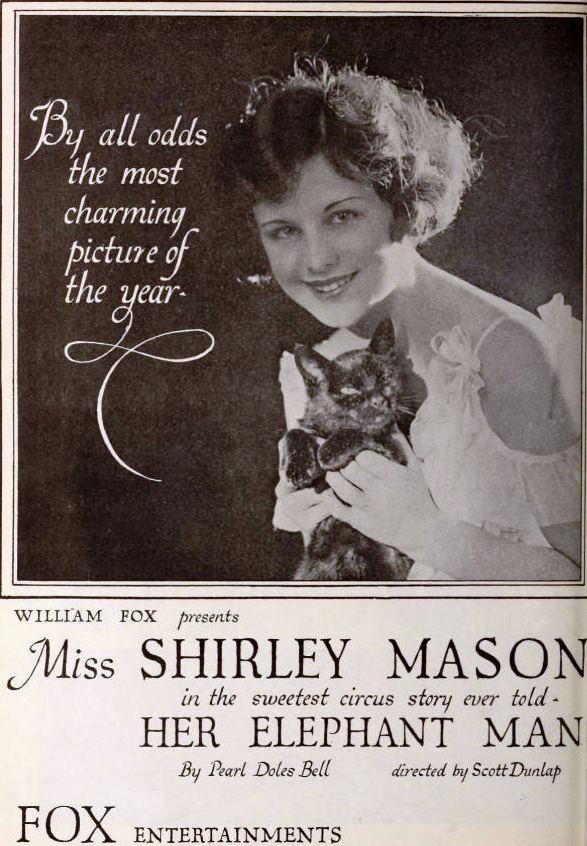
A definitive 7/10 rating for a film that redefined the boundaries of cult cinema. Her Elephant Man remains a cornerstone of transgressive art.
The first time I saw Her Elephant Man—a 35 mm print flecked like a leopard’s coat—its very title felt like a dare. How do you sell a love story stitched to the humiliation of cuckoldry, then freight it with imperial swagger and big-top bravura? Yet this 1920 oddity, directed by the now-obscure J. S. Blackton protégé Wesley Ring, pirouettes on that tension with the reckless grace of Joan herself astride a cantering stallion.
Philip Dorset’s wound is money: specifically, the realization that his marriage certificate doubles as an invoice. Alan Roscoe plays him like a man who has swallowed a diamond and can’t decide whether it cuts or sparkles more on the way down. When he boards a steamer for the Gold Coast, the film swaps Gatsby-esque ballrooms for fever-green vistas achieved through hand-tinted frames that flicker between jade and gangrene. The tonal whiplash is intentional; the picture wants you to feel the scalp prickle under pith-helmet colonialism while never quite relinquishing the scent of peanuts and sawdust.
Enter the circus men: cigar-chewing entrepreneurs who treat Africa like a gigantic prop room. Their dialogue cards—lettered in a font that looks suspiciously like Barnum’s own cigar band—spout lines such as “We need a tusker with temperament; the crowd wants danger they can hum on the trolley home.” Dorset buys in, because penance is cheaper when you’re paying in someone else’s currency of risk.
The discovery of Joan, played by Shirley Mason with eyes wide as communion wafers, is staged like a nativity in negative. She emerges from a hut backlit by equatorial sun, hair bleached to flax, surrounded by Ashanti children whose choreographed curiosity reads half-ethnography, half-chorus line. The film never interrogates the optics of a white orphan becoming the troupe’s mascot; it simply folds her into the menagerie, another exotic to be shipped stateside alongside ivory and parrots.
Time collapses via a dissolve so leisurely you could butter bread with it: suddenly Joan is twenty, her limbs as sure as protractor lines against the back of a galloping Arabian. Dorothy Lee, doubling for Mason in the long shots, performs the sort of thigh-to-neck balances that make you believe human spines were once forged from licorice. The circus sequences, shot inside an actual Ringling tent leased for three winter mornings, exhale authenticity: the air looks thick with oats and kerosene, the light sliced by canvas seams into cathedral blades.
Romance blooms in the negative spaces—between hoof-beats, beneath bleachers, inside the elephant barn where Dorset teaches Joan to speak to pachyderms through eyebrow twitches and palm pressure. Their chemistry is less flirtation than shared stewardship of the oversized. When she finally confesses love via intertitle—"I’d rather share your sawdust eternity than a silk paradise alone"—the card lingers long enough for the organist to milk a minor chord into wet cement.
Of course, Dorset recoils. The script, adapted from Pearl Doles Bell’s pulp serial, understands that melodrama runs on the physics of elastic shame. He bolts, embarking on a whistle-stop tour of self-flagellation that includes, hilariously, a stint as a tar-paper evangelist billed as “The Millionaire Penitent.” Meanwhile, Joan’s star ascends; posters paste her silhouette over whole barn-sides, the bareback queen who tamed grief into geometry.
The cyclone finale—achieved with a combination of miniature tents, wind machines powered by a World War I airplane engine, and double-exposure lightning—remains a technical astonishment for 1920. Canvas rips like wet tissue, horses rear in silhouette against flashing nitrate, and an elephant swings his trunk like a boom mic, searching for footing. Dorset returns, drenched and shirt adherent as if shellacked, to find Joan inside the menagerie wagon, cradling a lion cub that may or may not be a metaphor for their tamed but untamable desire.
Comparative context helps: if Den hvide Slavehandels sidste Offer traffics in the white-slavery panic of a decade earlier, and The King’s Game polishes royal intrigue to patent-leather gloss, then Her Elephant Man occupies a stranger hinterland—part travelogue, part three-hankie weepie, part circus infomercial. Its nearest kin might be His Birthright, another tale of masculine self-exile, yet that film’s Japanese settings feel almost conventional next to Ring’s fever-dream Africa rendered on Fort Lee backlots.
Performances oscillate between stock stillness and flashes of modern interiority. Roscoe’s Dorset has a habit of letting his gaze drop just a half-second before cutting away, as if ashamed the camera caught him feeling. Mason, meanwhile, telegraphs Joan’s arc from foundling to freestanding woman through gait alone: early scenes shuffle in oversized boots; by adulthood she enters every frame like a thrown javelin. The supporting crew—Henry Hebert’s circus boss, Harry Todd’s Shakespeare-quoting clown—provide comic ballast, though Todd’s drunk act now scans as vaudeville surplus.
Cinematographer Gus Peterson shoots dusk scenes through amber filters that make characters appear embalmed in honey, while night exteriors rely on the blue-grayscale palette common to early two-strip processes. The result is a chiaroscuro carnival: faces glow like jack-o’-lanterns, elephants become moving cliff faces. One memorable insert—an elephant’s iris filling the entire frame—anticipates the psychedelic critter close-ups of Incantesimo decades later.
Gender politics, inevitably, fray under scrutiny. The film wants Joan’s economic ascent to read as proto-feminist, yet her autonomy hinges on Dorset’s eventual benediction. When she declares, “I’m no man’s baggage,” the intertitle undercuts itself by placing her on horseback within a ring of male gazers. Still, compared to the sacrificial dolls populating The Girl from Nowhere or the erasure of female agency in Der Mandarin, Joan at least commands narrative real estate.
The score, reconstructed by the Mont Alto Motion Picture Orchestra in 2018, leans on brassy fanfares for the big-top set pieces and a waltz-time lullaby that recurs whenever Joan rehearses her elephant commands. Listened loud, the tuba line vibrates your ribcage like a second heart. Silent-film purists may carp about the anachronistic lushness, but the juxtaposition feels honest to the movie’s own schizophrenia between spectacle and sentiment.
Availability remains spotty: a 2K restoration circulates via sporadic DCP, while Grapevine DVD offers a serviceable if contrast-blown transfer. For streamers, the best bet is European archive portals that rotate licensing every fiscal quarter—search the slug her-elephant-man plus "streaming" in incognito mode to bypass geoblocks.
Bottom line: Her Elephant Man is the missing link between Victorian parlor tragedy and the soon-to-emerge flapper irreverence. It stumbles over colonial clichés, yet its emotional candor about masculine insecurity and female resilience keeps it weirdly alive. Watch it for the storm sequence, stay for the quiet miracle of a love story that chooses forgiveness over revenge, all while an elephant trumpets off-key in the background like a deity who can’t remember the hymn.
IMDb 6.5
1930
Community
Log in to comment.