DbcultAccessing Vault...
7.1/10
Senior Film Conservator
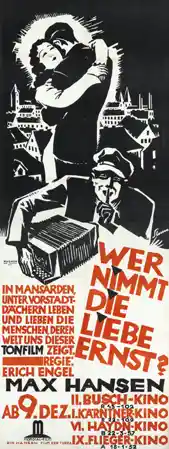
A definitive 7.1/10 rating for a film that redefined the boundaries of cult cinema. Wer nimmt die Liebe ernst...? remains a cornerstone of transgressive art.
Alright, so if you're looking for a shiny, fast-paced modern romance, Wer nimmt die Liebe ernst...? is absolutely not it. This 1931 German film is a genuine relic, a snapshot of early sound cinema that's best enjoyed by folks who already have a soft spot for really old movies.
You’ll probably dig it if you're into seeing how films used to be made, or if you like a story that just sort of meanders along. If you need explosions or even just a plot that snaps into place right away, you might find yourself checking your watch.
The whole thing kicks off with Max Hansen as our protagonist, a small-time crook who's kinda on the run. He stumbles into this fleeting moment of shelter, offered by a woman whose name, I think, is Lissy, played by Jenny Jugo. It's a quick scene, really just a glimpse.
But man, it sticks with him. You see it in his eyes, a kind of bewildered gratitude. He gets this idea in his head, this *need*, to find her again.
What follows is his relentless, almost goofy, quest. He’s not exactly a smooth operator, our Max. He's got this energy, a bit frantic, a bit scatterbrained. Every time he *almost* catches a break, something just slides out of his grasp. It feels very human, that constant near-miss.
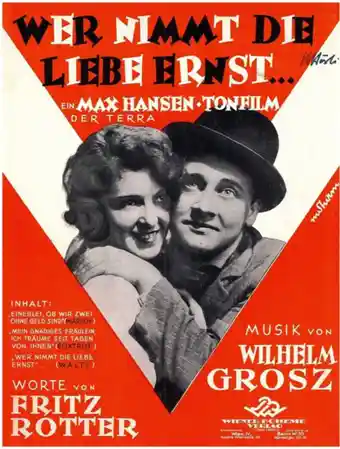
There's this one moment where he spots her in a crowd, and the camera just holds on him, his face lit up with this hope. Then she's gone again, just like that. *Poof*.
Jenny Jugo, as Lissy, has this really understated presence. She doesn't have a ton of dialogue, especially in the early parts. But you understand why Max is so captivated. There's a certain stillness to her, a quiet strength that kinda anchors the chaos around her.
Her initial act of kindness, it wasn't a grand gesture. It was just a simple offering of a safe space. But for Max, it clearly meant the world.
The film itself feels a bit like a chase scene that never quite builds to a fever pitch. You follow Max through these bustling Berlin streets, in and out of cafes and shady dealings. The sound design is very typical for early talkies, a bit flat at times, but it adds to the charm.
Sometimes the background music swells a little too dramatically, *really* trying to tell you that this is a poignant moment.

Max Hansen's performance is the real engine here. He's got this earnestness that makes you root for him, even when he’s being a bit of a klutz. He isn't some dashing hero; he's just a guy who got a tiny piece of kindness and decided it was worth everything.
There’s a scene where he’s trying to sell something shady, and he keeps getting distracted, looking for Lissy. He just can't focus on the task at hand. It’s kinda funny, actually.
The plot itself is simple, almost episodic. Max gets into trouble, he thinks he sees Lissy, he gets into more trouble. It's less about a complex narrative and more about the *feeling* of a guy who just can't let go of a beautiful memory.
And sometimes you just wonder, 'dude, just move on!' But then you remember that little flicker of hope on his face.
It’s a peculiar little film. It doesn’t try to be anything grand. It just shows you a persistent fellow and the woman who accidentally changed his whole outlook. If you’re ever curious about old German films from that specific era, maybe after watching something like M for contrast, this could be a gentle next step.
It’s not a masterpiece, no. But it has this oddly endearing quality. Like finding an old, slightly faded photograph.
IMDb 7.4
1931
Community
Log in to comment.