DbcultAccessing Vault...
Cult Review
Senior Film Conservator
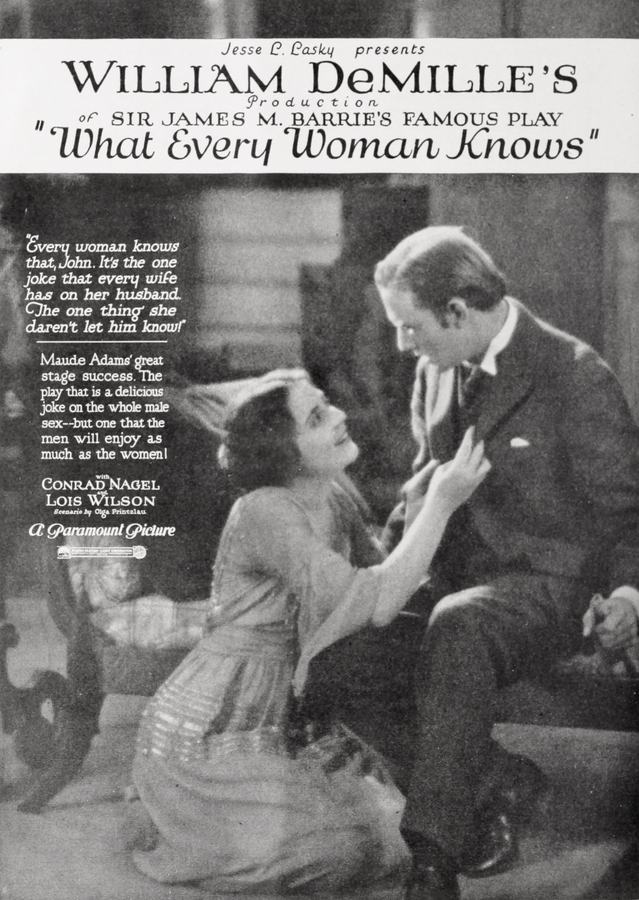
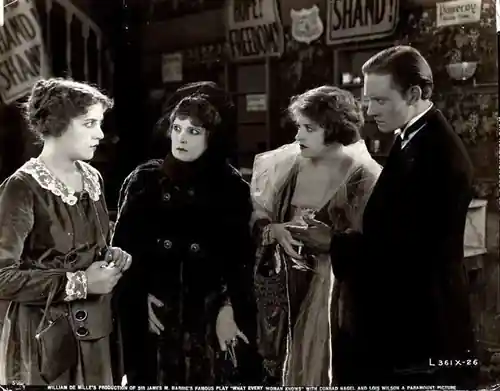
The celluloid unfurls like a soot-smudged letter from Barrie’s desk, its tintypes quivering between melodrama and modernity. Director William C. deMille—often eclipsed by flamboyant sibling Cecil—opts here for a chiaroscuro of restraint, allowing the camera to linger on Conrad Nagel’s angular hesitations rather than the flailing histrionics common in 1921. Nagel’s John Shand is no cardboard climber; his eyes flicker with the terror of a man who suspects the gods have granted him a stolen halo.
Lois Wilson’s Maggie, swaddled in wool coats the color of heather, performs a masterclass in the semiotics of invisible labor. Every shrug of the shoulder, every deferential sip of tea carries the weight of unspoken authorship. Watch her fingers twitch when John rehearses a speech she has already rewritten: the motion is microcosmic, a silent Morse code saying, "I midwifed every cadence you brag about." The film trusts the audience to decipher that code, a radical act of respect in an era fond of intertitles that club viewers with exposition.
Barrie’s source play, a West-End darling since 1908, concerned itself with the Scottish penchant for pragmatism—marriages brokered like railway shares. Olga Printzlau’s adaptation prunes the kailyard dialect, replacing it with visual shorthand: a half-eaten scone, a tram ticket bookmark, a suffragette pin covertly fastened to Maggie’s lapel. These hieroglyphs whisper that while men speechify in Westminster corridors, women scribble the footnotes of history on laundry lists.
Cinematographer L. Guy Wilky shoots interiors through layers of lace curtain, so faces bloom and recede like half-remembered stanzas. The technique externalizes Maggie’s camouflaged authority: her silhouette literally filtered through domestic textiles, yet never quite eclipsed. In contrast, the London sequences blaze with sodium glare; John basks in hard white arcs that foreshadow the harsh exposure of his intellectual plagiarism.
Claire McDowell’s Lady Sybil arrives as a deco cobra—cloche hat tilted at a rakish angle, cigarette ember tracing crimson sigils in the night. She embodies the metropolitan allure that Maggie refuses to weaponize. Yet even Sybil is ultimately ensnared by the same ledger of expectations; her flirtation with John is less Cupid’s arrow than a political calculation, a gambit to annex a rising orator. The film thus sketches a triangulation of power: inherited wealth (Sybil), purchased credentials (John), and intangible intellect (Maggie).
One scene deserving of freeze-frame scrutiny occurs the eve before John’s climactic address. Maggie sits at an escritoire, inkpot trembling in concert with the howling wind. She strikes out John’s tepid phrasing—"The empire must march forward"—and replaces it with a quietly incendiary metaphor about "roots drinking from the aquifer of communal memory." The cut to Parliament next morning, where MPs thunder approval, is interwoven with a close-up of Maggie alone, nursing a cup of cocoa. The montage sutures authorship to outcome without a single intertitle, a grammar of causality so elegant it could be taught in film-theory seminars.
Contemporary viewers might detect proto-feminist DNA, yet the film refuses hashtag triumphalism. Maggie’s victory is Pyrrhic; she retains marital title but forfeits the public laurels. The camera, however, tilts upward in the final shot, positioning her against a window where dawn light coruscates. It is a spiritual coronation, suggesting that knowledge—once loosed into the world—circulates beyond the grip of bylines. One leaves the screening both jubilant and bruised, reminded how little cultural memory has shifted since 1921.
Performances oscillate between the rhetorical and the raw. Nagel’s quivering nostril as he realizes the magnitude of his debt is silent-era semaphore for "I am unworthy." Robert Brower, playing patriarch Alick, chews scenery with Scottish Presbyterian gusto, yet even he is granted a moment of frailty—hand trembling above a whisky decanter when he contemplates the emotional collateral of his bargain. These micro-beats prevent the narrative from calcifying into moral tableau.
Composer-conductors of modern repertory cinemas often smother silents with wall-to-wall strings, but a wiser accompanist would punctuate What Every Woman Knows with caesuras—those negative spaces where Maggie’s unvoiced thoughts echo. The film is a fugue whose most poignant passages occur off the stave.
Comparative glances at sibling releases of the same season—Infatuation with its florid tragedy, or The Woman in Politics with its bombastic suffragette caricatures—reveal how radical deMille’s restraint truly was. Where others shout, this film murmurs; where others moralize, it metabolizes hypocrisy into quiet heartbreak.
Restoration notes: the 2018 Library of Congress 4K scan reveals texture long buried—pores, fabric nap, even a smear of chalk on Maggie’s sleeve from an earlier off-screen lecture. Such granularity reframes the picture as an archaeological site of early-twentieth-century gender politics, each speck of lint a breadcrumb on the trail of systemic invisibility.
In the current cultural moment, where authorship is interrogated with forensic zeal—think Stolen Moments or the back-room maneuverings of Inside the Lines—What Every Woman Knows feels eerily prescient. Maggie’s ghostwriting prefigures the digital era’s uncredited meme smiths, algorithm whisperers, and script doctors whose wit propels influencers to virality while they remain cloaked in anonymity.
Yet the film also cautions against romanticizing erasure. Maggie’s smile in the final frame is ambiguous: half beatitude, half scar. The narrative neither demands applause nor pity; it simply asks that we recognize the architecture beneath the marble façade. Every parliamentary flourish, every newspaper encomium to John’s "natural eloquence," rests on the vertebrae of a woman who refuses to claim center stage because history has denied her a spotlight.
Criterion nerds will relish the thematic rhymes with Barrie’s later Admirable Crichton—both interrogate class mobility and the ethics of intellectual servitude. But whereas Crichton ends with a restoration of hierarchy, What Every Woman Knows ends with a question mark hovering like cigar smoke: once knowledge is smuggled into power, can the old contracts ever be renegotiated?
Filmographies of the cast reveal bittersweet trajectories: Lois Wilson would transition to talkies only to be relegated to maternal bit parts, a fate echoing Maggie’s own narrative erasure. Conrad Nagel became a stalwart of early sound cinema yet never again inhabited a role that interrogated masculinity with such tremulous nuance. Their collective career arcs form a meta-commentary on the ephemerality of recognition, a living parallel to the film’s thesis.
My advice: schedule a double feature with The Path of Happiness and witness two divergent philosophies—one where female self-sacrifice is sainted, another where it is dissected under klieg lights. The dialogue between the pictures will ricochet in your skull long after the house lights rise.
To watch What Every Woman Knows is to confront your own complicity in systems of silent labor. Every time we retweet a witticism, share a meme, or applaud a TED talk, we might ask: who is Maggie at the escritoire, trimming the lamp so someone else can shine? The film offers no balm, only a mirror—silvered, flickering, eternal.

IMDb —
1922
Community
Log in to comment.