DbcultAccessing Vault...
Cult Review
Senior Film Conservator
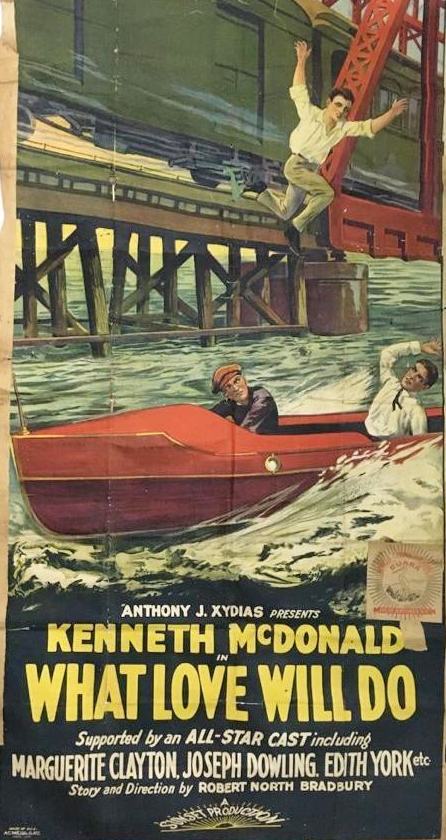
The opening frames of *What Love Will Do* introduce Dale Pemberton (Kenneth MacDonald) as a man whose career has been eclipsed by a lingering curse—an implied hoodoo that haunts his every professional endeavor. The film’s cinematographer captures his desolation through stark, high‑contrast silhouettes against a backdrop of endless cornfields, a visual metaphor for a soul trapped in perpetual twilight. When Pemberton stumbles upon the Gregory farm, the camera lingers on the weather‑beaten barn, the cracked porch, and the weary faces of the family, establishing a palpable sense of place that feels both specific and archetypal.
Amos Gregory (Joseph J. Dowling), the stoic patriarch, is immediately thrust into the narrative’s crucible when three avaricious bankers—agents of urban predation—disappear without a trace. Their vanishing is painted not merely as a crime but as a symbolic indictment of the encroaching capitalism that threatens the agrarian way of life. The screenplay, though uncredited, weaves a tapestry of suspicion, with townsfolk whispering that Gregory’s hands are stained with blood. Pemberton, driven by both professional desperation and a nascent moral compass, resolves to untangle the knot of rumor and fact.
Kenneth MacDonald delivers a nuanced portrait of a man caught between cynicism and hope. His eyes, often framed in tight close‑ups, convey a turbulence that dialogue cannot articulate. Marguerite Clayton, as the Gregory daughter, brings a luminous vitality to the screen; her gestures—soft yet decisive—signal a progressive femininity that was rare for its era. Edith Yorke, portraying the matriarch, provides a grounding presence, her measured cadence echoing the steadiness of the land itself. The ensemble’s chemistry feels organic, each interaction layered with subtext that rewards repeat viewings.
The director’s pacing oscillates between languid, pastoral sequences and rapid, breath‑shortening chase scenes. This dichotomy mirrors Pemberton’s internal conflict: the serenity of the farm versus the urgency of his investigative drive. Notably, the film employs a series of cross‑cutting shots during the climactic revelation, juxtaposing the frantic rustle of a hidden ledger against the slow, deliberate turning of a rusted lock—a visual metaphor for truth emerging from obscurity.
Though the film is rendered in monochrome, the director manipulates lighting to evoke the palette described in the brief: dark orange, yellow, and sea blue. Sun‑drenched fields are bathed in a warm amber glow, achieved through filtered lenses that imbue the scenes with a nostalgic sepia tone, reminiscent of the hue #C2410C. Moments of revelation are punctuated by a sudden burst of stark, almost fluorescent, brightness—an echo of #EAB308—signifying enlightenment. The river that borders the Gregory property shimmers with a cool, cerulean tint, a nod to #0E7490, underscoring the fluidity of truth and the inexorable flow of fate.
The screenplay adheres to a three‑act structure, yet it subverts expectations by interweaving flashbacks that reveal the bankers’ unscrupulous dealings with the Gregory estate. These interludes, presented in a slightly faster frame rate, create a rhythmic contrast that keeps the audience engaged. The resolution—Pemberton’s exoneration of Gregory and his marriage to the daughter—does not feel contrived; rather, it emerges organically from the character’s development, underscoring the film’s thematic emphasis on love as a catalyst for redemption.
At its core, *What Love Will Do* interrogates the intersection of personal affection and societal obligation. Pemberton’s journey from a cursed outsider to a champion of rural justice illustrates love’s transformative power. Simultaneously, the film critiques the predatory nature of urban financiers, positioning the Gregory family as emblematic of a vanishing agrarian ethos. The narrative thus operates on two planes: an intimate romance and a broader sociopolitical commentary, each reinforcing the other.
When juxtaposed with Squire Phin, which also explores the tension between rural tradition and external corruption, *What Love Will Do* distinguishes itself through its romantic subplot and its more pronounced use of visual symbolism. Similarly, the moral ambiguity present in The Brass Bullet finds a gentler echo here, where violence is supplanted by investigative tenacity.
Though silent, the film’s intertitles are crafted with a lyrical economy, each line punctuated by a subtle rustle of paper that mimics the wind across the fields. The accompanying musical score, historically performed live, weaves a motif that alternates between a plaintive violin (for moments of yearning) and a staccato brass section (for scenes of tension), reinforcing the emotional beats without overwhelming the visual narrative.
The set designers painstakingly recreated a turn‑of‑the‑century farm, complete with weathered wooden fences, a rusted plow, and a modest kitchen where the Gregory family shares meals. These details ground the story in a tangible reality, allowing viewers to immerse themselves fully. The authenticity extends to the costumes: Pemberton’s threadbare coat, the daughter’s simple yet elegant dress, and the bankers’ crisp suits—all serve as visual shorthand for class distinctions.
Contemporary reviews praised the film’s “heartfelt portrayal of love’s capacity to heal” while noting its “unflinching look at rural exploitation.” Modern scholars appreciate its layered storytelling and its subtle critique of early 20th‑century capitalism. The film’s endurance in academic circles can be attributed to its deft balance of genre conventions and thematic depth.
Though not as widely cited as some of its peers, *What Love Will Do* paved the way for later silent dramas that intertwined romance with social critique. Its visual language—particularly the use of color symbolism in a monochrome medium—has been referenced in retrospectives of silent cinema, influencing directors who seek to embed chromatic meaning without actual color.
The film’s craftsmanship lies in its ability to convey complex emotional currents through restrained performances, meticulous set design, and a deliberate pacing that respects the audience’s intelligence. It invites viewers to contemplate how love can act as both shield and sword, protecting the vulnerable while dismantling injustice. In an era where silent storytelling demanded visual ingenuity, *What Love Will Do* stands as a testament to the power of narrative economy paired with artistic ambition.
IMDb 6.9
1928
Community
Log in to comment.