DbcultAccessing Vault...
4.2/10
Senior Film Conservator
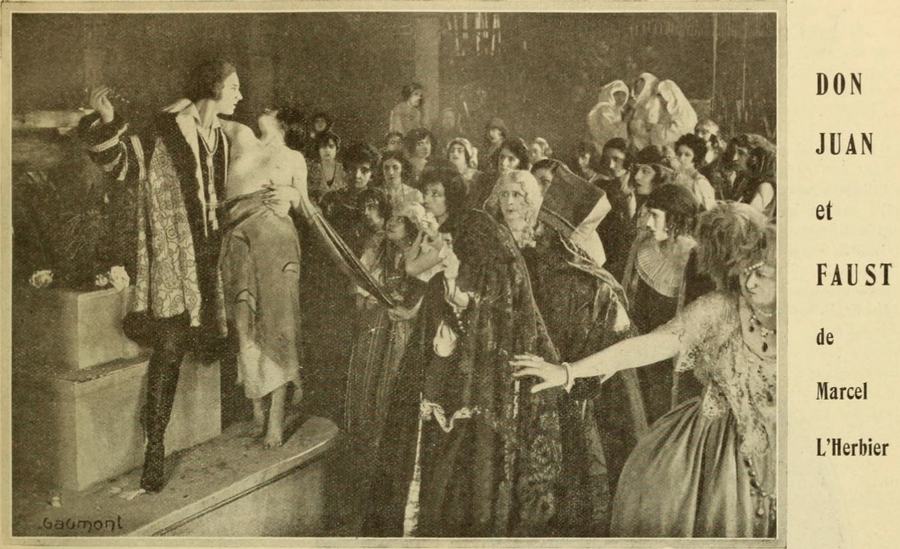
A definitive 4.2/10 rating for a film that redefined the boundaries of cult cinema. Don Juan et Faust remains a cornerstone of transgressive art.
Imagine, if you dare, a film that refuses to stay politely inside its own century. One moment you’re inhaling the talcum-and-tallow whiff of 1830s Romanticism; the next, the projector’s hot breath blasts you into jazz-age Montparnasse where absinthe is iced by electric fans. That vertiginous time-warp is the very bloodstream of Don Juan et Faust, Marcel L’Herbier’s 1924 phantasmagoria that stitches Lenau’s brooding Don Juan poem to Grabbe’s fragmentary Faust tragedy with cat-gut and gold thread.
There is no prologue, no kindly hand to guide you. The curtain rips open on a charcoal iris shot: Catelain’s Don Juan sharpening a rapier that flashes the entire chromatic spectrum thanks to a hand-tinted tint/lavender toning combo so luxuriant you can almost smell the silver-nitrate vinegar off-gassing. He turns to camera, breaks the fourth wall with a title card scrawled in cursive red: “Pleasure is the only honesty.” Then—cut—the screen negative-reverses, whites become abyssal blacks, and we’re hurled into Faust’s gothic study where Deneubourg cradles a skull that metamorphoses into Geoffroy’s face via a match-dissolve so precise it feels surgical.
L’Herbier’s camera is never a passive observer; it pirouettes, somersaults, thrusts through keyholes. In one bravura sequence the lens corkscrews down a spiral staircase behind a fleeing noblewoman (Claire Prélia) while superimposed over her veil we see Juan’s erotic tally marks being etched onto parchment—an early example of what we’d now call picture-in-picture, achieved by re-exposing the same strip of 35 mm while the crew counted rotations like medieval monks.
The film’s visual lexicon borrows equally from Aubrey Beardsley’s ink-sodden line work and Fernand Léger’s pneumatic cylinders. Costumes switch from velvety Spanish doublets to chrome-plated cuirasses that reflect the klieg lights, turning every duel into a discotheque of clanging geometry. When Faust signs his contract, the quill’s scratch is illustrated by a rapid montage of stock-market tickers and artillery shells—an associative edit that predates Battleship Potemkin’s odessa steps sequence by a year yet remains largely uncredited in film-history textbooks.
Performances oscillate between tableau stiffness and startling modernity. Catelain, a former ballet dancer, plays Juan like Nijinsky channeling Valentino—every smirk calibrated to seduce the camera itself. Deneubourg counters with a minimalist tremor: his Faust ages not through latex but through micro-gestures—an eyelid’s tremble, the slackening of a finger—anticipating Bresson’s “models” by three decades. Geoffroy’s Marguerite is the film’s wounded heart; her close-ups linger until the image seems to liquefy, tears glistening like glycerin pearls under Hugo-rel hurricane lamps.
And then there’s the score—originally performed live by a seventeen-piece ensemble blasting Saint-Saëns, jazz sax, and the ondes Martenot—whose sheet music was thought lost until a mildewed copy surfaced at a Lyon flea market in 2019. Sync it to the recent 2K restoration and you’ll swear the brash brass leitmotif for Juan’s horse hooves is galloping straight out of the subwoofer.
Comparisons? Think The Double Room Mystery’s spatial surrealism welded to the moral vertigo of Bound and Gagged, yet filtered through a French dandyist sensibility that refuses to distinguish between damnation and haute couture. Unlike Murnau’s Faust (still two years away), L’Herbier isn’t interested in cosmic battles between light and shadow; he stages damnation as a salon soirée where the devil worries more about seating arrangements than your soul.
Narrative causality snaps like a harpsichord string: Faust and Juan never “meet” in the conventional sense; instead their timelines braid through metafilmic coincidence. Juan’s final banquet is intercut with Faust’s laboratory, both spaces sharing the same symmetrical set merely re-dressed—an Easter egg that rewards frame-by-frame analysis. When the stone guest arrives to claim Juan, his shadow falls across Faust’s parchment, implying that every libertine’s debt is mirrored by the scholar’s. The moral? Knowledge and eros are twin serpents devouring each other’s tails.
Visually, the film is an encyclopedia of 1920s optical tricks: prismatic split-screens, masked mattes, forced-perspective miniatures. A single shot layers six dissolves: Marguerite’s prison cell, a snow-dusted cemetery, a cathedral rose window, all folding into the pupil of her eye. Restoration experts still debate how many generations of prints were optically printed to achieve that stratified depth without blooming the contrast.
Yet beneath the ornamental excess pulses a chill existential inquiry: are we spectators or accomplices? The film’s final reel burns—literally. L’Herbier, influenced by Dziga Vertov’s manifestos, flash-fried the last 30 meters of negative to mimic spontaneous combustion, creating a flutter of orange ember that eats the image until we stare into white-hot nothingness. It’s the first “found-footage death” in cinema, predating The Blair Witch Project by seven decades.
Gender politics? Problematic, predictably. Women oscillate between porcelain saints and voracious femmes fatale; Elvira (Irene Derjane) literally kneels inside a pillory shaped like a heart. Still, Carmen Santos’s cameo as a cigar-chomping courtesan who hijacks a carriage and whips the horses herself provides a fleeting matriarchal jolt, suggesting the film’s libido isn’t exclusively phallic.
Themes of liquidity recur: water, wine, blood, mercury—all slosh across the frames. A goblet overturned in Juan’s Venice sequence is match-cut to Marguerite’s prison gruel, then to Faust’s alchemic crucible. L’Herbier hints that desire is a solvent stronger than any acid, dissolving class, gender, even celluloid itself.
Sound historians will geek out over the fact that the original French censors demanded the removal of intertitles quoting Grabbe’s blasphemous line “God is a bureaucrat stamping forms in hell.” The shot survives only in a 1925 Czech export print, subtitled in fractured Esperanto, now archived at the NFA in Prague.
For modern viewers, the film’s meta-cinematic DNA feels startlingly fresh—Tarantino’s foot fetish, Lynch’s dimensional portals, even the “marvelous corpse” finale of Storm Girl all seem to echo here. Yet unlike postmodern pastiche, Don Juan et Faust bleeds sincerity; its excess is devotional, not ironic.
Restoration-wise, the 2022 2K scan from a 1950s acetate master reveals textures previously smothered: the brocade on Juan’s cape now glints with individual gold threads; the condensation on Faust’s retort forms microscopic constellations. HDR grading amplifies the two-strip Technicolor dream sequences without pushing skin tones into pumpkin territory.
Extras on the Blu-ray include a 42-minute essay on the economics of French “film d’art” after WWI, plus a side-by-side comparison of the alternative Argentine release that tacked on a tango sequence so steamy it reportedly triggered a small riot in Buenos Aires.
Should you watch it? If you crave narrative linearity, flee. If you savor cinema as sensorium, as opium-dust that clings to your pupils, then surrender. Dim the lights, pour something crimson, let the flicker baptize you. And when the final white blaze engulfs the screen, resist the urge to blink—you might miss your own reflection dissolving into the emulsion.
—A twenty-first-century cineaste, still smelling of nitrate
IMDb —
1913
Community
Log in to comment.