DbcultAccessing Vault...
Cult Review
Senior Film Conservator
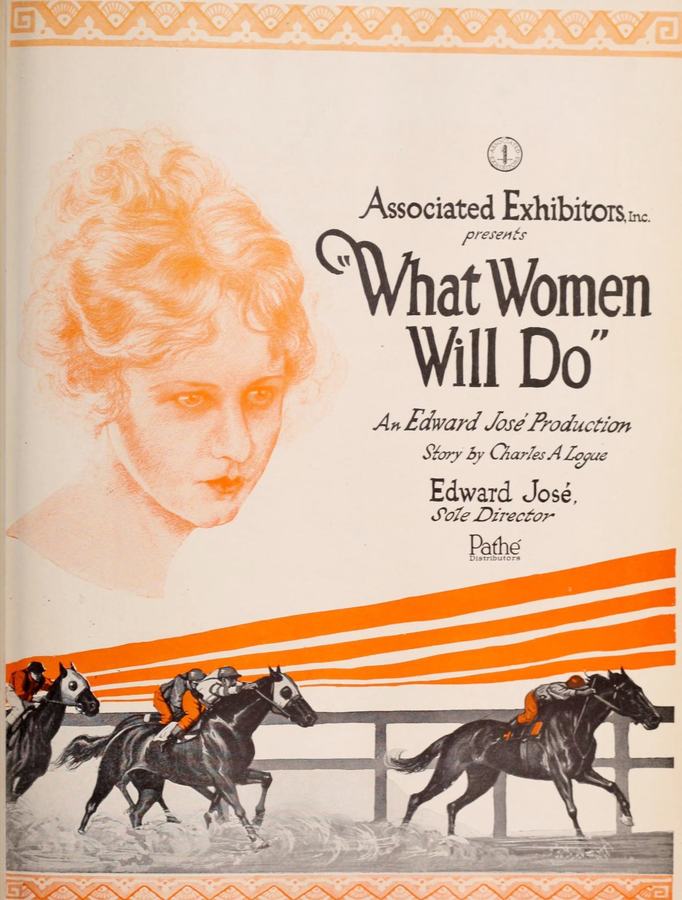
The first time we see Lily Gibbs she is counting nickels under a buzzing arc light, her pupils dilated like a nocturnal animal suddenly caged in klieg glare. Director Charles E. Whittaker lets the camera linger until the nickel in her fingers becomes a silver moon—an omen that every coin in this film will flip, every allegiance will invert, every soul will betray its own reflection before the iris closes.
What Women Will Do is a 1920 five-reel jolt of chloroform-scented noir released at the exact moment when Victorian spiritualism was bleeding into Jazz-Age grift. The picture survives only in fragmentary prints—nitrate blossoms curling like onion skins—yet even mutilated it radiates the chill of a confession whispered through keyholes. The plot is a confidence trick wrapped inside a ghost story stuffed into a redemption arc, stitched with a needle still warm from hell’s sewing kit.
Mrs. Wade’s house, shot in low-angle tableaux that prefigure German expressionism, looms like a mausoleum mistaken for a home. Its corridors are paved with the hides of endangered species; its chandeliers drip tallow that once illuminated abolitionist parlors and now lights séance charades. Into this mausoleum steps Lily, costumed in the dead son’s matrimonial fantasy—lace bodice cinched until her ribs confess counterfeit lineage. Jane Jennings plays her with the brittle poise of a woman who has learned to breathe through pain the way a flute learns to make music through forced air.
The séance sequence—lit entirely by a single candle passed hand-to-hand—remains one of the most erotic passages of early cinema, not because of skin (there is none) but because belief itself is stripped naked. The medium, a glowering Dr. Joe, intones planchette gibberish while his gloved thumb strokes Lily’s wrist under the table, a private Morse that whispers: remember who owns you. Anna Q. Nilsson’s Mrs. Wade watches through widow’s weeds that resemble judicial robes, her face a battlefield where hope and skepticism exchange artillery.
George Majeroni’s Dr. Joe is all velvet malpractice: when he removes his pince-nez the lenses retain the room’s reflection so that for a split second two tiny Lily’s appear trapped inside the glass—an accidental visual poem about surveillance. Earl Metcalfe’s Jim Corling, by contrast, is a cigarette ember in human form, burning down whoever draws too close. Their double-death—Jim garroted by a window-sash weight, Joe tumbling down a servant’s stairwell into a vat of photographic fixer—feels less like divine retribution than like the universe tidying up loose ends with an almost domestic indifference.
Arthur Brent, played by Allan Forrest with the bashful rectitude of a boy who still presses flowers in hymnals, arrives as the moral hinge. His courtship of Lily is conducted in a greenhouse where orchids exhale forbidden perfumes; when he snaps a bloom from its stem the pop of the ruptured vein mirrors every rupture in Lily’s manufactured identity. Note the color symbolism: Brent wears linen the shade of unwritten paper, while Lily’s gowns progress from soot-black to dove-grey to bridal white—not a moral gradient but a palimpsest being scraped clean before our eyes.
Whittaker’s montage is a card-shark’s flourish. In one cut we leap from a close-up of Lily’s pupils—huge as trolley tokens—to a long shot of Mrs. Wade placing those same tokens in the dead son’s overcoat pocket, a memento mori that collapses three years of grief into ten feet of celluloid. Intertitles, penned by Charles Logue, snap like rubber bands: “She sold her name for silk—then found her name was the only thing that couldn’t be repossessed.” The epigrammatic sting lands harder than most dialogue scenes in contemporaneous talkies.
Compare this editorial dexterity to the languid longueurs of Niniche or the pastoral stasis of The Swagman’s Story; What Women Will Do is jitterbug modernity trapped inside a Victorian ghost, a dialectic that makes the film feel like it was spliced yesterday yet haunted tomorrow.
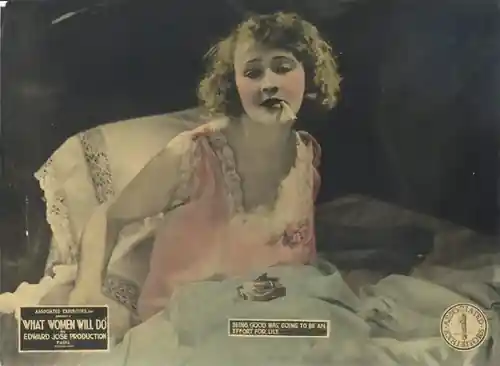
Silent cinema is often accused of objectifying women through fetishistic close-ups; here the reverse occurs. The camera ogles the men’s desperation: Dr. Joe’s twitching knuckles, Jim’s dilated nostrils, Arthur’s trembling Adam’s apple as he fingers the engagement ring like a loaded gun. Lily’s face, by contrast, is frequently obscured—turned toward window-light, reflected in mirrors, half-shadowed by veils—suggesting that her interiority is inviolate, a fortress the narrative can besiege but never quite breach.
When she finally confronts Mrs. Wade, the scene is shot from Lily’s height: the dowager looms, a colossus of grief, yet the low angle empowers the supplicant; we perceive not contrition but a coup d’état of conscience. The forgiveness that follows is not absolution granted but sovereignty ceded—an matriarchal abdication that rewrites the power grid of the entire mansion.
Seen today, the film’s tinting strategy feels avant-garde: amber for interiors (the color of preserved specimens), cerulean for exteriors (the shade of drowned hopes), and a sudden crimson wash when Lily discovers the murderous truth—a hemorrhage of knowledge. Because the nitrate has warped, these colors bleed at the edges, creating a halo that makes every figure look freshly sanctified or eternally damned, depending on the viewer’s latitude of mercy.
Accompanied by a contemporary pianist willing to lean into dissonance—minor seconds stomping like hobnailed doubt—the picture acquires a sonic afterlife. In the climactic stairwell struggle, if the keyboard hammers a low C and sustains it until the soundboard rattles, you can feel the moral ground tilt; the audience senses that the real victim is not any single character but the very possibility of trust.
Historians grouping What Women Will Do with other society-crook melodramas like Barriers of Society or A Baby Doll Bandit miss the film’s metaphysical sting. Its true siblings are the liminal nightmares: The Ghost Girl where identity is ectoplasm, or Vengeance and the Girl where revenge is a matrimonial vow. Yet none of those pictures grant the con-woman interior thunder; they linger on the mechanics of scam. Here the séance is not climax but catalyst—the moment when the swindle becomes secondary to the swindler’s self-reckoning.
Critics who demand moral clarity will gag on the ending: Lily keeps the pearls, the mansion, the social station. Mrs. Wade, rather than prosecuting, bankrolls the wedding. Brent, the ethical anchor, winks at the ledger of sins because love, he implies, is a higher accounting. The film refuses to punish ambition in a woman when it would applaud the same trait in a man—a feminist stance so sly it slips past the censors disguised as sentiment.
Watch the last shot frame-by-frame: Lily and Brent descend the mansion’s marble steps amid rice-throwing servants. For a single frame—twenty-fourth of a second—a smudge of nitrate damage creates a black tear across Lily’s cheek. Is it decay, or is the film itself weeping for every woman who had to forge her own absolution because the world refused to grant it? Either way, the tear dries before the next frame, leaving only the afterimage of conscience—a ghost more durable than any spirit the medium conjured.
In an era when Hoop-La celebrates the circus and Das rosa Pantöffelchen pirouettes in pastel fluff, What Women Will Do insists that the most daring spectacle is a woman rewriting her own mythology by lantern light. That the print survives only in shards feels appropriate: like Lily, the film wears its fractures as jewelry, proof that something broken can still glitter fierce enough to cut the dark.

IMDb 4.5
1927
Community
Log in to comment.