DbcultAccessing Vault...
Cult Review
Senior Film Conservator
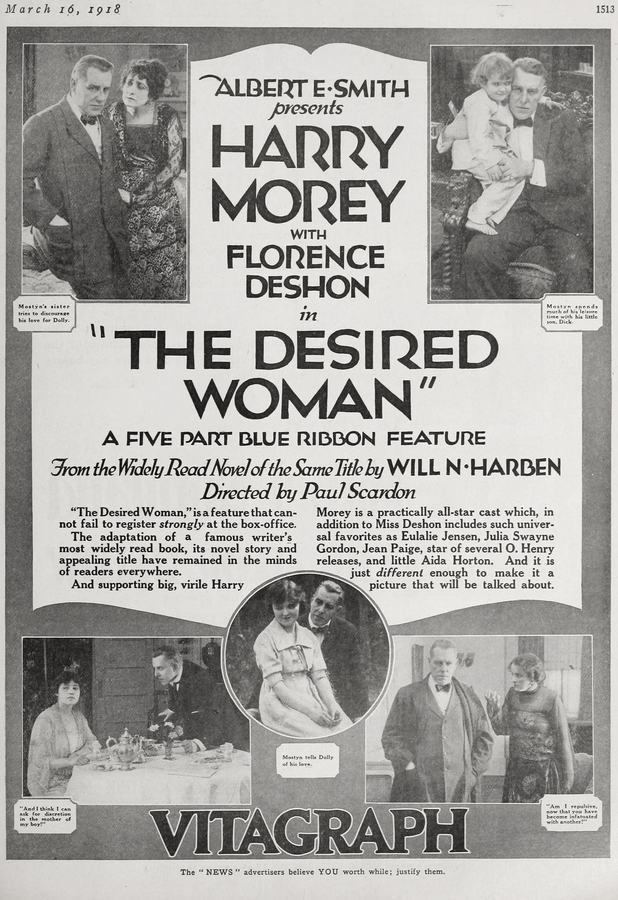
In the annals of silent cinema, specifically within the prolific output of the late 1910s, few films capture the oscillating pendulum between metropolitan cynicism and rural piety with as much gravitas as The Desired Woman. Released in 1918, a year defined by global upheaval, this Vitagraph production serves as a poignant microcosm of the American psyche’s internal conflict. It is a narrative that eschews the simplistic binaries of melodrama in favor of a more nuanced, albeit tragic, exploration of the human condition. The film, directed with a keen eye for atmospheric contrast, presents a world where the soul is a commodity frequently traded for social standing, only to be reclaimed through the fire of personal devastation.
The film opens with an almost transcendental depiction of the Tennessee hills. Here, the cinematography captures a sense of timelessness that stands in stark opposition to the frenetic energy of the New York stock exchange. Richard Mostyn, portrayed with a brooding complexity by Charles Hutchison, is the quintessential urban interloper. His arrival in this pastoral Eden is not merely a vacation but a collision of two disparate realities. When he encounters Dolly Drake (Florence Deshon), the schoolteacher whose simplicity is her greatest strength, the film flirts with the aesthetics of a bucolic romance. Unlike the lighter rural themes found in Johanna Enlists, the atmosphere here is heavy with the portent of inevitable betrayal.
The visual language employed to depict Mostyn’s return to New York is jarring. The shadows grow longer, the interior sets more claustrophobic. The transition from the open vistas of the South to the gilded cages of Manhattan high society serves as a visual metaphor for Mostyn’s shrinking moral horizon. This thematic shift mirrors the dark trajectories seen in European contemporaries like Topiel, where the environment acts as a corrosive agent on the protagonist’s ethics.
Mostyn’s marriage to Irene Mitchell (Julia Swayne Gordon) is presented not as a union of souls, but as a transaction of status. Gordon delivers a chillingly effective performance as a woman for whom marriage is a social necessity rather than an emotional bond. Their domestic life is a masterclass in silent tension, punctuated by the presence of their son, Dick. The child represents the only vestige of Mostyn’s humanity, a fragile link to the purity he discarded in Tennessee. The film’s portrayal of this unhappy marriage echoes the domestic disillusionment found in Assigned to His Wife, yet it carries a much heavier spiritual burden.
The tragedy of the child’s death on the operating table is the film’s most harrowing sequence. It is a moment of profound cinematic cruelty that serves a specific narrative purpose: the total dismantling of Mostyn’s ego. The surgeon’s failure is not just a medical one; it is a cosmic signal that Mostyn’s world of material success and social climbing is built on sand. The loss of the child acts as a catalyst for Irene’s departure, as she flees back to the arms of a former lover, leaving Mostyn in a vacuum of his own making. This sequence invites comparison to the heavy moral reckoning of Urteil des Arztes, where the medical profession intersects with profound ethical dilemmas.
When a broken Mostyn returns to the Tennessee hills, the audience is conditioned to expect a traditional happy ending—the prodigal son returning to his first love. However, the screenwriters, Edward J. Montagne and William Nathaniel Harben, subvert these expectations with a brutal realism. Dolly Drake is no longer the static ideal Mostyn left behind; she is a woman who has moved forward, her heart now belonging to Mostyn’s business partner. This rejection is perhaps more painful than the death of his son, as it signifies the permanent loss of his former self. Unlike the characters in Cheerful Givers, who find solace in simple benevolence, Mostyn finds that his path to earthly happiness is irrevocably blocked.
This narrative choice elevates The Desired Woman above the standard fare of its era. It acknowledges that time is a linear, destructive force. The hills of Tennessee, once a sanctuary, are now a mirror reflecting Mostyn’s failures. The film shares this sense of inescapable fate with Far from the Madding Crowd, where the landscape itself seems to participate in the characters' trials.
The final act of the film, where Mostyn turns to religion and becomes an evangelist, is often misinterpreted as a simplistic "moral of the story." In reality, it is a complex psychological pivot. Having lost his son, his wife, his social standing, and his hope for romantic redemption, Mostyn’s turn to the pulpit is an act of survival. It is the only space left where his suffering can be given meaning. This transition into the religious sphere is a common trope in silent drama, seen in works like As Ye Sow and Du sollst keine anderen Götter haben, yet here it feels uniquely earned through the sheer scale of the protagonist's loss.
As an evangelist, Mostyn is no longer seeking "The Desired Woman" of the title; he is seeking a divine reconciliation. The title itself becomes ironic by the film's conclusion. The woman he desired was never Dolly, nor Irene, but a version of himself that was lost the moment he chose the city over the soul. The film suggests that the ultimate desire is not for another person, but for a state of grace that can only be achieved through total renunciation of the material world. This echoes the philosophical depth of The Broken Law, where the legalities of man are superseded by higher spiritual truths.
Technically, the film is a testament to the sophistication of Vitagraph’s production standards in 1918. The lighting in the New York sequences is particularly effective, using high-contrast setups to emphasize Mostyn’s isolation. The performances are restrained, avoiding the over-the-top gesticulation that plagued many lesser films of the period. Eulalie Jensen and Harry T. Morey provide strong supporting turns that flesh out the social milieu of the time. While it may not have the surrealist leanings of Zelyonyy pauk or the adventurous spirit of Some Boy, it possesses a grounded, somber intensity that remains compelling.
In comparison to other dramas of the era like Ten of Diamonds or the character-driven Jaffery, The Desired Woman stands out for its refusal to provide easy comfort. It is a film about the consequences of choice, the permanence of loss, and the arduous road to redemption. It captures a specific American anxiety about the loss of innocence in the face of industrial and financial progress—an anxiety that remains relevant over a century later. Even when compared to films dealing with the deadly sins like Sloth, Mostyn’s journey is more about the sin of omission—the failure to cherish what is truly valuable until it is gone.
Ultimately, The Desired Woman is a haunting experience. It reminds us that while we may seek to return to our own personal Tennessee, the person who left can never truly go back. The film concludes not with a celebratory hymn, but with a quiet, dignified acceptance of a life redirected. It is a vital piece of silent cinema history that deserves a modern reassessment, not just as a period piece, but as a profound meditation on the cost of the American Dream. If you find yourself intrigued by tales of high-stakes diplomacy and moral intrigue like A Diplomatic Mission, you will find in Mostyn’s spiritual journey a different, yet equally compelling, kind of negotiation—one involving the very soul of a man.
IMDb 5.2
1926
Community
Log in to comment.