DbcultAccessing Vault...
Cult Review
Senior Film Conservator
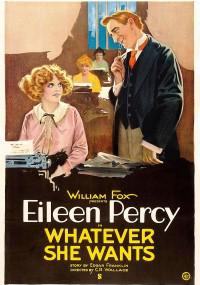
In the shadowed corridors of 1930s industrial ambition, Whatever She Wants unfolds as a chiaroscuro study of female agency and the corrosive allure of deception. Enid North, portrayed with a simmering intensity by Eileen Percy, is not merely a character but a cipher for the era’s conflicted ideals of womanhood. Her engagement to manufacturer John Barr, a man whose financial acumen is eclipsed by his emotional obtuseness, sets the stage for a narrative where professional empowerment becomes both armor and vulnerability.
The film’s opening act is a masterclass in restrained tension. Enid’s covert enrollment in business courses—a subterfuge born of necessity and curiosity—positions her as a proto-feminist figure, though the script’s gendered constraints complicate this reading. Her infiltration of Barr’s office, facilitated by a complicit general manager, is less a triumph of cunning than a tragicomedy of miscalculation. The power dynamics here are razor-sharp: Enid’s competence threatens the male hierarchy, while her secrecy renders her complicit in the very system she seeks to transcend.
The midpoint’s social entanglements—particularly Enid’s fateful visit to a roadhouse with the morally ambiguous Amos Lott—elevate the film into a darker register. Lott, played with a suave fragility by Otto Hoffman, embodies the archetype of the married man seduced by romantic escapism. The near-arrest by detectives, mistaking Enid and Lott for criminals, is a narrative non sequitur that feels less like a plot contrivance and more like a metaphor for the precariousness of her double life. The subsequent clash with Lott’s wife, a scene brimming with unspoken class resentment, underscores the film’s thematic preoccupation with societal hypocrisy.
John Barr’s surveillance of Enid, revealed in the film’s penultimate act, transforms the narrative into a cat-and-mouse game of psychological warfare. The decision to frame this confrontation in a dimly lit office—a space that symbolizes both her professional aspirations and her entrapment—highlights director Edgar Franklin’s visual economy. The dialogue here is terse, almost clinical, as if to suggest that Barr’s anger is less about betrayal and more about the existential threat posed by Enid’s self-sufficiency.
The film’s denouement—Enid’s tearful plea for forgiveness—is a masterstroke of emotional ambiguity. Is it a capitulation or a recalibration of power? The script leaves this unresolved, a deliberate choice that reflects the period’s fraught negotiations of gender roles. Eileen Percy’s performance is the linchpin of this ambiguity; her eyes, wide and luminous, convey a spectrum of defiance and vulnerability that defies simplistic characterization.
Comparisons to contemporaneous films like The Bugler of Algiers and Laughing Bill Hyde reveal Whatever She Wants’s unique textual identity. Unlike the exuberant escapism of the former, Franklin’s film is a chamber piece of intimate strife. Its pacing, though occasionally plodding, mirrors the internal monologue of a woman negotiating her place in a world that alternately lionizes and menaces her.
Visually, the film employs a muted palette that mirrors its protagonist’s emotional palette. The office scenes, awash in sepia tones, contrast sharply with the neon-lit roadhouse, a symbolic nod to the duality of Enid’s existence. Camera movements are deliberate, often lingering on empty spaces to evoke the isolation of her choices. This aesthetic restraint, however, occasionally undermines the film’s dramatic potential, particularly in the climactic confrontation with Barr, where a more dynamic mise-en-scène might have heightened the stakes.
The supporting cast, while competent, struggles to match Percy’s magnetic presence. Richard Wayne’s portrayal of Barr is a study in understatement, his stoicism bordering on affectlessness—a choice that, while faithful to the script’s themes, risks rendering him a cipher. Herbert Fortier’s turn as the general manager, a character who could have been a narrative linchpin, is disappointingly underwritten, his complicity in Enid’s deception left unexplored.
Thematically, the film’s exploration of autonomy is both its strength and its limitation. While Enid’s professional ambitions are framed as progressive, the narrative’s resolution—a return to the fold, albeit with a conditional grace from Barr—suggests a compromise with the very structures it critiques. This tension between radicalism and reconciliation is a hallmark of 1930s cinema, a period when Hollywood often sanitized subversive themes for mass appeal.
In the broader cinematic landscape, Whatever She Wants occupies a niche between the pre-Code audacity of The Heiress at Coffee Dan’s and the moralistic cautionary tales of The Sacrifice of Pauline. Its unresolved ending and complex protagonist make it a precursor to the psychological dramas of the 1940s, yet its narrative conventions remain firmly rooted in the romantic melodrama of its era.
The film’s most enduring legacy may lie in its portrayal of professional women, a subject that remains as contentious as it is relevant. Enid’s journey—from secret student to office confidante to embattled fiancée—mirrors the real-world struggles of women navigating male-dominated spaces. While the script’s gender politics are undeniably of their time, its exploration of ambition and identity transcends the period, offering a template for modern narratives about women’s agency.
In conclusion, Whatever She Wants is a film of quiet audacity, its power lying not in spectacle but in the subtlety of its character study. It may lack the operatic grandeur of The Drifters or the swashbuckling energy of The Rainbow Girl, but its introspective focus and nuanced performances render it a compelling artifact of 1930s cinema. For viewers seeking a drama that balances personal and professional turmoil with a touch of moral ambiguity, this film remains a rewarding, if imperfect, journey into the heart of a woman’s struggle for self-determination.

IMDb —
1936
Community
Log in to comment.