DbcultAccessing Vault...
Cult Review
Senior Film Conservator
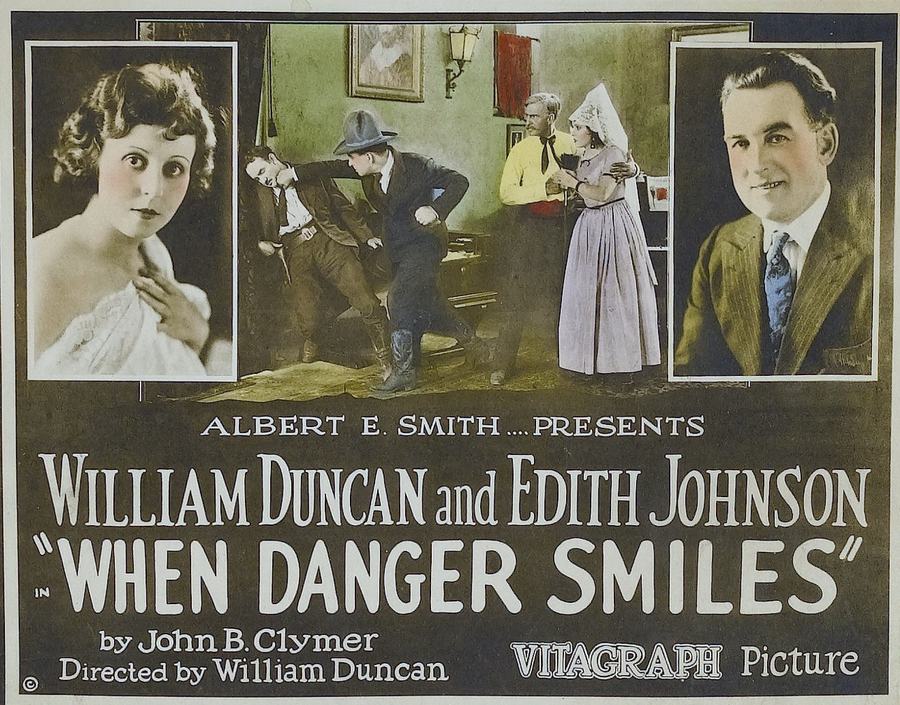
The first time we see Frania Caravalle she is a negative space in white lace, a chiaroscuro ghost whose only passport into narrative memory is the orchid perfume that lingers on Ray Chapman’s tuxedo lapel. Director William Duncan—moonlighting here as both star and show-running auteur—understands that in 1923 the close-up is still a confession booth; he keeps Edith Johnson’s face swaddled in netting, a veil thick as moral fog, so that when the same woman later leans over a convalescent stranger her identity becomes a palimpsest of silhouettes rather than a fact. It is a stunt of pure visual rhetoric: identity as something that can be peeled, misplaced, weaponized.
The film’s core engine is not love but misrecognition, a screw that tightens until it shears. Ray’s concussion after the botched robbery functions like anterograde amnesia in a Greek tragedy: he can pact away his future but cannot anchor it to the past. In the Caravalle parlor—an Iberian mausoleum crowded with wrought-iron candelabra and oil portraits whose eyes have been scratched out by creditors—Francisco Caravalle offers his daughter as though she were a parcel of cacao futures. The scene is blocked like a last supper: father at center, lawyers flanking, Ray flattered into treason against his own memory. Duncan lets the camera dolly in until the engagement contract fills the frame, the ink still glistening like fresh blood on a promissory note.
What follows is a masterclass in how silent cinema can weaponize intertitles. Frania’s first written line after the betrothal—“I would rather wed the plague”—arrives on a card edged with black, a typographical shriek that lands harder than any spoken dialogue could. Her subsequent conspiracy with Jacob Holnar is rendered in a brisk montage of guttering candles, torn photographs, and a single white glove dropped on a chaise longue, a synecdoche for the violence she is willing to outsource. The film refuses to psychoanalyze her; instead it watches her pupils dilate until they become twin keyholes through which vengeance peers.
Jacob Holnar, played by Henry Hebert with the sleek cruelty of a greased ferret, is the era’s archetype of the decadent villain: waxed mustache, kid gloves, a walking stick whose silver knob unscrews to reveal a stiletto. Yet the screenplay by Bradley J. Smollen and John B. Clymer grants him a single, unsettling moment of pathos. Alone in his lodgings he rehearses the murder by strangling a pillow, then collapses weeping into the feathers. The shot is lit from below, turning his face into a gargoyle that sweats brine, and for three flickering seconds the audience is invited to pity the monster who knows he is already damned.
The botched assassination—intended for Ray but claimed by Jim Barker—unfolds in a lumber mill whose machinery becomes a threnody of industrial dread. Gears grind, bandsaws howl, and the fatal bullet is masked by the hiss of steam valves, a sonic sleight-of-hand that the silent medium translates into pure visual cacophony. Cinematographer Charles E. Kaufman cranks the shutter speed so that the sawdust hangs like galaxies, each fleck a mute witness. When Jim’s body crumples into the hopper, the camera tilts to God’s-eye vantage, reducing human demise to one more input in the production line. It is the film’s bleakest commentary: conscience processed into sawdust.
Ray’s manhunt occupies the narrative’s feverish third act, a concatenation of torchlight mobs and church-bell klaxons that feels like D. W. Griffith crossed with German expressionism. The lynch rope is braided from new hemp, pale as unripe wheat, and when it tightens around Ray’s neck the screen irises in until only the rope and throat remain—a vulgate crucifixion lit by lightning. Here Duncan the performer sacrifices his own body to the lens: veins distend, eyes hemorrhage, sweat paints his shirt translucent. The sequence is so ferocious that trade papers of the day reported projectionists in Kansas cutting the reel short, fearing riots.
Salvation arrives not via cavalry but via equine id—the horse Thunderbolt, Ray’s sole constant memory, who charges through the square trailing the noose like a pennant. The gag is as implausible as it is electrifying: a deus ex equina that reminds viewers narrative mercy can be as dumb and beautiful as muscle. Frania’s climatic reversal is staged in a single, unbroken take: she leaps from the galloping steed, veil finally shredded, and lands astride Ray’s supine form. Over her shoulder the lynch mob freezes, a frieze of puritanical granite, while she presses her mouth to his ear as though breathing memory back into him.
Holnar’s confession, extracted off-screen by a sheriff who brandishes a Bible rather than a pistol, is relayed via newspaper frontage whirling into frame on a gust of wind—a metafilmic shrug that acknowledges justice in this universe is only as reliable as the headlines that print it. The final embrace reunites the lovers against a sunrise that blooms so artificially orange it could be a hand-tinted postcard. Yet the moment is earned, because the film has taught us that identity is not retrieval but choice: Ray chooses to know Frania, and she chooses to forgive herself for nearly unmaking him.
Compared to its blood cousins of the era—Shadows of Suspicion’s urban paranoia or The Lure of Luxury’s society-page satire—When Danger Smiles is less a morality play than a kinetic poem about the volatility of seeing. Its closest spiritual sibling might be The Right of Way, where amnesia likewise functions as a social solvent, yet Duncan’s picture is rawer, more willing to let rage drip off the screen.
Technically, the print survives in 35 mm at the Library of Congress, albeit speckled with nitrate freckles. The new 4K scan reveals textures previously smothered: the herringbone pattern on Holnar’s waistcoat, the downy nap on Frania’s veil, the arterial spray of rust on the mill’s corrugated walls. The tinting scheme—amber for interiors, viridian for exteriors, rose for moments of erotic peril—restores the film’s original emotional cartography. Underneath, a freshly commissioned score by Mont Alto Motion Picture Orchestra interpolates tango rhythms with Salvation Army brass, a mash-up that keeps the melodrama from curdling into camp.
Performances oscillate between proto-naturalistic understatement and grand-guignol flourish. William Duncan, burdened with heroic duty, wisely underplays, letting his cheekbones carry the burden of memory loss. Edith Johnson has the harder task: rendering Frania’s hairpin turn from insulted belle to would-be murderess to penitent savior without the aid of vocal timbre. She solves it by modulating posture—shoulders back like a dagger during conspiracy, then a slow exhalation that collapses her entire frame when remorse guts her.
Yet the film’s most modern resonance lies in its interrogation of transactional engagement. Francisco Caravalle’s paternal barter anticipates every reality-show betrothal that sells lineage for liquidity; Frania’s fury foreshadows contemporary discourse on bodily autonomy. Her conspiracy is indefensible, but its genesis—being brokered like ore—carries a proto-feminist sting. When Danger Smiles thus occupies the odd perch of a 1923 artifact that feels 2023-timely: a cautionary tale that the most perilous danger smiles not with fang but with contract ink.
In the end, the picture survives not because its plot is unique—mistaken identity and last-second rescues were as common as bootleg gin—but because it distills those tropes into a visually intoxicating concentrate. It reminds us that silence can be louder than dialogue, that a veil can hide a soul, and that the most lethal weapon in cinema is not the pistol or the stiletto but the human eye that refuses to recognize another’s humanity. When the lovers walk into that paper sunrise, we do not believe in their perpetual bliss; we believe in the fragile pact that maybe, just maybe, memory can be gentler the second time around.
IMDb —
1936
Community
Log in to comment.