DbcultAccessing Vault...
Cult Review
Senior Film Conservator
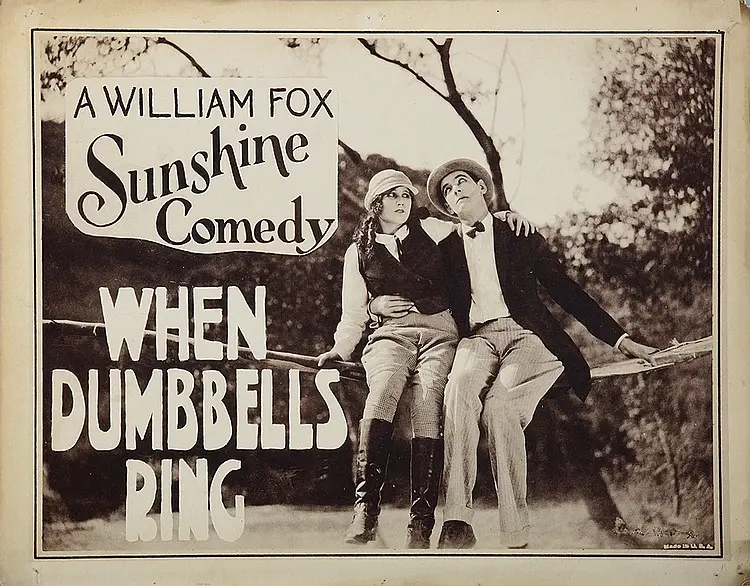
Should you invest twenty minutes of your life into a silent short from 1926? Short answer: Yes, but only if you find the sight of a man fighting a stationary object inherently hilarious. This film is for the vintage comedy enthusiast and the student of physical performance; it is absolutely not for anyone who requires a 'plot' to stay awake.
When Dumbells Ring is a fascinating artifact of an era where comedy was measured in inches and seconds. Slim Summerville, with his hangdog expression and limbs that seem to have too many joints, delivers a performance that feels surprisingly modern in its self-deprecation. It is a raw, unpolished look at the 'weakling' archetype that would later be refined by the likes of Don Knotts or even the early work of Jim Carrey.
1) This film works because Summerville understands that his body is his greatest special effect, using his lanky frame to create visual geometry that is both awkward and beautiful.
2) This film fails because it relies on a repetitive gag structure that starts to feel like a loop by the twelve-minute mark.
3) You should watch it if you are a fan of physical slapstick like Tillie's Punctured Romance and want to see how the genre evolved toward the end of the silent era.
The most striking element of When Dumbells Ring is not the script, which is virtually non-existent, but the timing. There is a specific scene involving a pulley machine that serves as a masterclass in tension. Summerville approaches the machine with a mix of terror and misplaced confidence. He pulls. Nothing happens. He pulls harder. The machine wins. It’s a simple setup, but the way he allows his body to be hoisted into the air—dangling like a confused marionette—is genuinely impressive.
Contrast this with the work in Way Out West. While that film leans into the grandeur of the landscape and the situational irony of the frontier, When Dumbells Ring is claustrophobic. It traps the performer in a room full of heavy things and lets the audience watch him struggle. It is a minimalist comedy. It works. But it is flawed by its own simplicity.
The cinematography is typical for 1926—mostly static, medium shots that allow the actor's full body to remain in frame. This was a necessity for the 'physical' comedians. You cannot cut away from a man falling over a bench; the fall is the point. The lack of camera movement actually enhances the comedy here, as it emphasizes how small and out of place Summerville is in the rigid, square world of the gym.
Yes, When Dumbells Ring is worth watching for anyone interested in the history of the 'underdog' trope in cinema. While it lacks the emotional depth of a Chaplin feature, it offers a pure, concentrated dose of silent-era slapstick. It is a quick, punchy experience that highlights a performer who is often overshadowed by his more famous contemporaries.
If you are looking for a deep narrative, look elsewhere. If you want to see a man get into a physical argument with a set of dumbbells and lose, this is your film. It is a bite-sized piece of history that still manages to elicit a genuine chuckle through sheer physical commitment.
We often forget that the 1920s were obsessed with the 'New Man.' After World War I, there was a massive push for physical fitness and 'scientific' exercise. This film parodies that movement perfectly. Summerville isn't just a clumsy guy; he is a critique of the hyper-masculine ideal. Every time he fails to lift a weight, he is poking fun at the societal pressure to be 'built.'
In many ways, this film feels like a precursor to the satirical tone seen in The Teaser or even the social maneuvering in The Fate of a Flirt. It uses the gym as a stage to play out the anxieties of the average man. It’s not just about the weights; it’s about the fear of being seen as inadequate. That is a timeless theme, even if the gags are nearly a century old.
The pacing, however, is where the film shows its age. Modern audiences are used to a faster edit. Here, a single gag can take two minutes to resolve. You have to adjust your internal clock. You have to breathe with the film. If you can do that, the payoff is rewarding. If you can't, it will feel like a chore.
Pros:
Cons:
When placed alongside other films of the time, like The Rescue or the more dramatic The Masked Heart, When Dumbells Ring feels like the 'pop music' of 1926. It wasn't trying to be high art. It was trying to make a theater full of people laugh for fifteen minutes before the main feature started. There is a honesty in that goal that is often missing from modern 'prestige' comedy.
It lacks the technical sophistication of Where Is Coletti?, but it makes up for it with heart. Summerville is an incredibly likable loser. You want him to succeed, even though you know the entire point of the movie is for him to fail. That is the secret sauce of great slapstick—empathy for the victim of the joke.
"Summerville’s performance suggests that the human body is not a machine, but a poorly designed contraption prone to sudden and hilarious collapse."
When Dumbells Ring is a minor work, but a significant one for understanding the evolution of the comedic persona. Slim Summerville proves that you don't need a big budget or a complex script if you have a unique look and a perfect sense of timing. It is a film about the struggle against the inanimate, a battle that we all lose eventually. This short just makes that loss look like an art form.
Is it a masterpiece? No. Is it essential viewing for a film historian? Absolutely. It’s a scrappy, sweaty, and surprisingly charming piece of celluloid that deserves to be remembered for more than just its title. It’s a reminder that sometimes, the funniest thing in the world is just a man who can't figure out how to stand up straight.
IMDb —
1918
Community
Log in to comment.