DbcultAccessing Vault...
Cult Review
Senior Film Conservator
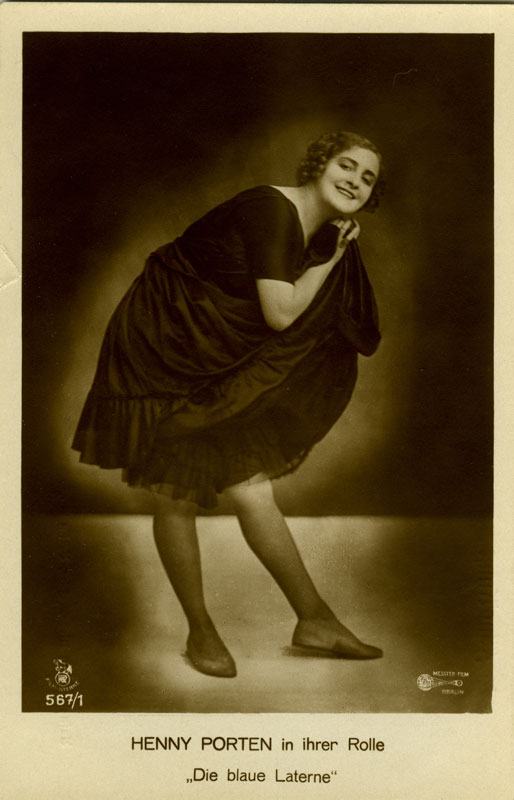
In the flicker of 1918 celluloid, when Europe still reeked of cordite and Spanish influenza stalked alleyways, Robert Wiene shot Die blaue Laterne like a physician dissecting a social ulcer. The film, long buried beneath archival dust and the more famous angular silhouette of Caligari, surfaces now as a sulphur-blue flare across the retina of Weimar historiography. It is less a narrative than a contagion: two sisters, once mirror images in a childhood bedroom, diverge under capital’s invisible hand—one into the gilded sarcophagus of marriage, the other into the phosphorescent maw of Berlin’s nocturnal entertainment machine.
Wiene’s Berlin is no civic postcard; it is a breathing organism whose arteries pulse with tungsten and sweat. The eponymous Blue Lantern cabaret squats beneath a railway arch, its entrance a gaping cobalt maw that devours women’s reputations and men’s wallets with equal gusto. Inside, cigarette smoke coils around gas chandeliers like ectoplasm, while a pit band grinds out waltzes in perpetual rubato, always half a beat from collapse. The camera, operated by Willy Gaebel with proto-expressionist daring, snakes through tables where champagne flutes sweat onto mahogany already scarred by the rings of previous nights. Every cut feels like a scalpel incision—violent, precise, exposing how glamour is merely hunger wearing sequins.
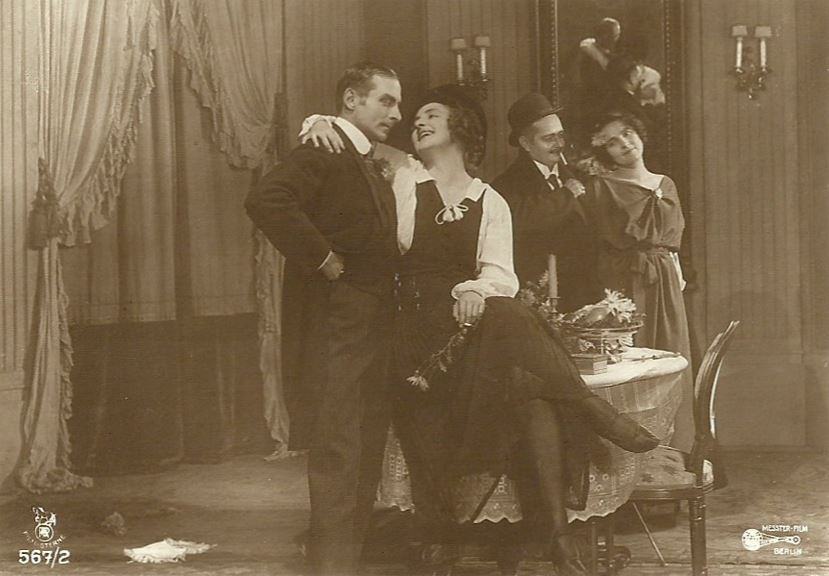
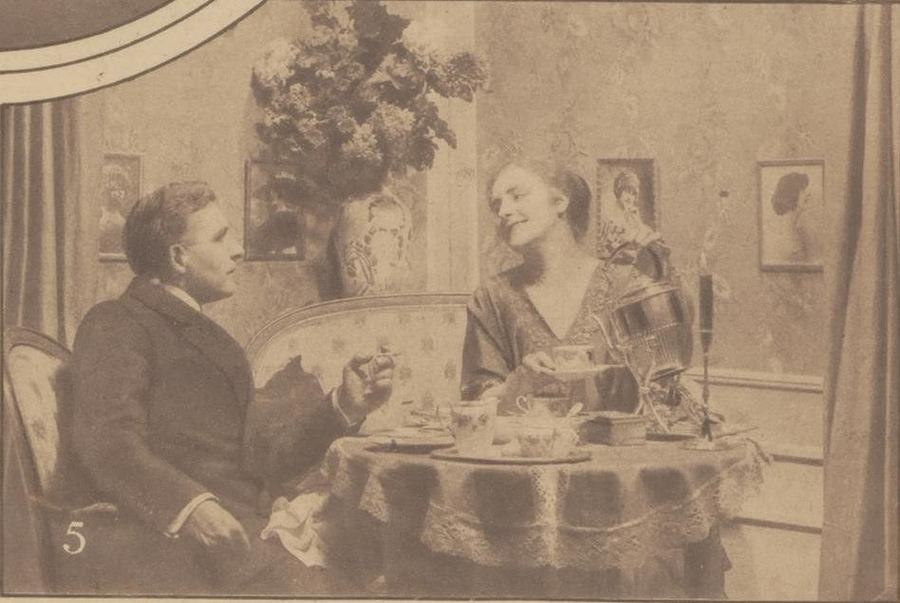
Ellen, portrayed by Henny Porten with the porcelain composure of a woman who has signed away her pulse, marries banker Wolfgang Döring (Karl Elzer). Their wedding scene is staged like an embalming: organ music wheezes under stained glass while Porten’s veil trails across parquet that reflects her face in amber distortion. Post-nuptials, Wiene imprisons her in cavernous apartments where the only sound is the ticking of an ormolu clock counting down dowry installments. When Ellen rehearses a private dance for her husband—an attempt to resurrect the kinetic joy she once shared with Sabine—Elzer’s gaze turns predatory, then proprietary. He claps not in applause but in ownership, each slap of palm against palm echoing like a judge’s gavel. The film slyly insinuates that respectable matrimony is merely the legalized purchase of choreography.
Johanna Zimmermann’s Sabine, spurned by a lover whose farewell letter is read in voice-over atop a black screen—an audacious avant-garde flourish for 1918—descends the city’s geothermal gradient. Her first night at the Blue Lantern is shot entirely in chiaroscuro silhouettes: a row of chorus girls undressing behind a backlit scrim, their limbs elongated into predatory insects. Zimmermann’s face, when finally revealed, carries neither innocence nor corruption but the stunned vacancy of someone waking inside a Kafka parable. Each subsequent performance strips another layer of identity; by the time she headlines as “The Blue Flame,” she has metabolized objectification into auto-hypnosis, staring past footlights into an abyss that returns her gaze tenfold.
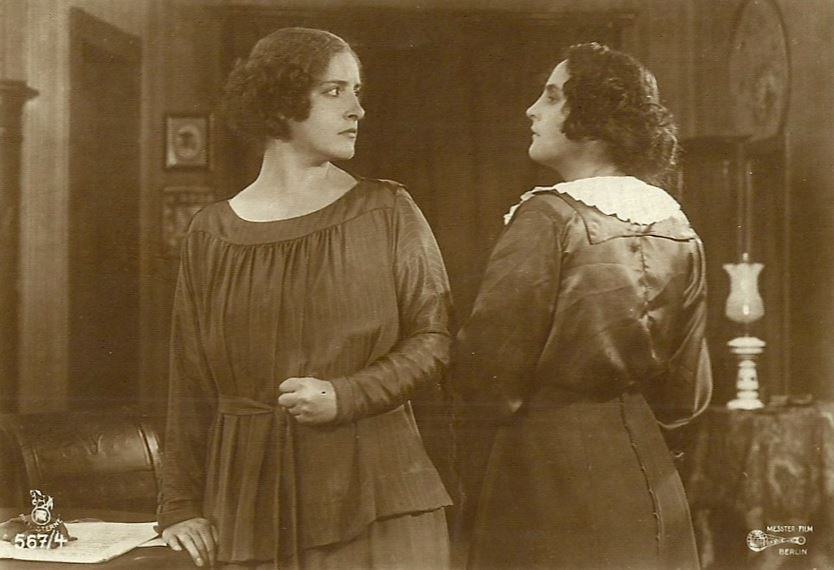
“I am not seen, therefore I am not spent,” she whispers to her reflection, a line cribbed from Irene Daland’s original scenario but delivered like a cracked mantra. The mirror, a recurring visual motif, fractures her face into silver slivers—Wiene’s premonition of Weimar’s forthcoming fragmentation.
Unlike contemporaneous melodramas such as A Woman’s Honor or The Hypocrites, Die blaue Laterne refuses to moralize. There is no fallen woman to redeem, no last-act marriage to restore equilibrium. Instead, it exposes how both marriage and cabaret operate on the same ledger: women’s bodies as bearer bonds. In a bravura montage—predating Soviet montage by several months—Wiene cross-cuts between Ellen’s marital bed and Sabine’s backstage cot: identical iron bedframes, identical mosquito netting, both women staring at the ceiling as if deciphering the same stain. The only difference is the color temperature of the light: cold teal for Ellen’s bourgeois ennui, bruised indigo for Sabine’s commodified nights.
Where Hamlet (1911) relies on theatrical tableaux, Wiene’s camera is predatory, prowling corridors at waist height to turn audience members into accomplices. Deep-field staging traps characters between looming doorframes and receding mirrors, creating mise-en-abyme vortexes. In one shot, Sabine regards a backstage looking-glass that reflects another mirror behind her, and within that reflection a third mirror—an infinite regression of selves, each iteration dimmer, until the final pane is pure black. It is cinema announcing itself as ontology: identity as endless refraction, with no original.
Though silent, the film evokes sensory overload. Intertitles appear sparingly, often superimposed over billowing fabric or smoke, as if language itself were embarrassed to intrude. The orchestra conductors of the era—pianists thumping out Kreisler arrangements—reported that during the Blue Lantern sequences, they would insert off-key chords and metallic rattles, mimicking the clatter of beer steins. Contemporary journals describe audiences coughing from imagined cigarette haze, so persuasive was Wiene’s visual odor.
Scholars often trace Wiene’s angular, psychotic sets in Caligari back to wartime trauma. Yet the seeds are visible here: the Blue Lantern’s backstage is a labyrinth of scaffolds and canvas flats that jut at impossible angles, presaging the asylum corridors of 1920. The difference is one of ontology: in Die blaue Laterne the distortion is socioeconomic, not schizophrenic. When Sabine finally collapses onstage, the set tilts 15 degrees—furniture bolted to the floor slides toward her like a conspiratorial jury, a visual coup achieved by tilting the camera and securing props with wires, predating Hitchcock’s Psycho shower trick by four decades.
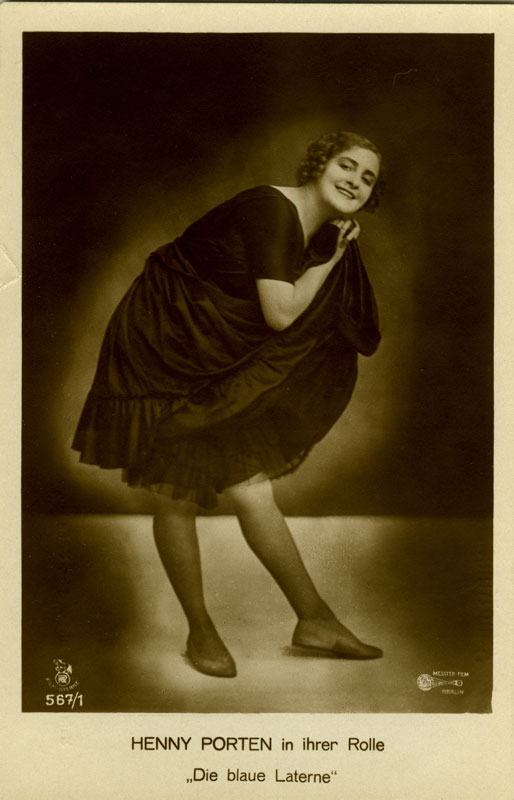
Henny Porten, usually the epitome of sturdy Germanness, here allows micro-fractures of panic to ripple across her glacial façade. Watch her hands: in early scenes they rest in polite half-moon curves; by midpoint they clutch invisible reins, as if steering an unseen carriage toward cliff-edge. Johanna Zimmermann, lesser-known outside cine-archives, delivers a masterclass in corporeal linguistics—each high-kick a semaphore of fatigue, each smile a treaty with nausea. The supporting male roster—Rudolf Biebrach as the lantern’s cigar-chomping impresario, Paul Biensfeldt as a tuba-bellied patron—are caricatures carved from Weimar’s real underbelly, yet photographed with such textured sincerity that they transcend misogynist grotesque.
Triple-barreled authorship often spells incoherence, yet Daland, Lindau and Wiene achieve polyphonic dissonance. Daland, a former dancer, injects kinetic authenticity into rehearsal sequences—feet blistering, calves cramping. Lindau, playwright of boulevard scandal, supplies acidic dialogue for intertitles (example: “A wife’s virtue is a bank vault with a time lock set to eternity”). Wiene, the visual alchemist, fuses both into a fever dream that anticipates the collaborative scripts of Pabst’s Pandora’s Box.
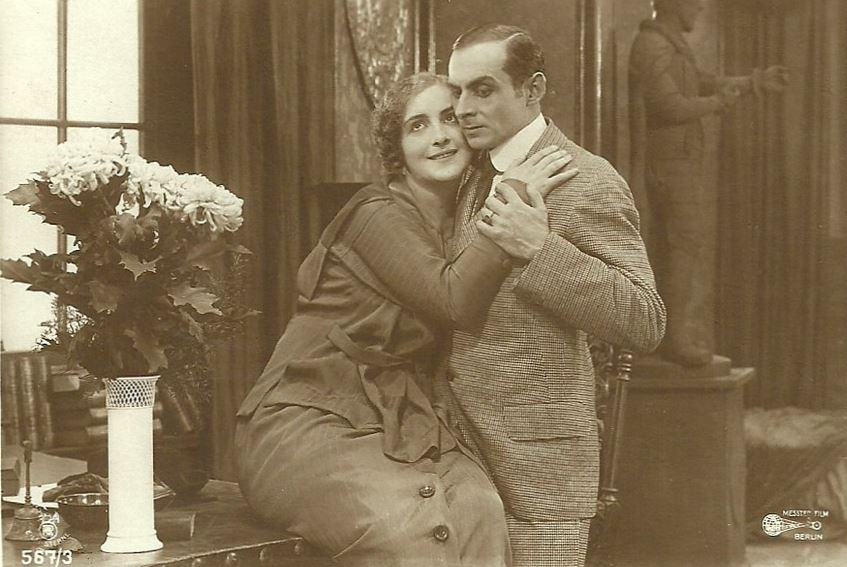
Released in December 1918, weeks after Armistice, the film detonated moral panic. Conservatives condemned it as “a bordello on celluloid”; feminists split—some hailed it as unflinching indictment of patriarchal economy, others decried the voyeuristic linger on garters. Censors in Bavaria demanded deletion of a 30-second shot where Sabine tears up a banknote to stuff inside her bodice, an act of symbolic prostitution too incendiary for inflation-ravaged audiences. Most prints vanished in the 1923 nitrate fires that devoured Ufa vaults. Only a spliced 52-minute version survived, housed in Moscow’s Gosfilmofond, discovered in 1998 beneath Revelj reels. Current restorations extrapolate missing sequences via still photographs, tinting them cobalt to match the lantern’s glow.
Viewed today, amid gig-economy precarity and OnlyFans commodification, the sisters’ dichotomy feels prophetic. Ellen’s marriage emerges as the original Patreon: sexual content traded for housing security. Sabine’s cabaret foreshadows today’s creator platforms—subscription to gaze. The film’s refusal to rescue either woman from market dynamics lands it closer to The Battle of the Sexes than to Cupid Angling’s Edwardian coyness.
Wiene’s tilted stage reappears in The Scarlet Drop’s saloon brawl; the recursive mirror gag resurfaces in Revelation (1918)’s convent sequence. More recently, the neon-blue corridors of Atomic Blonde’s Berlin owe chromatic debt to the lantern’s cyan haze. Even the Wachowskis cited the film in Sense8’s club scenes, replicating the pulsating backlight that turns sweat into liquid sapphire.
Modern curators face dilemma: tint the lost scenes in sea-blue authenticity, or leave them sepia to mark absence? Current 2K restoration opts for a gradient—missing fragments fade from cobalt to desaturated steel, a visual watermark of archival lacunae. Purists object, arguing the film should scar, not smooth. Yet the hybrid approach mirrors the sisters’ own fracture: presence and erasure dancing a slow foxtrot.
Die blaue Laterne is less entertainment than x-ray, revealing the calcium decay inside Weimar’s skeletal glamour. It offers no catharsis, only a prism through which to regard our own backlit screens—where every swipe, every transaction, continues the ancient barter of visibility for sustenance. When the lantern’s flame finally gutters, the screen does not fade to black but to a phosphor afterglow that brands the retina, a reminder that someone, somewhere, is always paying for the light.
Verdict: 9/10 — a resurrected marvel whose cobalt bruises still bloom a century on.
IMDb —
1917
Community
Log in to comment.