DbcultAccessing Vault...
Cult Review
Senior Film Conservator
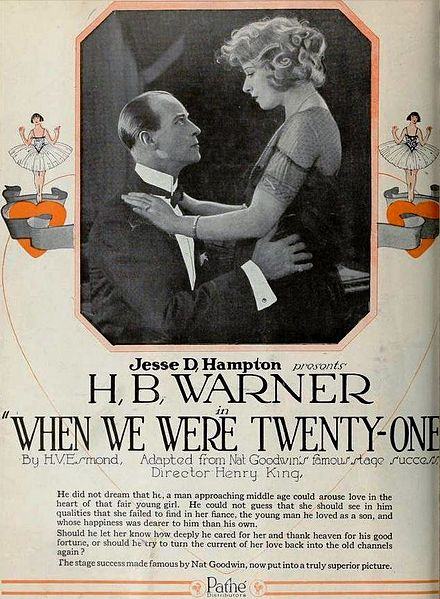
London, 1913, captured through the brittle shimmer of early orthochromatic stock: champagne flutes catch ghost-light, top-hats slice the frame like black paper dinghies. Into this chiaroscuro struts H.B. Warner’s Richard Carewe, a study in charcoal restraint—every measured blink confessing volumes his tongue will never sanction. Warner, later to play Christ in King of Kings, here embodies a secular savior, doomed to shepherd a boy who covets everything except counsel. The performance lives in micro-gestures: a thumbnail worrying a signet ring, the deliberate way he sets down a fountain pen as though it might detonate. It is acting scaled for whispers rather than proclamations, a master-class in the silent era’s most underused dialect: the unsaid.
Claire Anderson’s Phyllis glides opposite him, equal parts porcelain and steel. Anderson never succumbs to the era’s penchant for arm-flung despair; instead she lets the camera inhale the tremor at the corner of her mouth, a seam of grief unpicked one frame at a time. Her alleged rival, Kara Glynesk, is essayed by Christine Mayo with feline languor—each languid shrug of a mink stole signals calculation. Mayo, unjustly forgotten, wields her eyes like accounting ledgers, tallying every coin and caress. When she purrs “I do” at the altar, the vow lands less as promise than invoice.
James Morrison, Claude Payton, Minna Grey form the self-appointed “Trinity,” fluttering through drawing rooms with epigrams fluttering like distressed carrier pigeons. Their function? Ostensibly to prevent the Imp’s nuptial catastrophe. Yet in their futile scrambles—one dons a waiter’s disguise, another commandeers a honeymoon cab—director H.V. Esmond inflates the spectacle until it borders on absurdist ballet. The trio’s slapstick, flecked with sea-blue tinting in surviving prints, counterweights the film’s coral-pink (orange-amber) romantic fatalism, reminding us that melodrama and farce share a bed more often than polite critics admit.
The hinge upon which the plot pirouettes is a billet-doux—Kara’s honeyed enticement—intercepted by Phyllis. Cue mistaken attribution, hearts ricocheting like mis-cued billiard balls. Silent cinema adored the trope: a single sheet of paper wielded the explosive force of a stick of dynamite. Esmond, also the scenarist, wrings every droplet of suspense from the device, cross-cutting between Phyllis’s candle-lit bedroom (tinted ghost-blue) and Richard’s study aglow in sulphuric amber. The sequence climaxes with a match-cut: Phyllis’s tear splattering the letter’s ink, dissolving—via luminous ripple—to a champagne bubble ascending a flute at the wedding breakfast miles away. Geography collapses; hearts synchronize in anguish.
Dick “Imp” Audaine, essayed by an ebullient James Morrison (not to be confused with the Trinity member), embodies Edwardian leisure-class entropy: moneyed, mannered, maddeningly obtuse. Morrison’s physique—reedy, almost elastic—permits him to ricochet from cocksure grins to crestfallen bewilderment without alienating viewer sympathy. When Kara absconds with a wealthier paramour, the film withholds cathartic revenge; instead the Imp receives a mirror. His comeuppance is ontological, not judicial. The camera dollies back, leaving him a diminutive figure against a cavernous gentlemen’s club, the caustic yellow of gaslights gnawing at his silhouette. One almost hears the echo of a coin dropped into an abyss.
Though penned by a male writer-director, When We Were 21 acutely limns the transactional corset women wore beneath their lace. Kara’s mercenary instincts are vilified yet transparently systemic: matrimony doubles as career. Phyllis, conversely, wields passivity as subversion; her refusal to contest Kara directly becomes a strategic withdrawal, a silence that purchases moral leverage. In the final reel, Esmond grants her the editorial upper-hand: she walks toward camera, Richard at her side, the frame irising in until Kara and the Imp dissolve into periphery. It is a proto-feminist reclamation smuggled inside conservative melodrama.
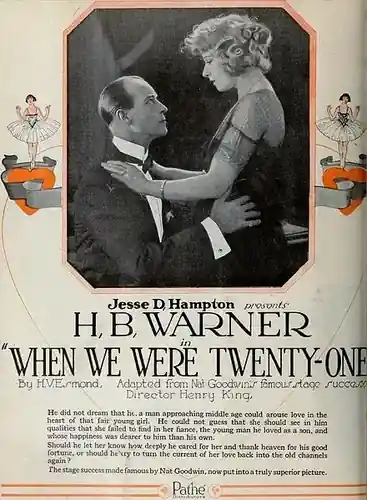
Survival prints, though incomplete, reveal a sophisticated tint strategy: amber for interiors (opulence, deceit), cerulean for exteriors (freedom, peril), rose for intimate clinches (desire, exposure). Such chromatic rhetoric anticipates the coded palettes of Perils of Thunder Mountain and The Kingdom of Love. Meanwhile, the camera—often hand-cranked at variable speed—lingers on textures: the nacreous gleam of a kid glove, the sooty velvet of a butler’s collar. These haptic close-ups solicit the viewer’s fingertip memory, collapsing decades between skin and screen.
Place When We Were 21 beside The Unfortunate Marriage and you’ll note a mutual fascination with intercepted documents. Pair it with The Unwelcome Wife for thematic cousinry in guardian-ward entanglements. Yet Esmond’s film diverges from Silnyi chelovek’s muscular determinism; its stakes are emotional, not proletarian. Unlike the open-range morality of Taming the West, London’s drawing rooms compress ethics into the flutter of fans and the pause between syllables.
No original score survives, but curators might extrapolate: a string quartet’s pizzicato for Trinity shenanigans, a solo cello’s descending glissando to trace the Imp’s epiphany, cymbal crash for Kara’s betrayal. Tempo should lag 5% beneath standard 24 fps to accommodate period practice, allowing audiences to savor Warner’s micro-glances. Brass would be eschewed; the film’s epiphanies are intimate, not coronations.
Trade papers of 1923 praised Anderson’s “restrained pathos” while dismissing Mayo’s Kara as “vampish boilerplate.” Modern retrospection corrects the imbalance: Mayo’s predatory elegance anticipates the femme fatales of noir, whereas Anderson’s muted strength foretells the 1940s woman’s picture. Critics seeking proto-feminist arcs now celebrate the film’s tonal pivot from farce to moral inquiry, a trajectory mirrored—though with greater narrative sprawl—in The Road Called Straight.
When We Were 21 is less relic than revelation: a compact treatise on capital, cupidity, and the hazardous currency of affection. Esmond, working within the confines of stage-derived melodrama, nonetheless fractures the proscenium: he cross-cuts timelines, manipulates tint as emotional annotation, and grants his female lead the ultimate dolly-in. Imperfections—occasional staginess, the loss of two reels—remain, yet they invite conjecture, fan reconstruction, scholarly symposia. In the current renaissance of silent re-evaluation, this film merits pride of place beside Livets Gøglespil and Nearly Married for its sly subversion of genre expectation.
Watch it for Warner’s chiseled reticence, for Anderson’s quietly seismic close-ups, for Mayo’s predatory silk. Watch it for the Trinity’s pratfalls that leaven the moral crucible. But mostly watch it to witness cinema at an inflection point: manners about to shatter, modernity about to speak, love re-defined as something you cannot purchase with any coin—least of all the twenty-one shillings that once bought a boy’s illusions.
IMDb —
1927
Community
Log in to comment.