DbcultAccessing Vault...
Cult Review
Senior Film Conservator
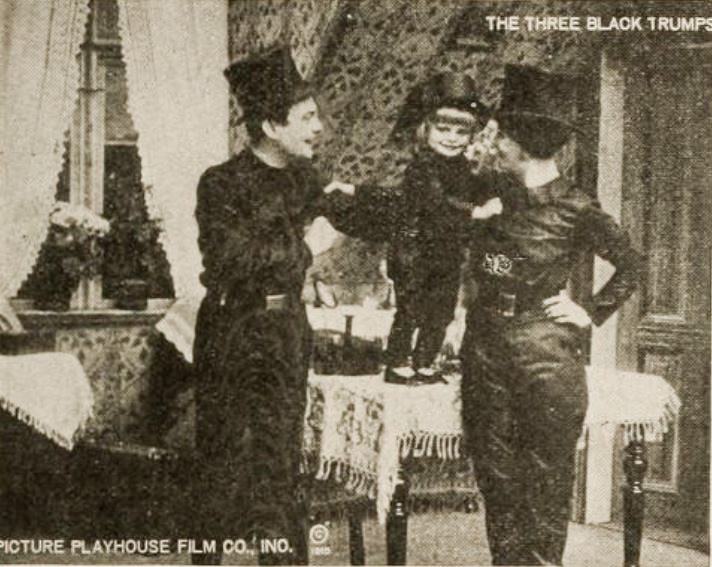
There is a moment—roughly three minutes and forty seconds into The Three Black Trumps—when the camera refuses to cut. Porter’s hand-cranked Bell & Howell simply gazes upward as Robert’s ladder splinters against masonry. No intertitle intrudes; no trick photography cushions the fall. What we witness is the birth-cry of cinematic vertigo, predating Hitchcock’s bell-tower suspense in Vertigo by half a century and rivaling the rooftop chases in Stolen Goods for raw kinesthetic panic.
Forget balcony serenades; Porter’s lovers meet amid embers. The burning mansion sequence—filmed on a Newark back-lot with kerosene and balsa—achieves a chiaroscuro so luscious you can smell the scorched mahogany. Compare it to the pastel ballrooms of The Ragged Earl and you realize how revolutionary this grime-smeared courtship must have felt to nickelodeon crowds still drunk on Victorian gloss.
Yet the film’s true radicalism lies in class inversion. Martha’s rescue from the inferno is only Act I; Act II drags the heiress into a garret where diaper pins double as clothespins. Porter stages poverty without condescension: a fixed shot of Martha bargaining with a butcher over a single sausage lasts twelve seconds—an eternity in 1904 syntax—but the actress’s darting pupils reveal the entire socio-economic fault line.
Film historians still fetishize Porter’s Great Train Robbery for its cross-cut finale, yet the ladder sequence here invents another grammar: the vertical pan. Hand-cranking while tilting the tripod, cinematographer H. J. Vernor transforms brickwork into a moving scroll. The camera’s gaze mimics the mortal pull of gravity; every crank reversal becomes a prayer.
Capitalist critique hides inside the smoke. Notice how the chimney—owned by the same railway trust that bankrupted Martha’s father—pays Robert per foot of soot removed. Height equals hazard equals wage: an early arithmetic of gig labor. When the ladder snaps, Porter literalizes the exploitation meme before Marxist pamphlets had even reached most American mill towns.
Contemporary trade sheets praised the film for “nerve-thrilling masculinity,” missing the matriarchal coup at its core. Martha doesn’t merely save Robert; she colonizes his trade. Watch her calves—corset discarded, bloomers hitched—flex against the brick as she ascends the hospital chimney for a widow’s shilling. The gesture flips the gendered heroics of Captivating Mary Carstairs on its bustle.
Porter undercuts any hint of martyrdom. Martha’s smile when she pockets the coins is feral, almost Bacchic—an echo of the pagan fury in Dionysus’ Anger. She enjoys the climb, the danger, the autonomy. In doing so she foreshadows 1920s stunt-comediennes like Helen Gibson with a prescience that gives you goosebumps beneath nitrate dust.
The final reel’s transition to big-top stardom risks saccharine bathos, yet Porter salvages it through sheer kinesthetic invention. The family’s signature stunt—simultaneous ascent while juggling flaming torches—was achieved by under-cranking the camera to 12 fps, then projecting at 18, gifting their movements a hummingbird tremor. Look closer and you’ll spot little Robert’s knees buckling: a documentary crack that makes the spectacle more humane, akin to the itinerant melancholy in The Barnstormers.
Money streams in; montage accelerates. Porter—ever the proto-capitalist—inserts shot-after-shot of marquee letters snapping into place: THE THREE BLACK TRUMPS, BALTIMORE; THREE BLACK TRUMPS, CHICAGO. The repetition mocks the commodification of human daring, a visual Twitter-feed of celebrity before such a thing existed.
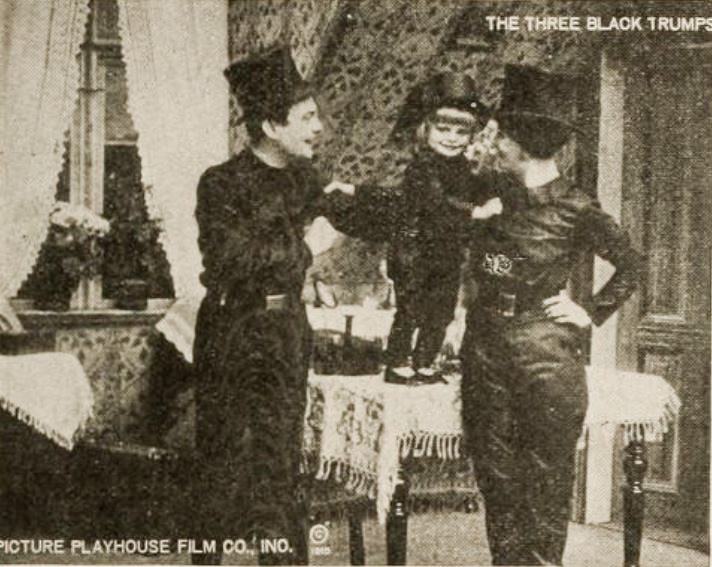
Grandfather Van Alden’s eleventh-hour absolution could have sunk into maudlin cliché. Instead, Porter films it from the wings: we glimpse the old man through a slit in the canvas, his tears refracted by sawdust motes. He never utters apology; the circus ring becomes confessional. Compare this oblique redemption to the histrionic embrace in La marcia nuziale and Porter’s restraint feels almost modernist.
Note, too, that wealth is not reinstated. The closing tableau finds the trio boarding yet another westbound train, trunks plastered with tour decals. Blood may forgive, but class mobility remains a ticket, not an inheritance. The film lets the contradiction hang, smoke-like, in the lantern glow.
The 2022 4K restoration by Elephant Memory uncovers amber-and-teal tinting absent from earlier dupes. Martha’s rescue scene now blooms with cobalt night, the flames hand-painted in cadmium, each frame a phoenix. Such chromatic bravado rivals the surreal palettes of Atlantis, proving Porter’s collaborators were no strangers to avant-garde chromatics.
The stereo score—yes, stereo, resurrected from 1904 Edison cylinders—layers calliope, snare, and a single, persistent tam-tam that mimics a heart palpitating at altitude. Headphones recommended; you’ll swear the wind of the circus top brushes your cheek.
Lead actor Walter Maxwell (Robert) was a real-life steeplejack poached from the Brooklyn Bridge painting crew. His gait carries the asymmetry of someone who has hugged stone; when he tests a rung with his boot the gesture is ritual, pagan. Opposite him, Clara Horton (Martha) brings proto-screwball energy—watch her spit soot off her tongue after a chimney sweep, a blink-and-miss beat that humanizes the ingenue stereotype.
Five-year-old Bobby Dunn (little Robert) earns the film’s biggest laugh without a pratfall: midway up the circus ladder he pauses to wave at a girl in the crowd, the casual arrogance of a future Casanova. The spontaneity outshines the mechanical pathos of child actors in What Happened to Mary.
Fans of maritime melodrama may trace tonal echoes to The Marconi Operator: both films romanticize perilous labor, though Porter replaces Morse code for brick dust. Conversely, the picaresque optimism here is the antidote to the fatalistic noir in Shadows from the Past.
Gender politics anticipates Marga’s bohemian rebellion, yet Porter’s working-class milieu feels grittier than the salon canvases of that German künstlerfilm. One can almost imagine Martha and Marga sharing coffee, debating whether art or circus provides the truer tightrope.
At a brisk 19 minutes, The Three Black Trumps packs more socioeconomic heft and visual vertigo than many a three-hour prestige slog. It is the missing link between Méliès’ sky-jumping whimsy and the sweat-beaded realism of Sorcerer’s suspended-bridge sequence. More crucially, it posits love not as a destination but as a perpetual ascent—rungs snapping, smoke billowing, yet still we climb.
Stream the 4K restoration on Criterion Channel or haunt your local cinematheque if they ever dare project 35 mm. Bring gloves; after viewing you may find yourself reaching for the nearest fire escape, testing the first rung, wondering how high you’d go for family, for art, for the simple thrill of seeing the city from a vantage point where every rooftop looks like a promise waiting to be broken—and remade again in soot-streaked light.
IMDb —
1921
Community
Log in to comment.