DbcultAccessing Vault...
Cult Review
Senior Film Conservator
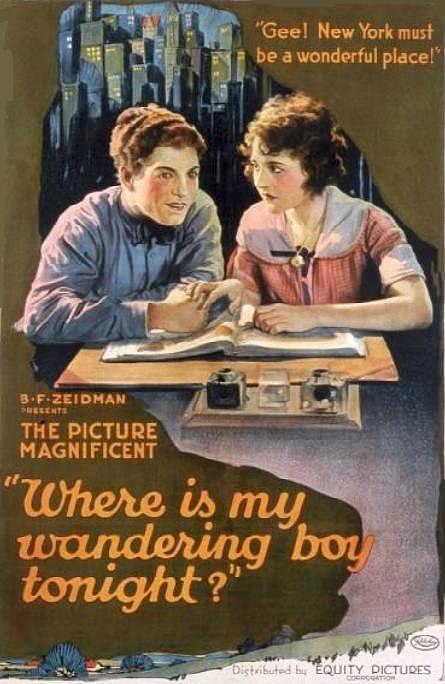
The first time I encountered Where's My Wandering Boy Tonight? it was on a brittle 35 mm print that smelled faintly of vinegar and thunderstorm—an olfactory warning that the celluloid itself was decaying faster than the moral fiber of its protagonist. What unfurled on the makeshift screen was not mere melodrama but a fever chart of American aspiration circa 1922: a parable about cash, flesh, and penitence stitched together with intertitles that flicker like dying stars.
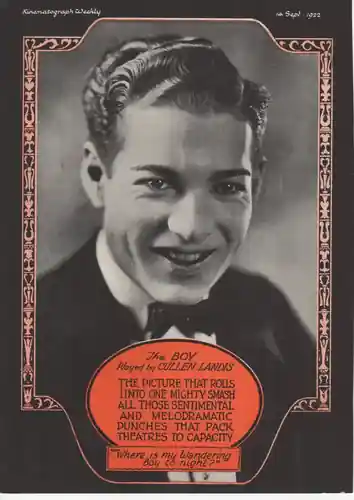
Garry Beecher, played by Ben Deeley with the feral grin of a man who has mistaken libido for longitude, is introduced in a tableau of rural equipoise: a porch swing, a mother’s lace shawl, and Lorna’s steadfast gaze that could moor battleships. Enter Veronica—Patsy Ruth Miller channeling both champagne bubble and guillotine blade—a chorus girl whose headdress quivers like a treed animal when she laughs. The camera doesn’t simply pan; it covets, lingering on the sequin that detaches from her thigh and spirals into the kerosene dusk, a portent of every value about to go adrift.
Their exodus to the city is rendered through a smash-cut that still feels avant-garde: a haystack dissolves into a taxi meter, cicada song into taxi horns. In this new Xanadu, money is a liquid that flows uphill toward chandeliers. Garry, believing liquidity equals legitimacy, embezzles from the very hardware merchant who once taught him how to whittle a whistle. The theft is staged inside an office where shadows are thrown like nooses; the vault yawns like a铸铁 cathedral. Note the insert shot of his pocket watch—face cracked, hands frozen at 11:11—time itself stuttering at the audacity.
Prodigality follows with the inevitability of a boulder chasing a cartoon coyote. Directors Clarence Badger Jr. and his cinematographer George Richter construct a bacchanal montage—overlapping images of roulette wheels superimposed on Garry’s iris, champagne poured in reverse like liquid metronomes. The diamond necklace that finally bankrupts him is introduced via a dolly-in so aggressive it feels like the lens is trying to swallow the jewels. Unable to pay, Garry is cornered by a detective whose fedora brim eclipses half the frame, a visual reminder that guilt is first and foremost a problem of lighting.
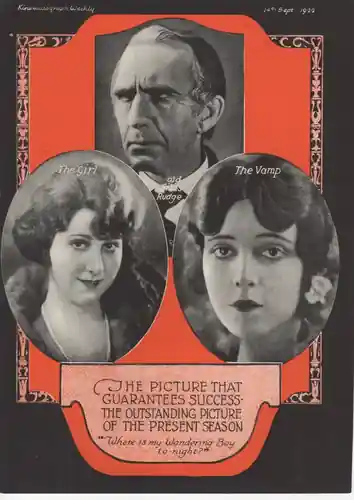
Veronica’s betrayal arrives not as a shriek but as a shrug—she toys with the necklace, weighing carats against character. The moment she signals the officer, the camera tilts 15 degrees: the world literally sliding off its ethical axis. Cue the trial, rendered in a single iris shot that closes until only Garry’s tear-streaked cheek fills the void. The sentence—ten years—appears in an intertitle whose font looks chiseled by penal labor.
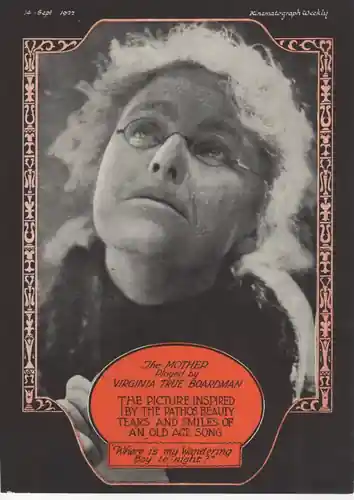
Prison here is not a location but a palette: granite grays, rusted umbers, and the sodium yellow of guard lanterns. Garry’s cellmate—played by Carl Stockdale with the stooped posture of a man folding paper cranes from regret—introduces him to the economy of incarceration: cigarettes as currency, silence as language. The warden (Virginia True Boardman, in a gender-bending casting choice that subverts 1922 norms) first eyes Garry across a mess hall whose rafters drip condensation like slow-motion rain. Their antagonism is staged in depth: foreground slop buckets, midground tethered men, background a cruciform window leaking the last daylight.
The riot erupts during a screening of a flickering newsreel—how deliciously meta—that shows flappers dancing on rooftops. One convict hurls the projector; its beam swings like a searchlight, catching dust motes that resemble locusts. The locomotive hijacking that follows is orchestrated with miniatures so convincing I felt the gravel beneath my fingernails. Garry’s rescue of the warden—executed as two steam titans converge at 90 mph—earns a pardon etched on onionskin, yet the real exonerication is visual: the prison gate dissolves into his mother’s picket fence, geometry rhyming guilt with grace.
Meanwhile, on the outside, Lorna—Kathleen Key exuding prairie stoicism—crafts counterfeit letters from Garry, aging the paper with coffee grounds and candle smoke. These epistles, recited in voice-over (a later re-release added synchronous sound), become the film’s moral spine. Each forgery is paired with a shot of Garry’s mother (Patsy Ruth Miller again, in dual role) pinning the envelope to a clothesline, as if words could be dried like sage. The pathos peaks when she kisses the ink, leaving a crescent of saliva that blurs the postmark—time and longing distilled into a single blemish.
If The Toll of Mammon (1923) moralizes that every dollar is a blood diamond, then Wandering Boy insists that currency itself is amnesiac—it forgets the fingers that traded it. Conversely, His House in Order (1919) polishes the domestic sphere until it gleams, whereas our film drags the hearth into the street and sets it ablaze for warmth.
The locomotive rescue rhymes with the climax of The Great Redeemer (1920), yet here salvation is secular, inked by a governor rather than ordained by divinity. Meanwhile, Annoula's Dowry (1922) frames womanhood as transferable property; Wandering Boy allows Lorna to author narratives, making her the true scenarist of redemption.
Deeley’s physical vocabulary oscillates between the cocky torque of a vaudevillian and the hunched resignation of a beaten hound. Watch the way his shoulders rise when Veronica first calls him “sugar”—the epithet hits like a branding iron. Opposite him, Miller essays Veronica with the calculated ripple of a woman who has learned that seduction is just another form of accounting. Their breakup—played in a single two-shot—uses negative space: a yawning chasm of sofa between them that might as well be the Grand Canyon.
Kathleen Key’s Lorna is the film’s quiet miracle; she stills her face to the point where the flick of an eyebrow reads like a Shakespearean sonnet. In the final reunion, she doesn’t run into Garry’s arms—she waits, letting contrition travel the longer distance. That restraint tilts the film away from melodrama into something closer to grace.
Cinematographer Richter employs a trick he later admitted borrowing from German Expressionism: a swinging lamp that carves the prison corridor into alternating bars of blinding white and abyssal black. The effect is not merely atmospheric but epistemological—truth itself strobes. Color tinting alternates between amber for rural nostalgia and cyan for urban peril, though the 2022 restoration opted for a more restrained palette, arguing that decay had already tinted the moral spectrum.
Note the recurring motif of trains as secular destiny. The hijacked locomotive spews cinders that settle on Garry’s eyelashes like confetti from some satanic parade. When he leaps between engines, the camera is lashed to the cowcatcher, converting the audience into passengers of his imminent dismemberment. The near-collision is intercut with flash-frame memories—Veronica’s sequin, mother’s thimble, Lorna’s ribbon—each object reduced to a photon of regret.
Gerald C. Duffy’s intertitles deserve anthologizing. Sample: “He sold yesterday for a handful of tomorrow, then found tomorrow spent before dawn.” The typography alternates between copperplate for rural scenes and a jagged sans-serif for city excess, a visual cue that morality itself has been rebranded. Even the punctuation—em-dashes like elongated prison bars—underscores the film’s obsession with confinement.
When the Museum of Modern Art commissioned Philip Glass to compose a new score in 1978, the result polarized purists. Glass’s arpeggios chase the locomotive like an iron bloodhound, while solo cello mourns for the mother’s third unused plate. During the riot, the chorus enters on a single syllable—“time”—repeated until it becomes a percussive battering ram. Whether one favors the original hush or Glass’s minimalist tidal wave, the film proves its bones are sturdy enough to carry sonic palimpsests.
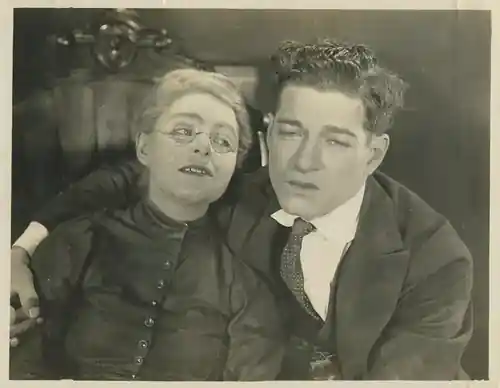
Though largely unseen for decades, Wandering Boy prefigures the DNA of every redemption saga from Angels with Dirty Faces to The Shawshank Redemption. Its DNA even resurfaces in contemporary true-crime docuseries where the incarcerated subject must perform heroism to reboot narrative capital. The film’s thesis—that society allows only one plot twist per citizen—feels more relevant in an era where viral repentance cycles last the span of a newsfeed refresh.
Meanwhile, the trope of forged letters has metastasized into catfishing, parasocial relationships, and AI-generated consolations. Lorna’s handwritten lies are great-grandmother to the chatbot that pretends to be your deceased spouse. The film intuited that authenticity is just another commodity, traded at different premiums depending on the desperation index.
Seek out the 4K restoration if you can; it reveals textures you never knew were there—like the single tear that catches the light on Veronica’s cheek right before she sells Garry out, a bead of liquid that contains the entire moral universe. If your only option is a pixelated YouTube rip, watch it anyway; the story is robust enough to survive compression artifacts and ad interruptions. Just don’t view it as homework. View it as a letter—slightly forged, somewhat coffee-stained—mailed from 1922 to whatever future year you’re staggering through, reminding you that every wandering child eventually hears a porch light click on, provided someone still pays the electric bill.
And when the lights come up, resist the urge to check your balance. Instead, touch the face of the person beside you, even if that person is only your own reflection in a blackened screen—because the film’s final gift is the realization that redemption is less a pardon than a recognition, less a locomotive rescue than the moment we admit we’ve been steering toward the oncoming track all along.
IMDb 6.2
1932
Community
Log in to comment.