DbcultAccessing Vault...
Cult Review
Senior Film Conservator
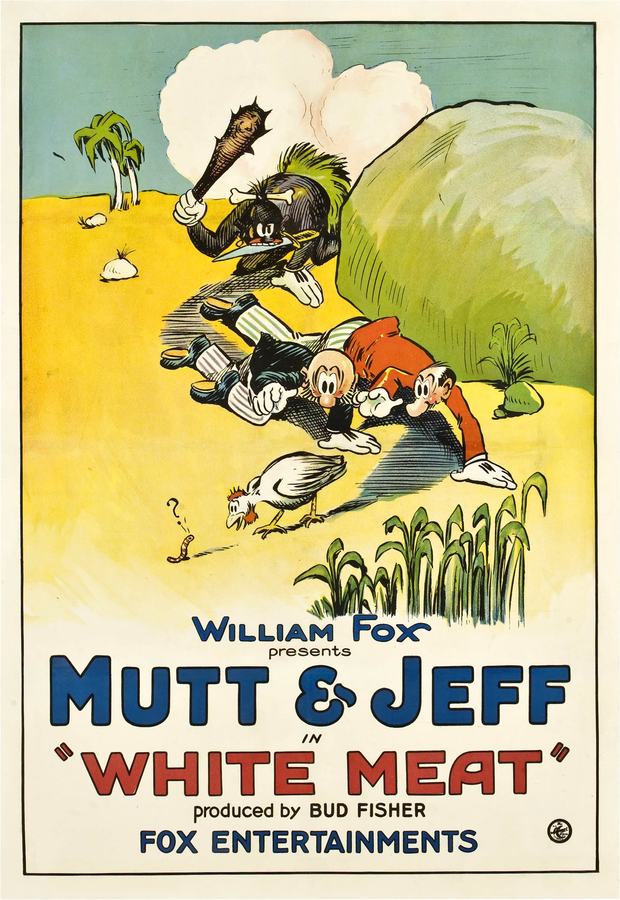
In the pantheon of silent cinema, Bud Fisher’s White Meat (1922) occupies a peculiar niche: a film that is at once a relic and a revelation, a product of its era yet strikingly modern in its thematic resonance. Fisher, who would later become synonymous with the character Slue-Foot Sue, here strips away the grotesque exaggerations of his later work to deliver a performance of subtle, simmering mania. The film’s conceit—a butcher’s existential crisis over the moral and aesthetic implications of meat-cutting—is both absurd and oddly prescient, echoing contemporary debates on ethics and industry with a clarity that surprises given its 1920s origins.
At its core, White Meat is a study in duality. Mr. Hambone, Fisher’s protagonist, is a man of meticulous precision, his world governed by the unyielding logic of the cleaver and the scale. Yet this same rigidity renders him blind to the organic chaos of human relationships. The film’s first act is a masterclass in visual satire: Hambone’s butcher shop is a cathedral of order, with meat arranged in perfect symmetry, until a stray dog’s paw interrupts the symmetry, triggering a chain reaction of comedic failures. This incident—a paw mistaken for a prime cut—becomes the catalyst for Hambone’s unraveling, a narrative choice that underscores the fragility of systems built on arbitrary rules.
Visually, the film is a marvel of economical storytelling. Director Fisher employs a stark palette of shadows and high-contrast lighting, using the butcher shop’s dimly lit interior as a metaphor for Hambone’s moral ambiguity. The camera lingers on the butcher’s tools with a reverence that borders on the sacred, only to undercut this gravitas with slapstick when they’re repurposed as comedic props. A scene where Hambone attempts to use a meat tenderizer to resolve a romantic entanglement is both hilarious and unsettling, a testament to Fisher’s ability to blur the line between the farcical and the tragic.
What elevates White Meat beyond mere slapstick is its nuanced exploration of identity. Hambone’s obsession with ‘white meat’—a term that, in the film’s world, denotes both a culinary ideal and a social hierarchy—is a veiled critique of early 20th-century America’s fixation on purity and categorization. This theme resonates with unsettling immediacy when viewed through the lens of modern audiences, particularly in comparison to The Ring of the Borgias’ more overtly political machinations or The Flame of Passion’s romantic entanglements. Fisher’s genius lies in his ability to embed these ideas in a narrative so absurd it seems to invite dismissal, only to reveal their weight in the film’s final moments.
The second act of the film is a technical tour de force. A sequence involving a meat-hoarding rival (a nod to The Fire Flingers’ pyrotechnic rivalries) is executed with the precision of a stage play, each movement choreographed to maximize comedic effect while advancing the plot. The rival, played with gleeful malice by an uncredited supporting actor, serves as Hambone’s foil, embodying the excesses Hambone claims to despise. Their final showdown in a meat locker—where the two men’s ideologies literally come to a head over a side of beef—is a visual and thematic climax that rivals the best of Straight Is the Way’s moral dilemmas.
Where White Meat truly shines is in its character dynamics. Hambone’s relationship with his sister, played with weary charm by a rising star, is a quiet counterpoint to the film’s chaos. Their scenes together are marked by a dry humor that contrasts with the slapstick, showcasing Fisher’s range and the film’s emotional depth. This relationship also serves as a narrative throughline, culminating in a resolution that is as unexpected as it is poignant—a moment that lingers in the mind long after the credits roll, much like the final scenes of Good Women’s moral reckoning.
In comparing White Meat to contemporaneous works like The Ace of Hearts or Le torrent, one cannot overlook Fisher’s unique approach to narrative pacing. While many silent comedies of the era favored rapid-fire gags, Fisher adopts a more measured rhythm, allowing the absurdity to breathe and the themes to resonate. This is particularly evident in the third act, where Hambone’s journey from rigid conformity to reluctant acceptance of chaos mirrors the broader cultural shifts of the 1920s. The film’s resolution—where Hambone opens a ‘mixed cuts’ shop, embracing diversity in both meat and community—is as bold a statement in 1922 as it would be in today’s discourse on inclusivity.
Technically, White Meat is a product of its time, with the limitations of silent film technology visible in its occasionally stiff transitions and rudimentary special effects. Yet these are not flaws but rather characteristics that add to the film’s charm. The use of intertitles is particularly noteworthy, with Fisher’s witty wordplay (‘The secret to good beef is a little bad beef’) becoming a character in its own right. The score, though likely added in later re-releases, complements the film’s tone perfectly, with jaunty tunes underscoring the comedy and somber strings heightening the more reflective scenes.
For modern viewers, White Meat offers a fascinating glimpse into the evolution of comedy. Its blend of physical humor and thematic depth prefigures the work of later filmmakers who would dare to explore serious themes through laughter. While it may not reach the heights of The Devil’s Wheel’s operatic drama or East Lynne with Variations’ gothic intrigue, it stands as a significant contribution to the silent film canon. Fisher’s performance, in particular, is a masterclass in using the body as a language—every twitch, every exaggerated gesture a testament to the era’s unspoken rules of cinematic expression.
In conclusion, White Meat is more than a relic of early Hollywood; it is a film that continues to challenge and amuse. Its exploration of identity, excess, and the human condition remains startlingly relevant, a fact that only deepens its appeal. For those interested in the roots of American comedy or the broader cultural history of the 1920s, this film is an essential watch. It invites viewers to laugh while also prompting reflection—a rare and valuable feat in any genre, silent or otherwise.
IMDb 6.9
1931
Community
Log in to comment.