DbcultAccessing Vault...
6.5/10
Senior Film Conservator
A definitive 6.5/10 rating for a film that redefined the boundaries of cult cinema. Who Pays? remains a cornerstone of transgressive art.
Twelve moral invoices flutter across five feverish months in 1915, each stamped with a different face yet inked with the same interrogative watermark: Who Pays? Viewed today, the cycle feels like a cabinet of curiosities rescued from a burning wax museum—its figures melt, re-cast, and re-melt again, but the scent of scorched liability lingers. Henry King, who also wrote every segment, understood that the nickelodeon crowd craved not continuity but conscience: a new chance each week to sit in judgment, to feel the vertigo of complicity.
"No cliff-hangers tether week to week; instead, every curtain drops a mirror.”
Episode 1, The Price of Fame, already announces the tonal mosaic. Roland’s character, an unnamed chorine, pirouettes into the blinding footlights of a big-city revue. King’s off-stage huckster supplies silk tights in exchange for off-stage favors. When critics crown her the new "electric Venus," the camera lingers on her cracked smile—an early instance of stardom portrayed as hairline fracture. The reel ends with the impresario found slumped over unpaid bills; the chorine’s bouquet wilts in the foreground. Title card: "WHO PAYZ?"—the z an intentional typo that implicates the barely-literate ticket buyer.
Unlike The Exploits of Elaine with its gasping episode breaks, Who Pays? prefers open wounds. Directors (King among them) favor medium-wide tableau: two planes of action compress foreground sinner and background society into the same depth of field. The camera rarely dollies; instead, characters drift toward us as though petitioning the auditorium jury. The tinting strategy is equally argumentative—amber for pleasure, viridian for avarice, rose for shame. When these hues overlap at reel-ends, the resulting clash functions like a chromatic subpoena.
In When Justice Sleeps (Ep. 3), the courthouse is painted sickly sea-blue (#0E7490) at twilight. As the wrongly accused laborer receives a ten-year sentence, the blue leeches into the celluloid grain, implying institutional rot seeping into the very pores of the frame. Viewers of 1915, many only a generation removed from Civil-War-era jurisprudence, would have recognized the color as bruise rather than décor.
Roland’s mutability across the cycle deserves cine-forensic study. In Unto Herself Alone (Ep. 5) she incarnates a spinsterish librarian whose private manuscript is plagiarized by a crusading journalist. Roland communicates erudite obsession through micro-gestures: the way her thumb strokes the gutter of a book as though it were a violin fretboard. Come Blue Blood and Yellow (Ep. 7), she’s a silk-stocking heiress tainted by anti-Asian agitprop. The transition is not cosmetic; her gait shifts from compressed verticality to languid horizontality, torso undulating like a barge in no hurry to dock.
This protean range allows the cycle to sidestep star-fatigue. One exits Friday’s matinee sneering at the heiress’s bigotry, only to return next week and champion Roland’s tenement doctor in For the Commonwealth (Ep. 9). The audience’s emotional ledger thus remains fluid, mirroring the moral one.
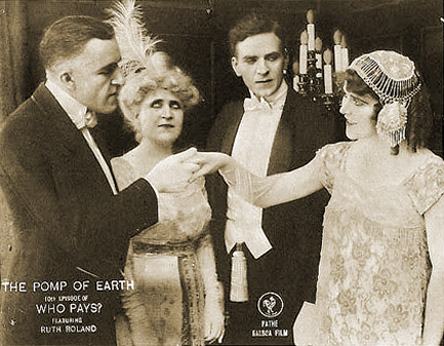
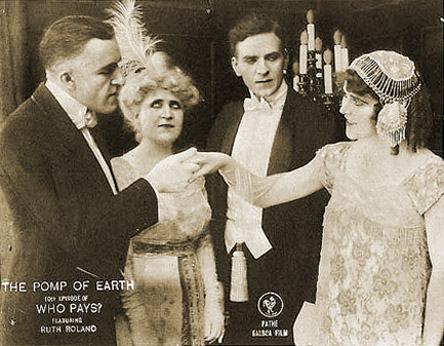
King’s authorship is less auteurist than auditorial; he tallies social costs like a bespectacled clerk. His intertitles eschew floridity for double-entry bookkeeping. Example from Pomp of Earth (Ep. 10):
"He bought marble for his foyer while workers bought coffins for their lungs. Who, O spectator, co-signed?"
The direct address plants a seed that blossoms in the final episode, Toil and Tyranny. There, King himself steps before the lens as a factory foreman literally branding steers with the company logo. The self-casting is no Hitchcockian cameo but a confession: the filmmaker acknowledges his place in the very supply chain he indicts.
Adjacent to Who Pays?, the serial The Exploits of Elaine preaches narrative dependency: each omission jeopardizes the next thrill. King’s cycle inverts that addiction; it supplies narrative independency yet thematic dependency. One could, in theory, enter at Houses of Glass (Ep. 6) and still decode the moral circuitry. This modular design anticipates later anthology television—The Twilight Zone owes a spectral debt.
Conversely, compare Lena Rivers (1914), where melodrama courts closure. Who Pays? denies catharsis; every ending is an invoice forwarded, not a mortgage burned.
Contemporary trade papers reported heated lobby debates. In Fort Wayne, a preacher slugged a banker over culpability in The Love Liar (Ep. 4). In Ogden, Utah, suffragists paraded wearing sashes that read "I Pay—Do You?" This participatory furor was no accident. Distributors supplied theater owners with blank ledger pads stamped with the Who Pays? header; audiences scrawled answers, pinned them on cork boards, and reconvened the following week to see if the next reel corroborated their verdicts.
Thus the cycle weaponizes the very economics it critiques. Viewers become subscribers to an open-ended moral spreadsheet, compelled to return not for plot resolution but for audit season.
Few complete prints survive. UCLA’s Film & TV Archive holds a 35 mm nitrate composite of episodes 1, 5, and 11, salvaged from a shuttered Montana opera house. The George Eastman Museum possesses a 16 mm reduction of The Fruit of Folly (Ep. 11) with Dutch intertitles—evidence of brisk overseas sales. Digital 2K scans reveal granular detail: the texture of King’s suspenders, the fray on Roland’s collar, the thumbprint on a prop newspaper. These micro-traces intensify the cycle’s forensic aura, as though evidence is being cataloged for an unseen tribunal.
Today, binge culture replicates Who Pays?’s weekly accounting ritual. Imagine releasing each episode on TikTok, ending on a freeze-frame poll: Who’s Guilty? The 1915 challenge translates seamlessly to the swipe-generation courtroom. Topics—wealth asymmetry, racialized jurisprudence, gendered double standards—remain disconcertingly au courant.
Where contemporary anthologies (Black Mirror, Social Distance) rely on speculative tech, King’s cycle needs only the arithmetic of ordinary exploitation. Its prescience lies in recognizing that technology merely accelerates the same old cost-shifting.
Who Pays? is not a nostalgic curiosity; it is a foundational text on how narrative can implicate without preaching. Its formal daring—variable casting, chromatic coding, open ledger structure—prefigures modern interactive storytelling by a century. Yet the cycle is also a product of its era: some portrayals traffic in grotesque racial caricature, particularly in Blue Blood and Yellow. Rather than cancel, we must contextualize, acknowledging that the moral audit extends to the filmmakers themselves.
Watch it, if you can locate fragments. Discuss it, because the question refuses closure. And when the final intertitle asks Who Pays?, resist the reflex to point at the screen. The film’s lingering afterimage hovers between projector beam and retina—an unfaded invoice awaiting signature.
For further exploration of silent-era morality tales, see retrospectives on Judge Not and The Crucible. If you’re researching serial precedents, consult The Exploits of Elaine and European entries like Diligencekusken fra San-Hilo.
IMDb 5.7
1931
Community
Log in to comment.