DbcultAccessing Vault...
Cult Review
Senior Film Conservator
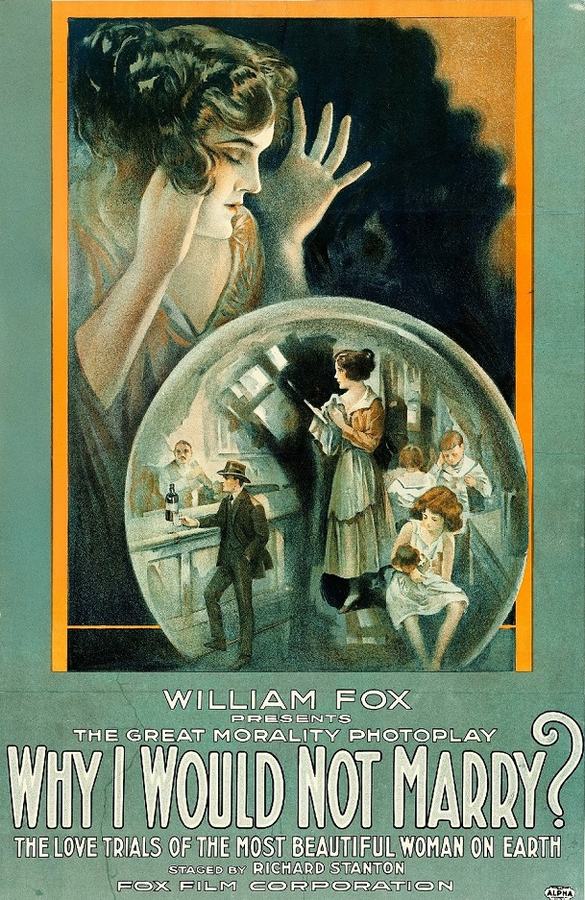
In the annals of early cinematic history, certain films emerge not just as entertainment but as poignant social commentaries, reflecting the burgeoning anxieties and aspirations of their era. Why I Would Not Marry, a 1920 silent drama, stands as one such artifact, offering a fascinating glimpse into the evolving role of women and the societal pressures surrounding marriage at the dawn of the Roaring Twenties. It’s a narrative that, despite its century-old vintage, still resonates with surprising contemporary relevance, posing questions about agency, authenticity, and the true cost of conventional happiness.
The film introduces us to Adele Moore, portrayed with an arresting blend of grace and inner turmoil by the luminous Lucy Fox. Adele is a woman whose beauty attracts no shortage of admirers, four of whom have, by the film's opening, formally sought her hand. Yet, her heart remains a tempest of indecision. Her father, a character emblematic of patriarchal pragmatism, subtly but firmly steers her towards a financially advantageous match, viewing marriage not as a romantic ideal but as a strategic alliance. This familial expectation, coupled with her own uncertainty, plunges Adele into a profound existential quandary. The film masterfully sets up this dilemma, presenting Adele as a figure on the precipice, caught between societal expectation and an undefined yearning for something more genuine.
Desperate for clarity, Adele eschews conventional advice, seeking instead the arcane wisdom of a fortune teller. This narrative device, while common in early cinema, is employed here with particular effectiveness, transforming the film from a simple romantic drama into a profound exploration of potential realities. As Adele gazes into the fortune teller's crystal ball, the screen becomes a window into four distinct, chillingly plausible futures, each representing a life with one of her suitors. These aren't mere fantasies; they are vivid, almost tactile enactments of what could be, imbued with a stark realism that belies their supernatural origin.
The visions are a masterclass in narrative economy, each revealing a devastating flaw in the seemingly perfect facades of her potential husbands. The esteemed lawyer, a pillar of the community, is exposed as faithless, his public rectitude a flimsy veil for private betrayal. The prosperous banker, a man of apparent financial integrity, is revealed as a thief, his wealth built on illicit gains. The devoted doctor, a healer of bodies, becomes a neglectful spouse, his professional dedication eclipsing any personal affection. Perhaps most harrowing is the vision concerning the humble clerk, a man of modest means. Driven to desperation by a threatening employer, he suggests that Adele sacrifice her honor, reducing her to a mere commodity to save his own skin. Each vision is a hammer blow, shattering Adele's illusions and forcing her to confront the grim realities that often lurk beneath the surface of societal expectations. This sequence, in particular, showcases the potent storytelling capabilities of silent film, conveying complex emotional and moral dilemmas through visual metaphor and compelling performance.
The cumulative effect of these revelations is profound. Adele, initially torn between choices, now finds herself liberated by the truth, however painful. Her subsequent dismissal of all four suitors is not an act of petulance but one of profound self-preservation and burgeoning independence. She refuses to be a pawn in her father's financial schemes or a victim of any man's moral failings. This moment marks a pivotal shift, transforming Adele from a passive object of desire into an active agent of her own destiny. It's a powerful statement for a film of its era, subtly challenging the prevailing notions of a woman's place and purpose.
Her decision to leave her familiar surroundings and relocate to the tranquil, if somewhat remote, landscape of Vermont is a testament to her resolve. Here, she endeavors to forge a new life, opening a modest general store. This entrepreneurial venture, while initially fraught with challenges and slow business, symbolizes her commitment to self-sufficiency. It’s a deliberate rejection of the gilded cages offered by her previous suitors, a choice for hard-won freedom over pre-packaged comfort. This journey of self-discovery, though arduous, is a vital part of her transformation, echoing themes seen in other films of female empowerment, even if more subtly expressed in the silent era.
Just as her new life seems to be stagnating, fate intervenes in the form of a passing salesman. This character, whose arrival feels serendipitous rather than contrived, embodies a different kind of masculinity – one rooted in partnership, respect, and shared ambition. He sees not just a struggling shopkeeper, but a woman of untapped potential. William B. Davidson, in this role, brings a certain grounded charm that contrasts sharply with the earlier, more flawed suitors. Under his astute management and collaborative spirit, Adele’s store blossoms, transforming from a quiet enterprise into a booming success. This partnership is crucial; it’s not about a man rescuing a woman, but rather a man recognizing and amplifying a woman's inherent capabilities.
The culmination of this journey is Adele's agreement to marry the salesman. This decision, unlike her previous predicament, is born not out of obligation or desperation, but from genuine happiness, mutual respect, and shared success. It's a union predicated on a foundation of earned independence and authentic affection, a stark contrast to the hollow promises of her past suitors. The film thus delivers a satisfying, albeit idealistic, conclusion, affirming that true happiness lies not in conforming to external pressures but in forging one's own path and finding a partner who supports that journey.
Lucy Fox's portrayal of Adele Moore is undoubtedly the anchor of Why I Would Not Marry. Her expressive face and nuanced gestures convey Adele's initial confusion, her growing horror, her resolute determination, and ultimately, her serene contentment. In an era where performances often veered towards the melodramatic, Fox manages to imbue Adele with a believable inner life, making her struggles and triumphs genuinely felt. Her ability to communicate complex emotions without dialogue is a testament to her skill as a silent film actress. William B. Davidson, as the transformative salesman, provides a sturdy and appealing counterpoint, his character representing the ideal partner who values collaboration over control. Edward Sedgwick, whose role might be less central but no less impactful in supporting the narrative, contributes to the overall atmospheric integrity of the film.
Adrian Johnson's screenplay for Why I Would Not Marry is remarkably well-structured, particularly in its clever use of the fortune teller device. This narrative technique allows for a concise yet comprehensive exploration of multiple potential outcomes, offering both dramatic tension and moral clarity. The pacing is deliberate, building suspense during the visions and allowing Adele's subsequent journey of independence to unfold organically. The film's visual language, typical of early 20th-century cinema, relies on clear compositions and effective use of intertitles to bridge the narrative gaps that facial expressions and body language alone couldn't convey. The production design, while perhaps not extravagant, effectively distinguishes between the opulent settings of Adele's initial life and the rustic simplicity of Vermont, underscoring her journey of self-reinvention.
The core themes of Why I Would Not Marry are surprisingly durable. At its heart, it is a story about female agency and the courage to defy societal expectations. Adele's initial dilemma – marrying for financial security versus an elusive ideal of love – was a very real one for women of her time. The film challenges the notion that a woman's worth is tied solely to her marital status or her husband's wealth. Instead, it champions economic independence and the pursuit of personal fulfillment. This resonates with films like The Way of a Man with a Maid, which also explored the intricacies of relationships and societal pressures on women, albeit perhaps from a slightly different angle of romantic pursuit rather than a direct rejection of traditional marriage structures.
Furthermore, the film delves into the often-hidden realities behind seemingly respectable facades. Each of Adele's prospective husbands, representing pillars of society, harbors a profound moral failing. This cynical view of conventional success underscores a pervasive unease with the superficiality of appearances, suggesting that true character is often concealed. It's a theme that finds echoes in later dramas that expose the secret lives of individuals, much like the hidden truths that might be explored in a film such as The Dead Secret, where concealed pasts dictate present choices. The film implicitly critiques a system that prioritizes material gain and social standing over integrity and genuine affection.
The shift from Adele's reliance on a fortune teller to her eventual self-reliance is also noteworthy. While the magical crystal ball provides the initial impetus for her decision, her subsequent actions are entirely her own. She doesn't wait for another prophecy; she actively builds her future. This transition from passive recipient of fate to active shaper of destiny is a powerful message of empowerment, especially potent for audiences of the early 20th century who were witnessing significant societal changes in women's roles. One might draw parallels to the agency displayed by protagonists in other silent films that tackled complex marital decisions, such as Whose Wife?, which similarly navigated the intricate landscape of matrimonial choices and their consequences.
Why I Would Not Marry, while perhaps not as widely known as some of its contemporaries, offers a compelling narrative that holds up remarkably well. It's a testament to the enduring power of storytelling that a film from the silent era can still provoke thought and discussion about personal values, societal pressures, and the pursuit of authentic happiness. It’s a quiet but resolute declaration of independence, celebrating the courage to walk away from what is expected in favor of forging a path less traveled.
The film's ending, where Adele finds love and professional success hand-in-hand, suggests a holistic view of fulfillment. It’s not just about romantic love, but also about meaningful work and a sense of purpose. Her eventual marriage to the salesman is a conscious choice, made from a position of strength and self-knowledge, rather than desperation or societal pressure. This nuanced portrayal of a woman's journey towards self-actualization makes Why I Would Not Marry a valuable cinematic gem, deserving of continued appreciation and study, not merely as a historical artifact but as a narrative that continues to speak to the timeless human desire for autonomy and genuine connection.
In an age where choices often feel overwhelming and the pursuit of external validation can overshadow internal contentment, Adele Moore’s story is a gentle reminder to look beyond the surface, to trust one’s instincts, and to dare to build a life that truly reflects one’s deepest desires. It’s a silent film that speaks volumes about the enduring quest for a life lived on one's own terms, a message as vibrant and relevant today as it was a century ago.
IMDb 3.5
1932
Community
Log in to comment.