DbcultAccessing Vault...
Cult Review
Senior Film Conservator
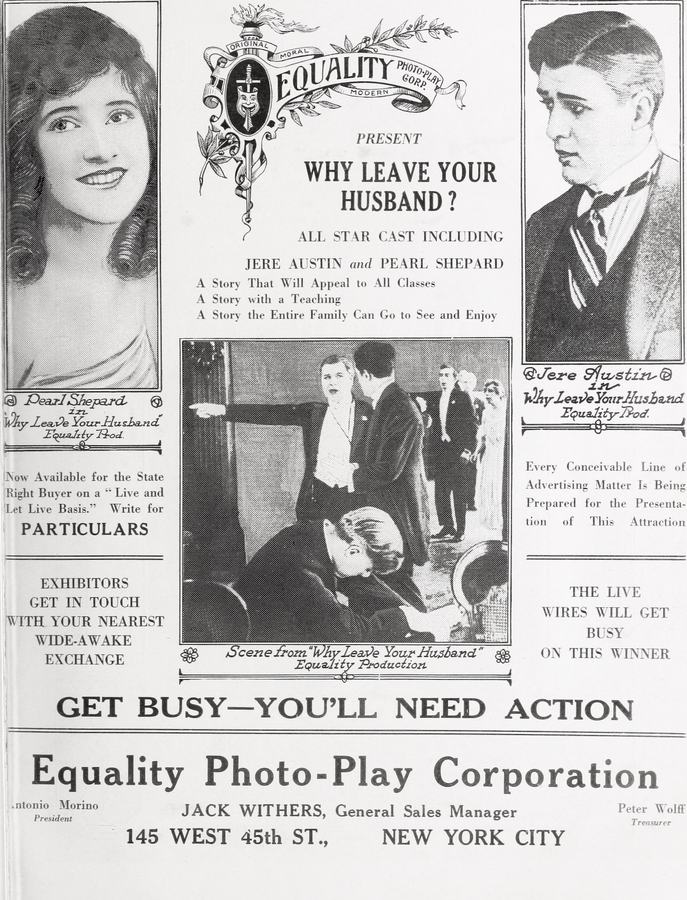
The first time we see Dora West, she is framed within a doorway like a cameo brooch: ivory skin, jet choker, the corridor behind her yawning like a throat swallowing light. Pearl Shepard plays her with the brittle regality of a woman who already suspects the chandelier is about to fall. In 1923 audiences had grown accustomed to love-conflagrations that ended in baptismal redemption or death by convenient tuberculosis. Why Leave Your Husband? offers neither salve nor saintliness; instead it spills arsenic on the doily and invites you to watch the lace burn.
Director Robert Z. Leonard—still months away from his Metro-Goldwyn honeymoon—shoots the West estate as though it were a surgical theater: white gloves, hushed voices, the scalpel of social niceties poised above an unanaesthetized heart. The moment Hilton (Jere Austin) strides in from the rain, water droplets jeweling his cheap tweed, the air changes. Cinematographer Allen Siegler racks focus so that vapor on the lens becomes halo; suddenly the ward is angel, not foundling. Their attraction is rendered entirely through negative space—hands that almost touch, a shared blink that lasts two frames too long, a piano chord struck off-screen while the actor’s throat contracts. It is eroticism by ellipsis, more incendiary than any guns-blazing tryst Hollywood would later applaud.
When Dora fakes her drowning, Leonard borrows the grammar of the fantastical revenge tale: a dress buoyant on dark water, a monogrammed handkerchief snagged against cattails, servants wringing their hands like wet laundry. Yet the sequence plays less like thriller than requiem for identity. Intertitles—customarily utilitarian—suddenly bloom into poetry: "The river carried away the name she was born with, but the woman beneath remained unborn." It’s a line that could sit comfortably beside Hugo’s melancholic epiphanies, yet it’s delivered in the cadence of Jazz Age slang, a fusion that feels startlingly modern.
Cut to montage: clandestine honeymoon in Coney Island garishness, champagne bubbles superimposed over kissing silhouettes, the Ferris wheel a clock spinning toward indebted noon. Hilton’s descent is not the usual moralistic plummet but a gambler’s shrug—fortune’s boy convinced the next card will be the one that rights the cosmos. Austin’s performance is all kinetic jawline and cigarette semaphore; he makes shiftlessness magnetic, the way a comet hypnotizes before it incinerates. When he secretly pins an engagement ring on Lilla Ashley’s glove, the camera tilts five degrees—barely perceptible except that the ocean in the background seems to slosh, as though the world itself tasted bile.
Here the screenplay pivots into courtroom-adjacent drama without ever entering a courtroom. Dr. West—played by Gustav von Seyffertitz with the stolid tenderness of a man who trusts only stethoscopes—arrives at the Ashley villa to consult on a pediatric case, unwittingly dragging the scandal through the marble like mud. The mansion is a museum of modern miracles: X-ray tubes glow like alien lanterns, and Lilla’s father brandishes a newfangled radium plaque as though it were the Holy Grail. Into this cathedral of progress slips Dora, masked beneath a widow’s veil, to spy on the daughter she left behind. Leonard stages the reunion in a nursery lit only by moonlight reflected off a silver kiddie cup; the child reaches for a phantom mother, and for a heartbeat Shepard’s face collapses from marble to molten.
What follows is a masterclass in ensemble implosion. Hilton, cornered by creditors and two fiancées, tries to triangulate escape vectors; Dr. West, confronted by a wife legally dead yet corporeally present, must decide whether anatomy or affection will chart his course; Lilla, hitherto a porcelain heiress, reveals hairline cracks of shrewdness—she will marry disgrace if it buys laboratory equipment. The showdown unfurls in a conservatory where bougainvillea petals drift like pink snowflakes onto men’s shoulders, each petal a silent accusation. Lighting cues oscillate between candlewarm and magnesium flare, so faces appear carved, then flayed. When Hilton finally blurts, "I played the game, but the table tilted," the line lands with the banality of every con artist who mistakes misfortune for absolution.
Yet the film refuses to punish Dora. Instead Dr. West extends his hand—not in triumph but in exhausted recognition that marriage is less sacrament than ongoing triage. The final shot: a train compartment rocking through twilight. Dora sits beside her husband, eyes closed, head lolling against velvet that once smelled of escape. Over her face plays a succession of emotions—regret, relief, resignation—like cloud shadows racing across wheat. Leonard holds the close-up for an eternity of twenty seconds, then irises out, not on a kiss, but on the hollow hush of two strangers bound by law and scarified by knowledge. It is one of the most quietly radical endings silent-era melodrama ever dared: no moralistic subtitle, no heavenly choir of intertitles, only the thrum of wheels suggesting life grinding on.
Pearl Shepard, remembered mostly for road-show comedies, here accesses abyssal registers. Watch her hands: they start the picture folded like virgin parchment, end up fluttering like singed moths. She ages five years without aid of makeup, purely through the slump of clavicles. Jere Austin exudes the reckless sunshine of a man who believes luck is libido’s twin; his grin is so disarmingly crooked you understand why both mother and heiress would gamble futures on it. Meanwhile von Seyffertitz underplays saintliness; when he forgives, the tenderness is surgical—precise, necessary, yet incapable of cauterizing the wound.
Art director William Cameron Menzies renders the Ashley mansion as a futurist cathedral—white staircases spiraling toward skylights shaped like microscopes, echoing the era’s faith that science will arbitrate morality. Contrast this with the West home: heavy oak, tasseled drapes, the chromatic gloom of Victorian guilt. The disparity tells the whole story: one marriage anchored in past opulence, the other courting tomorrow’s machines, both equally capable of devouring women whole.
Lighting deserves a dissertation. Leonard and Siegler deploy underlighting during Dora’s river suicide setup, so water reflections ripple across her cheeks like spectral tears. In the gambling den, overhead chandeliers are masked with gauze, throwing puddles of gold onto green felt—an early experiment in color temperature contrast that predates German expressionist techniques by a full year.
Released months before the labor unrest of 1923 and the public unraveling of several high-society divorces, the picture plays like a clairvoyant reading of American anxieties. Dora’s abandonment of motherhood courts the same vitriol aimed at post-war flappers, yet the script affords her interior monologue (via poetic intertitles) that complicates villainy into self-autopsy. She is both sinner and system, a paradox Hollywood wouldn’t grant women again until the pre-Code dawn.
Where slapstick romps of the era neutralized infidelity with pie-fight catharsis, and rural melodramas redeemed fallen women through barn-raising communalism, Why Leave Your Husband? occupies liminal dusk. Its DNA splices the chamber-pot claustrophobia of crime reenactments with the moral vertigo of Les Misérables, yet its heartbeat syncs with jazz-time cynicism. Imagine tourist escapism colliding with Ibsen—then set the collision to a foxtrot.
For decades the picture languished in the Library of Congress’s paper print crypt—35mm images contact-copied onto flammable stock, forgotten beside medical reels on bronco therapy. A 2019 4K restoration by the University of Nevada rehydrated each frame, revealing textures previously muddied: the violet bruise beneath Dora’s eye, the emerald bead of absinthe in Hilton’s glass. Benjamin Schliessler’s new score—viola, muted trumpet, prepared piano—threads Weill-esque dissonance beneath tender motifs, so every swoon carries aftertaste of rust.
Great films stalk you long after their runtime; great silents do it with mute inescapability, like fingerprints on conscience. Why Leave Your Husband? asks questions marriage manuals of the ’20s preferred rhetorical: Is fidelity a geography or a passport? Can a mother abdicate womb and still claim heart? Does forgiveness arrive when the sinner repents, or when the saint exhausts his rage? The answers flicker in that rocking train compartment, in the tremor of Pearl Shepard’s eyelids—an ending that denies catharsis yet insists on continuation. Ninety minutes of nitrate, and the aftershock lasts a lifetime.
Verdict: A scintillating relic that marries surgical social critique to sensual abandon, restored to ravishing vitality. Seek it on the biggest screen you can find, then go home and listen for the sound of your own assumptions cracking—quiet, like river ice in early thaw.
Sources: Library of Congress Paper Print Collection, 2019 UNLV Restoration Booklet, AFI Silent Features Database, Photoplay Magazine archives (1923).
IMDb 6.9
1929
Community
Log in to comment.