DbcultAccessing Vault...
Cult Review
Senior Film Conservator
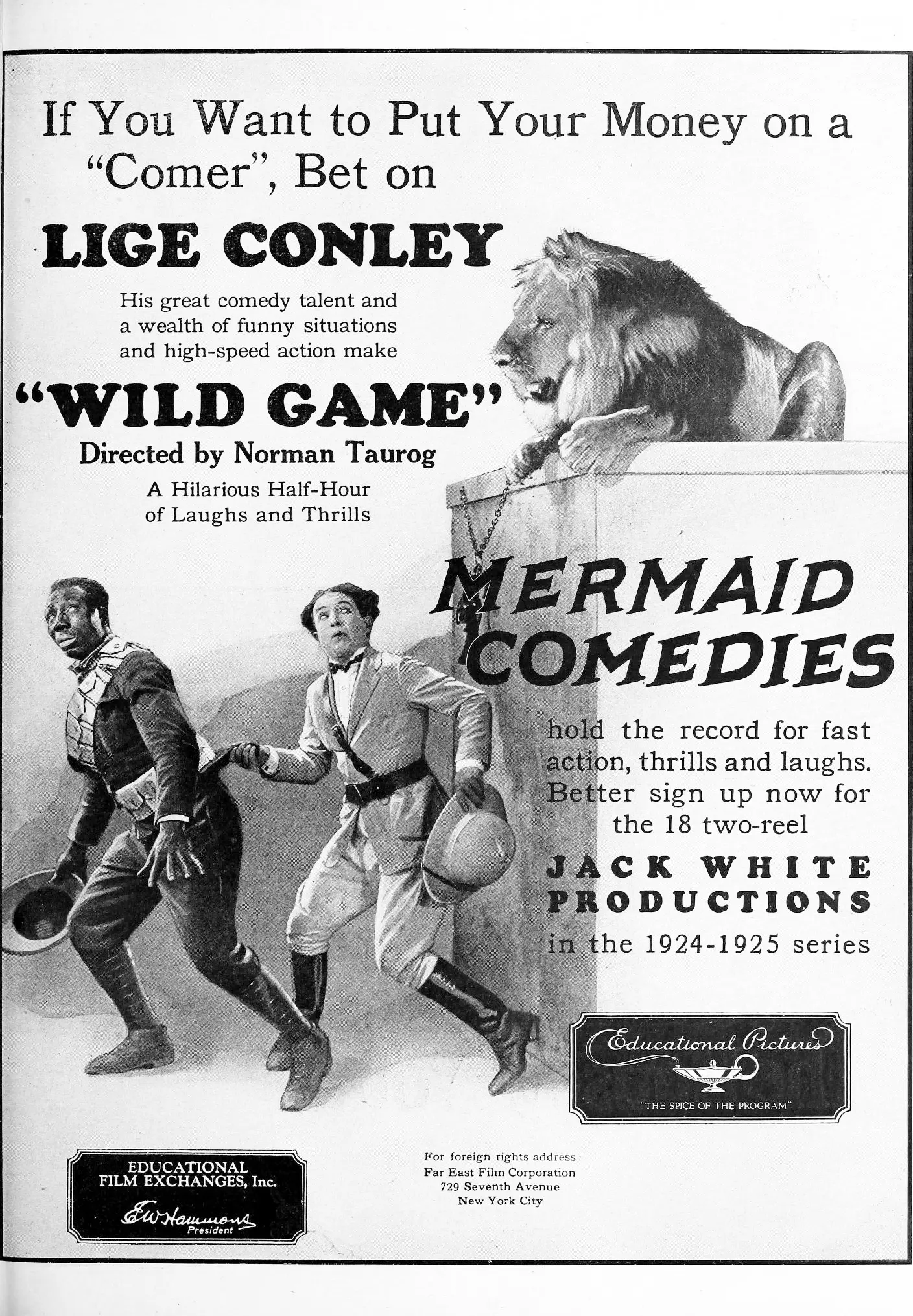
In the volatile landscape of 1920s short-form comedy, few performers possessed the elastic desperation of Lige Conley. "Wild Game," a 1923 relic of the Mermaid Comedies stable, stands as a testament to an era where narrative logic was secondary to the sheer, unadulterated velocity of the gag.
To watch "Wild Game" is to witness a cinema untethered from the gravity of realism. While contemporary audiences might find the maritime opening reminiscent of the grim naturalism found in The Sea Wolf (1920), Conley’s vehicle immediately pivots into the realm of the ludic. The shipwreck is not a tragedy but a transition—a threshold into a world where the laws of physics are merely suggestions. The introduction of Lige and his valet, played with a weary resilience by Spencer Bell, establishes a dynamic of peripatetic misfortune that defines the film’s first act.
The initial encounter with the island’s inhabitants is, undeniably, a product of its time, steeped in the problematic tropes of the "darkest Africa" subgenre. Yet, through a modern lens, the sequence functions as a bizarre, kaleidoscopic nightmare. The cannibalistic threat is rendered with such cartoonish exaggeration that it transcends malice, becoming instead a backdrop for Conley’s mercurial physical reactions. Unlike the more grounded suspense of Under Suspicion (1923), the danger here is purely aesthetic, serving as a springboard for the film’s first major technical set-piece: the flood.
The sequence involving the straw hut fire and the subsequent inundation is a marvel of early special effects and practical stunt work. There is a visceral quality to the rushing water that provides a stark contrast to the dry, dusty sets of the palace to come. As the heroes are swept away, the film engages in a moment of sublime absurdity: the alligator-as-spar. This gag, executed with a seamless blend of prop work and animal handling, exemplifies the "anything for a laugh" ethos of the Jack White productions. It lacks the maritime gravity of The Skipper's Narrow Escape, opting instead for a surrealist buoyancy that feels almost avant-garde.
The transition from the wild, uncurbed elements of the island to the structured, albeit decadent, environment of the Oriental palace marks a shift in the film’s comedic register. Here, the humor becomes more situational, rooted in the clash of cultures and the protagonist’s inherent unsuitability for polite—or even impolite—society. Otto Fries, as the potentate, provides a formidable foil to Conley’s lithe franticness. The ruler’s desire for the girl (Ruth Hiatt) introduces a plot engine that, while familiar, is handled with a brisk efficiency that prevents the film from sagging into melodrama.
Special mention must be reserved for Spencer Bell. Often relegated to the background in the historiography of silent comedy, Bell’s timing in "Wild Game" is impeccable. His valet is not merely a sidekick but a rhythmic partner to Conley. Their synchronicity during the palace chase is a precursor to the great comedy duos of the talkie era. While the film’s social politics are archaic, the chemistry between the two leads possesses a timeless quality, a shared language of shrugs, double-takes, and desperate sprints that resonates across a century.
The palace interior itself is a triumph of set design, a labyrinthine space of trapdoors, silk hangings, and hidden chambers. It provides the perfect arena for the film’s piece de resistance: the lion encounter. Unlike the domestic anxieties found in The Old Nest, the stakes in "Wild Game" are visceral and predatory. The lion is not merely a prop but a catalyst for a sustained sequence of acrobatic evasion that pushes Conley to the limits of his physical capabilities.
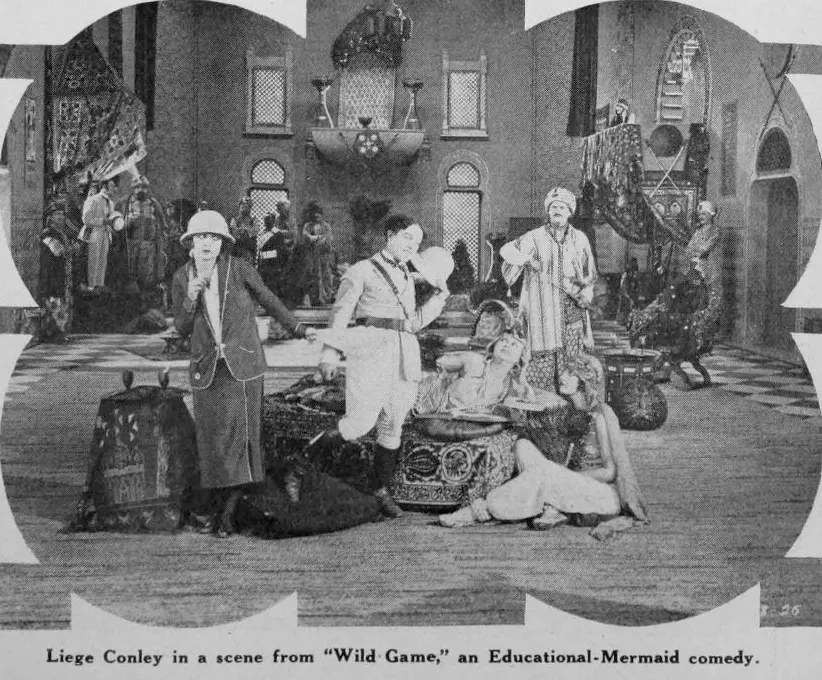
The climax of the film is a masterclass in spatial comedy. The hero and his companion are thrust into a room with a loose lion, initiating a chase that utilizes every inch of the palace’s vertical and horizontal planes. This isn't the calculated, slow-burn tension of a drama; it is a manic, breathless scramble. Conley’s ability to maintain his character’s specific brand of cowardly bravery while performing what are essentially high-wire stunts is nothing short of extraordinary.
One cannot help but compare this sequence to the more structured narratives of the time, such as Mr. Opp. Where other films of 1923 were beginning to experiment with psychological depth and nuanced character arcs, "Wild Game" remains proudly superficial. It is a cinema of attractions, a series of shocks and delights designed to elicit an immediate, visceral response. The eventual conquest of the lion by the hero is not a triumph of the spirit, but a triumph of the gag—a final, triumphant punchline to a twenty-minute joke.
In the broader context of 1923, a year that saw the release of such varied works as The Queen of Sheba and Barnaby Rudge, "Wild Game" occupies a unique niche. It represents the pinnacle of the "wild" comedy short, a genre that would soon be eclipsed by the more sophisticated feature-length comedies of Keaton and Lloyd. Yet, there is a purity in its chaos that the more polished features often lack. It is a film that feels like it was made on the fly, fueled by adrenaline and the sheer joy of visual invention.
The cinematography, handled with a steady hand despite the frantic action, captures the scale of the flood and the claustrophobia of the palace with equal skill. The editing is sharp, favoring a rhythmic pulse that keeps the viewer perpetually off-balance. Even in its quieter moments, such as the initial reception by the potentate, the film maintains an undercurrent of potential energy, a sense that at any moment, the furniture might come to life or a wild animal might burst through the wall.
Lige Conley remains one of the great "what-ifs" of silent cinema. His career, cut short by a tragic accident, was on a trajectory toward the pantheon of comedy greats. "Wild Game" is perhaps the best distillation of his appeal. He was the everyman in extremis, a figure of fragile dignity constantly besieged by a hostile and nonsensical universe. His performance here is a whirlwind of expressions, from the wide-eyed terror of the cannibal pot to the smug, accidental heroism of the lion’s defeat.
While the film’s cultural sensitivities are firmly rooted in the 1920s—requiring a significant degree of historical contextualization for the modern viewer—its technical prowess and comedic timing remain undeniable. It is a frantic, messy, and ultimately exhilarating piece of film history. It lacks the satirical bite of The Stimulating Mrs. Barton, but it compensates with a raw, unbridled energy that is infectious. For those willing to look past the dated tropes, "Wild Game" offers a fascinating glimpse into the anarchic heart of early Hollywood comedy.
"Wild Game" is a quintessential example of the 1920s short subject: fast, loose, and visually inventive. It serves as a vital document of Lige Conley's comedic genius and the technical ambitions of the Mermaid Comedies. A must-watch for silent film enthusiasts and historians of the slapstick form.
IMDb —
1923
Community
Log in to comment.