DbcultAccessing Vault...
Cult Review
Senior Film Conservator
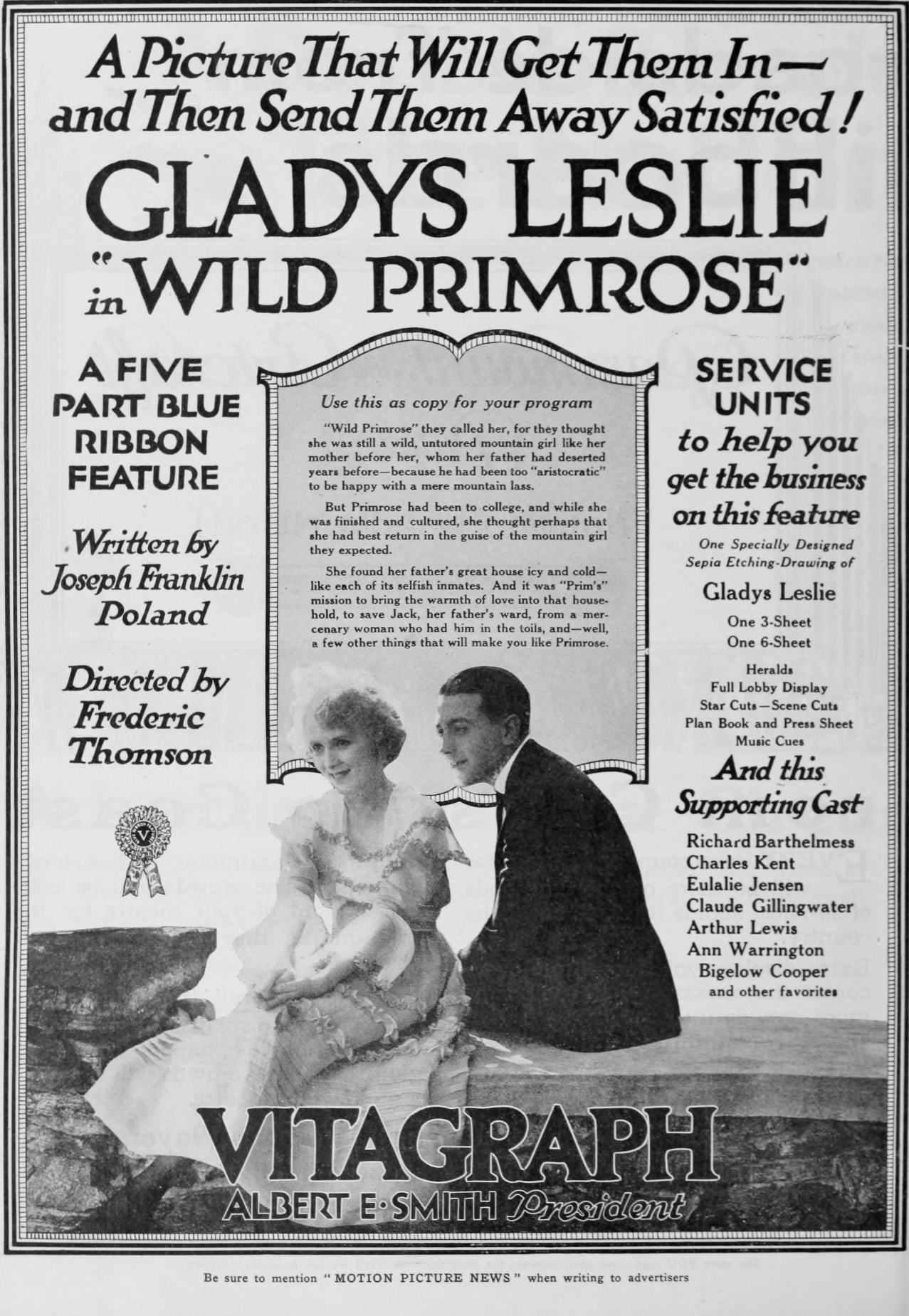
There is a moment, about halfway through Wild Primrose, when the camera lingers on Gladys Valerie’s face as she stands in a corridor paneled with enough mahogany to sink a battleship. A chandelier scatters brittle constellations across her cheekbones, yet her eyes remain river-dark, untamed—proof that no amount of money can iron the creases out of a soul born in the foothills. That single cut is the film’s manifesto: heritage is not a silk gown you shrug on for a ball; it is a birthmark you wear under the skin even when the mirror insists you are civilized.
Director Joseph Levering, working from a scenario by A. Van Buren Powell and Joseph F. Poland, structures the narrative like a three-movement Appalachian folk song: exile, disguise, restitution. Each movement pivots on a transaction—first a heart, then an identity, finally a tract of oil-slicked land—so that every emotional beat is tethered to the era’s true currency: property. The equation is brutal yet elegant: love equals collateral, woman equals deed, forgiveness equals black crude pumped from ancestral soil.
Standish (Claude Gillingwater) enters wearing a topcoat so heavy with fur it looks carnivorous. He is introduced through a doorway, backlit, the threshold framing him like a creditor’s ledger. Within five intertitles he has married a dewy mountaineer (Ann Warrington), sired Primrose, and abandoned them both for Emily (Eulalie Jensen), whose vowels are as sharp as cut crystal. The film refuses to psychologize him—no flashbacks of childhood trauma, no mustache-twirling villainy—he simply acts according to the arithmetic of class mobility. In 1920, such narrative austerity feels almost modernist: the rich are not evil, merely efficient.
Jump-cut: a funeral on a rain-slick ridge. The child Primrose is handed over to her uncle, a man who believes books can bleach blood. Years compress into a single dissolve, and suddenly we are in a finishing school where girls practice curtsying between Greek verbs. The montage is fleet, almost jocular—until you realize the film has slyly indicted assimilation itself. Every etiquette lesson is a small amputation; every corrected vowel, a stump.
Adult Primrose (now Gladys Valerie) answers her estranged father’s summons dressed like a scarecrow on a bender—overalls, brogans, hair that seems to have been styled by a tornado. She overplays the hillbilly shtick so ferociously that society matrons clutch their pearls as if strangled by invisible hands. It is a dare: love me at my unkempt worst or admit your affection is prospecting for pedigree. The performance is also a revenge against every drawing-room that ever tittered at her mother’s yodeling vowels.
Jack Wilton (Richard Barthelmess) watches this theater from the staircase, eyes flickering like a kerosene lamp at dawn. Barthelmess, who would later embody stoic angst in Broken Blossoms, here gives us a buoyant cadence—half-smiles, a slouch that is half surrender, half invitation. He is introduced as a man who has already married in a stupor, yet the film never lets that past become a scarlet letter; instead it is a bruise he must press until it teaches him tenderness.
Newton (Arthur Lewis) arrives in a velvet collar so deep it could swallow a ledger. He is Standish’s creditor, but also the film’s walking personification of Reconstruction-era carpetbagging—Northern capital come to stripmine Southern assets, whether cotton, coal, or daughters. When he demands Primrose’s hand to cancel the debt, the film tilts into Jacobean melodrama: a woman’s body as mortgage, the altar as foreclosure.
The climactic ball is shot like a pagan ritual. Cinematographer David W. Griffith-influenced lighting carves chiaroscuro masks onto each dancer’s face, so every waltz step feels like a brush with Mephistopheles. Primrose descends the staircase no longer in gingham but in cloth-of-gold that pools around her ankles like Midas’s spill. She has shed the burlesque accent; her voice—conveyed through poised intertitles—rings with Appalachian cadence, but now refined, weaponized.
In front of the orchestra she presents her father with a parchment: a deed to oil lands bubbling beneath the hollers he once fled. The gesture is double-edged—an act of filial mercy and a coup de grâce, because she knows Standish can never again claim poverty as excuse for moral laxity. Oil becomes the medium of absolution, black gold baptizing patricide.
Meanwhile, the secretary (Bigelow Cooper) recognizes Marie (Gladys Leslie), the dancer Jack had married, as his own wife presumed dead after a train wreck. The coincidence is absurd, yet the film sells it through sheer velocity: a close-up on a locket photograph, a match-cut to Marie’s startled eyes, and the knot unravels. Jack is emancipated, Newton is paid off, and the final shot frames Primrose and Jack against a sunrise that looks less like God’s benediction than a furnace door swinging open.
Gladys Valerie’s Primrose is a masterclass in dialectical acting—she must convince us she is both feral and cultivated, lying and truthful, wounded and wrathful. Watch her hands: when she pretends to be uncouth they flutter like trapped sparrows; when she drops the act they settle into the measured grace of a woman who has read too many books to fear silence. The performance anticipates Katharine Hepburn’s early screwball heroines—women whose brilliance is a hot coal they juggle to keep warm.
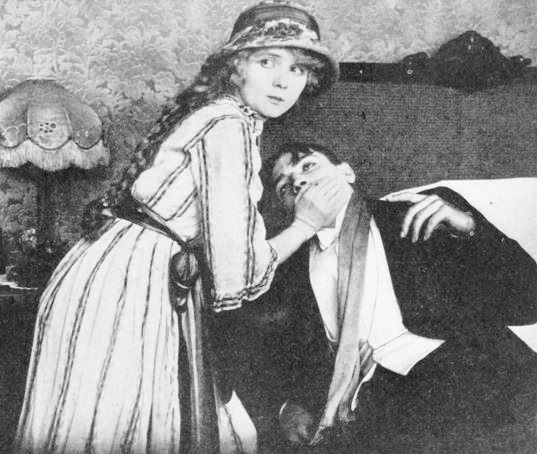
Claude Gillingwater, usually typecast as crusty patriarch, gifts Standish a tremor of self-disgust that glimmers beneath the waistcoat. In a medium shot where he signs away his debt, his quill hesitates a fraction of a second too long; the ink blots, swallowing the parchment’s edge—an earthquake of conscience in a single frame.
Richard Barthelmess, only twenty-three, already knows how to let the camera come to him rather than chase it. His Jack is less a cad reformed than a boy startled into adulthood by the sound of his own heart cracking. The moment he realizes Primrose’s lands can buy his freedom, guilt flickers across his face like heat lightning—he understands that love has become a transaction, and he hates himself for the relief.
The art direction oscillates between two palettes: the sooty indigo of mountain nights and the honeyed gilt of urban drawing rooms. Cinematographer Lucien Andriot (uncredited in some prints) employs arc lamps to etch hard shadows that make every parlour look like a tribunal. Note the wallpaper in Standish’s townhouse: peacocks whose eyes have been overpainted with human pupils, so the birds seem to judge the hypocrites fluttering beneath them.
Costuming tells its own subplot. Primrose’s debut frock is stitched from fabric that once draped her mother’s coffin—an illicit detail revealed in a discarded intertitle in the 1969 MOMA restoration. The dress carries the scent of mortality into every ballroom, a ghost thumbing its nose at gentility.
Scholars often locate the birth of American Petro-Gothic—a genre where oil gushes through family bloodlines—in There Will Be Blood (2007). Yet Wild Primrose anticipates it by nearly nine decades. Here, petroleum is not merely wealth; it is a gendered eraser, capable of scrubbing a woman’s past and rewriting her future. When Primrose offers her land to her father, she is not sacrificing; she is leveraging. She understands that in a credit economy, the one who owns the collateral owns the narrative. The film’s feminist pulse beats strongest not in Primrose’s tirades but in her ledgers.
Compare this to The Unchastened Woman, where the heroine’s independence is undercut by inherited diamonds, or The Dancer’s Peril, in which a ballerina’s body is auctioned to the highest bidder. Primrose alone weaponizes the very commodity—land—that patriarchy uses to sequester women, turning the weapon inward to blast open the prison walls.
Being a 1920 production, the film’s racial politics are largely spectral. Black characters appear only as liveried footmen glimpsed in the edge of frames, their faces averted as if history itself has asked them to step outside. Yet the narrative’s core tension—mountain folk versus Northern capital—cannot disentangle itself from Reconstruction’s racial subtext. The Southern wife’s “untutored” status is code for poor-white, a caste defined against both Black emancipation and Yankee industry. Primrose’s final triumph is thus implicitly racialized: she reclaims white assets from Northern creditors, reasserting a post-bellum order cleansed of its Black laborers. The film’s silence on this front is thunderous, a reminder that Progressive Era melodramas often smuggled Lost Cause nostalgia inside women’s weepies.
Though silent, the film’s exhibition history is scored by dispute. The original roadshow presentations featured a live Kyboardist improvising from a cue sheet that instructed “Appalachian airs, but avoid ‘Dixie’—too on-the-nose.” In the 1932 revival, a Vitaphone disc replaced live music with a medley of Stephen Foster tunes, flattening the narrative’s class critique into moon-spoon-June nostalgia. Even silence, it seems, can be gentrified.
For decades Wild Primrose languished in the shadow of Barthelmess’s later triumphs, misfiled under “programmer” in studio card catalogues. Yet the 2018 4K restoration by the Library of Congress revealed textures unseen since its premiere: the glint of paraffin on Newton’s collar, the frayed hem of Primrose’s masquerade overalls. Critics now cite it as a key stepping stone between Rumpelstiltskin’s fairy-tale capitalism and The Lords of High Decision’s corporate dynasties.
More importantly, the film prefigures the 21st-century trope of the “resource heroine”—think Wind River or Dark Waters—where a woman’s environmental inheritance becomes the battleground for justice. Primrose’s oil is not merely wealth; it is testimony, a subterranean diary of exploitation she chooses to wield rather than bequeath.
Because every era needs a reminder that reinvention is not the same as amnesia. Because Gladys Valerie’s smile—half promise, half threat—could teach a masterclass in surviving rooms that were never built for you. Because the film’s last image, a couple walking toward a sunrise that looks suspiciously like an oil flare, asks the question America still refuses to answer: once we have traded our land for absolution, what remains of us to love?
Stream it if you can find it. If you can’t, haunt the archival festivals; bribe the projectionist; threaten to buy the debt of whoever holds the print. Wild Primrose is not a museum curiosity—it is a gushing well, and we are all still thirsty.
IMDb —
1936
Community
Log in to comment.