DbcultAccessing Vault...
Cult Review
Senior Film Conservator
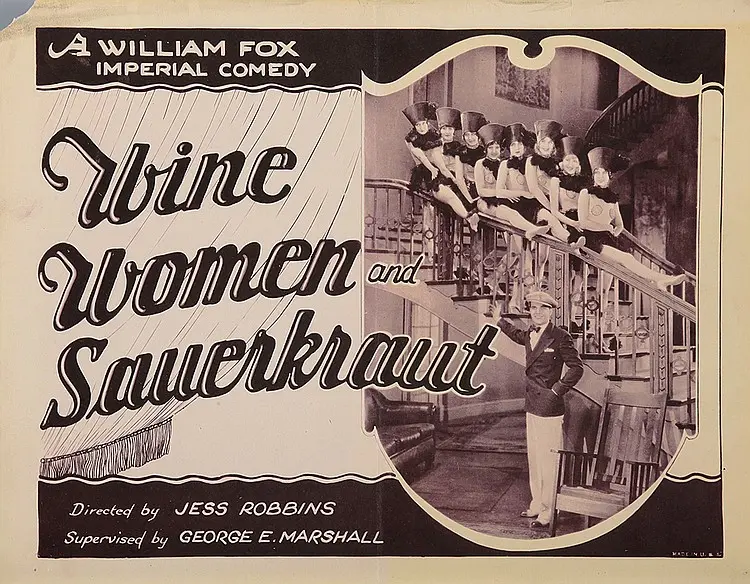
Does Wine, Women and Sauerkraut hold up as a comedic relic worth unearthing today? Short answer: yes, but only if you have a high tolerance for the relentless, unpolished energy of late-period silent slapstick. This film is specifically for those who appreciate the 'Educational Comedies' era and the evolution of the ensemble gag, while it will likely frustrate modern viewers looking for a coherent narrative or character growth.
This film works because its central premise—escaping a hotel bill—is a universal anxiety amplified to the point of absurdity. It fails because it relies too heavily on repetitive chase beats that lose their luster by the third act. You should watch it if you want to see a masterclass in low-budget set utilization and the physical prowess of 1920s bit players.
The 1920s were often portrayed as a time of excess, but Wine, Women and Sauerkraut reminds us of the gritty underside of the 'flapper' era. The chorus girls here aren't icons of glamour; they are working-class women one step away from the street. This desperation fuels the comedy. When Claire Cannon’s character eyes the exit, there is a genuine sense of stakes that modern 'hangout' comedies often lack.
The film utilizes the hotel setting like a clockwork machine. Every door is a potential trap, and every hallway is a gauntlet. Unlike the more sophisticated humor found in Le mauvais garçon, this short is interested in the raw physics of the escape. There is a specific moment where three girls attempt to hide behind a single, oversized trunk that perfectly encapsulates the film's 'hide-in-plain-sight' logic. It is silly, yes, but the timing is impeccable.
The pacing is breakneck. From the moment the house detective, played with a delightful, bulldog-like intensity by Fred Walton, enters the frame, the film refuses to breathe. It shares this frantic DNA with My Hero! (1922), though it trades Western tropes for urban claustrophobia. The 'sauerkraut' of the title is more of a thematic flavor than a literal plot point—it represents the messy, fermented chaos of their situation.
Nick Stuart brings a certain 'everyman' charm to the proceedings, though he is often overshadowed by the collective energy of the female ensemble. His role is to be the pivot point around which the chaos rotates. He isn't a comedian in the vein of Buster Keaton, but he understands the importance of the reaction shot. When the plan inevitably goes sideways, Stuart’s face mirrors the audience's own incredulity.
The chemistry between the girls is where the film finds its heart. They aren't just colleagues; they are a survival unit. This camaraderie is a refreshing change from the 'rival starlets' trope common in films like The Teaser. Here, the enemy is the institution—the hotel and its enforcer. The detective isn't a villain in the traditional sense; he is a bureaucrat of the lobby, making his eventual defeat feel like a victory for the little guy.
One standout sequence involves a complex series of hand signals used to navigate the lobby. It’s a silent film staple, but it’s executed here with a rhythmic precision that borders on dance. The way the actors move in sync suggests a level of rehearsal that belies the film's 'cheap' reputation. It is a reminder that even 'disposable' entertainment of this era required immense technical skill.
The camera work in Wine, Women and Sauerkraut is functional rather than poetic. It doesn't have the artistic aspirations of Tseka komissar Mirostsenko, but it excels at spatial clarity. In a film where the gag depends on knowing exactly where the detective is in relation to the girls, the director’s choice of wide shots is vital. We see the predator and the prey in the same frame, which builds a tension that close-ups would destroy.
The lighting is flat, typical for the time, but the set design is surprisingly detailed. The hotel feels lived-in, cluttered with the luggage of the era, which provides ample hiding spots. Compare this to the more minimalist sets in Brass Buttons, and you see how the environment itself becomes a character in the comedy. The stairs, the elevators, and the service carts are all weaponized for the sake of the punchline.
There is a brutal simplicity to the direction. It doesn't try to be clever with its editing. It trusts the performers to deliver the comedy through their bodies. This is 'pure' cinema in its most primal form—movement for the sake of movement. It’s a style that has largely disappeared, replaced by the rapid-fire cuts of modern action-comedy.
Is this film worth watching? If you are a student of comedy history, the answer is a resounding yes. It serves as a perfect bridge between the primitive slapstick of the early teens and the more sophisticated features of the late 20s. However, if you are looking for a deep emotional resonance or a plot that makes sense upon reflection, you will be disappointed. It is a snack, not a meal.
The film’s greatest strength is its lack of pretension. It knows exactly what it is: a twenty-minute distraction designed to make a theater audience chuckle before the main feature. In that regard, it is a total success. It doesn't overstay its welcome, though the final five minutes do feel like they are running on fumes. The 'Sauerkraut' element—which I won't spoil—is a bizarre tonal shift that works simply because the rest of the film is so unhinged.
Ultimately, Wine, Women and Sauerkraut is a testament to the durability of the 'debt-dodging' trope. We’ve seen this story told a thousand times since, from The Honeymooners to Seinfeld, but there is something uniquely charming about seeing it play out in the silent era. It’s loud for a silent movie. The visual noise of the flailing limbs and crashing props is almost audible.
Pros:
- Exceptional physical timing from the ensemble cast.
- A fast-paced runtime that prevents boredom.
- Interesting historical look at 1920s hotel culture and working-class struggles.
- Fred Walton’s performance is a masterclass in the 'straight man' archetype.
Cons:
- The plot is virtually non-existent beyond the initial setup.
- Some of the gags feel dated and predictable.
- The ending feels rushed and somewhat nonsensical, even for a slapstick short.
Wine, Women and Sauerkraut is a frantic, messy, and occasionally brilliant piece of silent-era ephemera. It doesn't have the grace of a Chaplin film or the structural genius of a Lloyd feature, but it has a raw, unbridled energy that is infectious. It’s a minor work, but a fascinating one. It works. But it’s flawed. If you can appreciate the craft of a well-timed pratfall, it’s a journey worth taking. For everyone else, it’s a curios piece of history that is better read about than watched. It’s a loud, silent scream for financial freedom wrapped in a comedy of errors.
"A chaotic snapshot of 1920s desperation, proving that the only thing scarier than a house detective is an empty wallet."
IMDb 6
1919
Community
Log in to comment.