DbcultAccessing Vault...
3/10
Senior Film Conservator
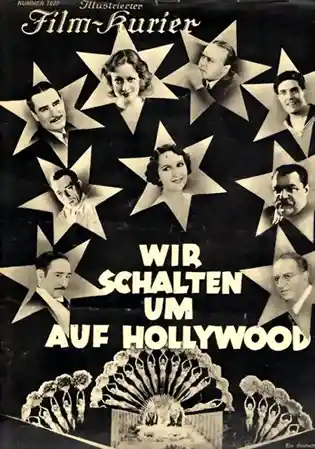
A definitive 3/10 rating for a film that redefined the boundaries of cult cinema. Wir schalten um auf Hollywood remains a cornerstone of transgressive art.
Look, if you're not already deep into classic Hollywood or early sound experiments, Wir schalten um auf Hollywood might feel like a bit of a head-scratcher. But for folks who geek out over silent stars navigating the talkie era, or just anyone curious about what a major studio's backlot looked like way back when, this little film is a fascinating peek. You'll probably skip it if you're looking for a plot or modern pacing. It's really more of a historical document with some famous faces.
Paul Morgan, our Austrian reporter, acts as our guide. He's got this earnest, slightly stiff charm, trotting around with his microphone. It's all very staged, of course, but you can feel the novelty of sound film still hanging in the air.
The real draw here, for me anyway, is seeing these legends in such an informal setting. When Buster Keaton shows up, it's just a quick moment, almost like a drive-by. He's not doing gags, just talking. There's this fleeting glimpse of a smile, and you almost wonder what he's thinking about all these microphones and cameras. It's a bit heartbreaking, seeing the Great Stone Face just... being.
Joan Crawford, on the other hand, is pure star power. Even in what feels like a casual chat, she commands the screen. Her energy is just different, more polished, even then. You can tell she knows how to work a camera, even for a simple radio interview.
But the absolute wild card is Adolphe Menjou. He performs a lengthy sketch entirely in German. And I mean lengthy. It goes on and on, taking up a surprising chunk of the film. It's one of those moments where you just lean back and think, *"Did they really just do that?"* It feels like a genuine effort to connect with a German-speaking audience, but it also totally stops the flow. It's not particularly funny, but it's *so* specific and unexpected, you can't help but be charmed by its sheer existence. 🎭
The Albertina Rasch Dancers pop in for a bit, a sudden burst of coordinated movement. It's a nice little break from the interviews, showing a different side of studio life. It feels like a moment to just remind everyone that MGM was about more than just talking heads.
Overall, the whole thing feels like a time capsule. The sound quality isn't perfect, the editing is a little clunky. But that's part of its appeal, honestly. You're not watching some slick modern production. You're watching history unfold, raw and a little unpolished.
Didja notice?
IMDb —
1923
Community
Log in to comment.