DbcultAccessing Vault...
Cult Review
Senior Film Conservator
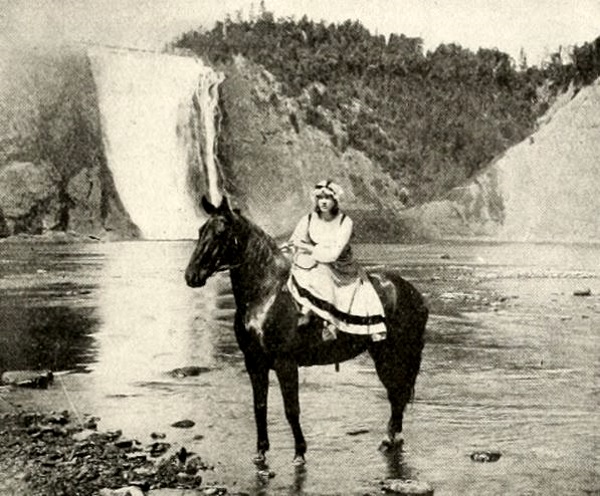
The year 1914 stood as a precipice for global history, yet in the realm of the moving image, it was a period of burgeoning sophistication. Wolfe; or, the Conquest of Quebec emerges from this era not merely as a dry recitation of colonial skirmishes, but as a vibrant, albeit silent, exploration of the human cost inherent in the birth of nations. Unlike the more domestic focus of contemporary works like Det gamle Købmandshjem, this production seeks a scale that rivals the grandest stage plays, attempting to condense the labyrinthine maneuvers of the 1759 siege into a coherent, emotionally resonant visual experience.
Harold A. Livingston’s portrayal of General Wolfe is a fascinating study in the 'sickly hero' archetype. From the outset, we are presented with a man whose physical fragility is perpetually at odds with his iron-willed sense of duty. The scene where he receives the locket from Katherine Lowther is not merely a trope of the genre; it serves as a tether to a life he is increasingly likely to forfeit. This personal stake is mirrored in the arrival of General Montcalm, played with a weary dignity by Arthur Donaldson. The film cleverly establishes Montcalm not as a villain, but as a mirror image of Wolfe—a professional soldier hamstrung by the petty jealousies of the French administration, specifically the 'vainglorious' Vaudreuil. This internal friction within the French camp provides a narrative texture that elevates the film above simple propaganda.
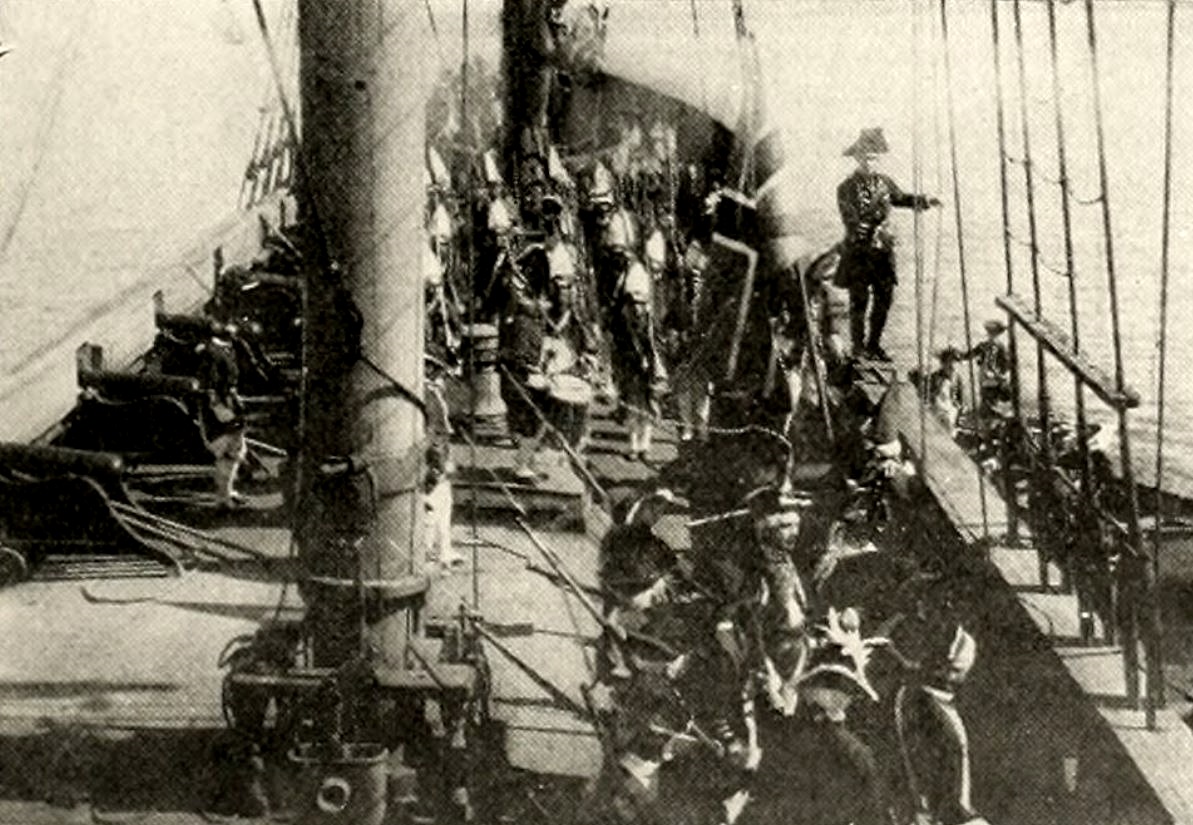
The visual storytelling reaches a zenith during the naval sequences. The ruse involving the French flag is executed with a tension that feels surprisingly modern. One can almost feel the chill of the St. Lawrence as the Canadian pilots are coerced into navigating the English fleet. This sequence highlights the film's commitment to showcasing the 'gray areas' of war—the deception, the threats of execution, and the exploitation of local knowledge. It stands in stark contrast to the more fantastical elements seen in The Mystery of the Black Pearl, opting instead for a gritty realism that was quite advanced for its time.
The Intertwined Fates of Arleigh and Mignon
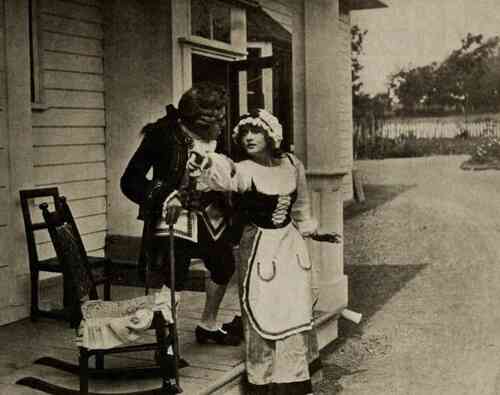
At the heart of the carnage lies the romance between Lieutenant Arleigh and Mignon Mars. Anna Q. Nilsson, a luminary of the silent era, brings a luminous intensity to Mignon. Her journey—from a captive of the Royal Americans to a desperate searcher on the battlefield—provides the necessary emotional grounding for the audience. The subplot involving her brother Hubert and his rescue of Arleigh adds a layer of 'brotherhood of arms' that transcends national boundaries. When Arleigh escapes the French hospital by assuming the identity of a deceased soldier, the film touches upon themes of mortality and the fluidity of identity in the chaos of conflict, reminiscent of the heavy moral weight found in Maria Magdalena.
The bombardment of Quebec is perhaps the film's most technically ambitious sequence. The use of pyrotechnics and practical effects to simulate the 'rain of death' upon the city is handled with a visceral energy. Houses rattling under the weight of shot and shell create a sense of environmental peril that was likely breathtaking for 1914 audiences. This isn't just a backdrop; it’s an active participant in the drama, forcing characters like Mignon and her father into 'dire peril' and necessitating Wolfe’s intervention. The Chateau Mars becomes more than a setting; it is a microcosm of the entire conflict—a home occupied by the very forces it sought to resist.
The Tactical Tragedy of Montmorenci Falls
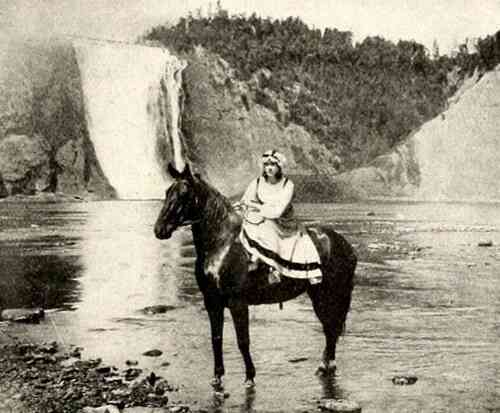
One must discuss the failure at Montmorenci Falls to understand the film's pacing. The impetuosity of the Grenadiers, leading to a disastrous retreat, serves as the narrative's 'darkest hour.' It is here that Wolfe’s dejection is most palpable. The film doesn't shy away from the messiness of military command—the disobedience, the sudden reversals of fortune, and the sheer brutality of the 'bushwackers' and indigenous allies. The inclusion of the Caughnawaga ally and the near-scalping of Arleigh injects a raw, frontier-style violence that reminds the viewer of the specific American-Canadian context of this war, a theme explored with different nuances in Arizona.
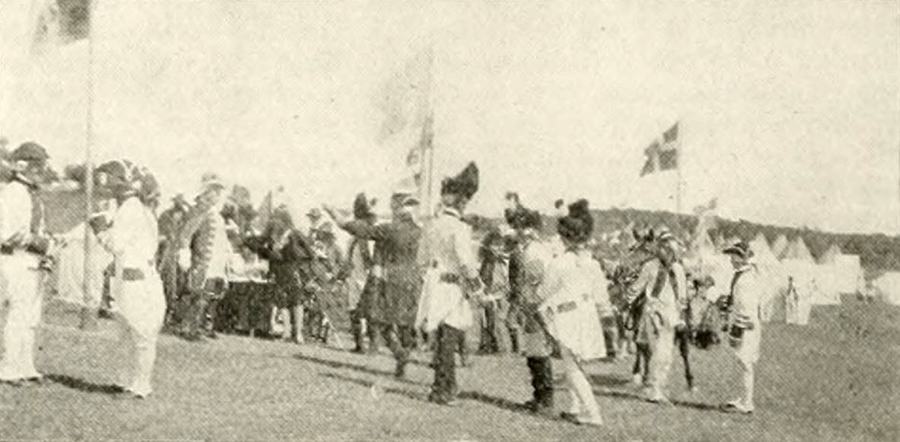
As we move toward the final act, the film’s focus narrows onto the Plains of Abraham. The sequence of the English troops toiling up the mountainside under the cover of night is a masterclass in silent suspense. The use of the password, the silence of the oars, and the eventual dawn reveal of the British line are framed with an epic sensibility that rivals the scale of Salambo, a $100,000 Spectacle. The cinematography captures the vastness of the plains, making the eventual 'clash that sends both sides reeling' feel like a collision of tectonic plates.
The Death of Two Titans
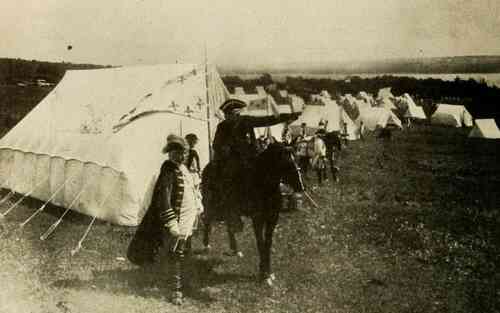
The double death of Wolfe and Montcalm is handled with a poetic symmetry. Wolfe’s final moments—gasping for news of the enemy's flight—are portrayed with a hagiographic reverence. "I die happy," he whispers, a line that has echoed through history books and is here given a physical, agonizing reality. Simultaneously, Montcalm’s reaction to his own mortal wound is equally poignant. His relief that he will not witness the surrender of Quebec provides him with a dignity that matches his opponent's. This dual tragedy suggests that in the conquest of Quebec, there were no true victors, only men of honor consumed by the machinery of empire.
Comparing this to other historical epics of the time, such as Du Barry or A Vida do Barão do Rio Branco, Wolfe; or, the Conquest of Quebec feels more focused on the tactical minutiae. It doesn't get lost in the opulence of the court; it stays in the mud, on the ships, and in the hospitals. Even the romance, which could have easily become cloying, is kept taut by the constant threat of the surrounding war. The final image—Arleigh and Mignon watching the flagship carry Wolfe’s body away—is a haunting reminder that while individuals find happiness, the tide of history moves on, indifferent to their survival.
Technically, the film utilizes a variety of camera distances to tell its story. While many 1914 films were still heavily reliant on the 'proscenium arch' wide shot, Wolfe experiments with closer framings during moments of high emotional distress, such as Mignon’s search among the dead. This proto-cinematic language helps bridge the gap between the theatricality of the 19th century and the visual storytelling of the 20th. It lacks the whimsicality of A Good Little Devil, replacing it with a somber, almost liturgical rhythm.
Ultimately, the film is a testament to the ambition of early filmmakers. To tackle a subject of this magnitude—involving naval battles, mass infantry charges, and a multi-layered romantic subplot—required a level of coordination that is impressive even by today's standards. The performances, particularly from Nilsson and Livingston, avoid the excessive gesticulation that plagued many silents, opting instead for a more grounded, 'human' approach. For those interested in the evolution of the historical epic, this film is an essential artifact. It captures a moment when cinema was beginning to realize its power to not just record history, but to mythologize it, much like the thematic reach of Atlantis or the dramatic tension in The Fugitive.
In the grander scheme of 1914 cinema, Wolfe; or, the Conquest of Quebec stands as a bridge. It looks back at the 18th century through the lens of early 20th-century nationalism and technical innovation. It is a film of fire ships and lockets, of fatal illnesses and mountain paths. It reminds us that the conquest of a city is always composed of a thousand smaller conquests—of fear, of love, and of the inevitable approach of the setting sun.
IMDb —
1932
Community
Log in to comment.