DbcultAccessing Vault...
Cult Review
Senior Film Conservator
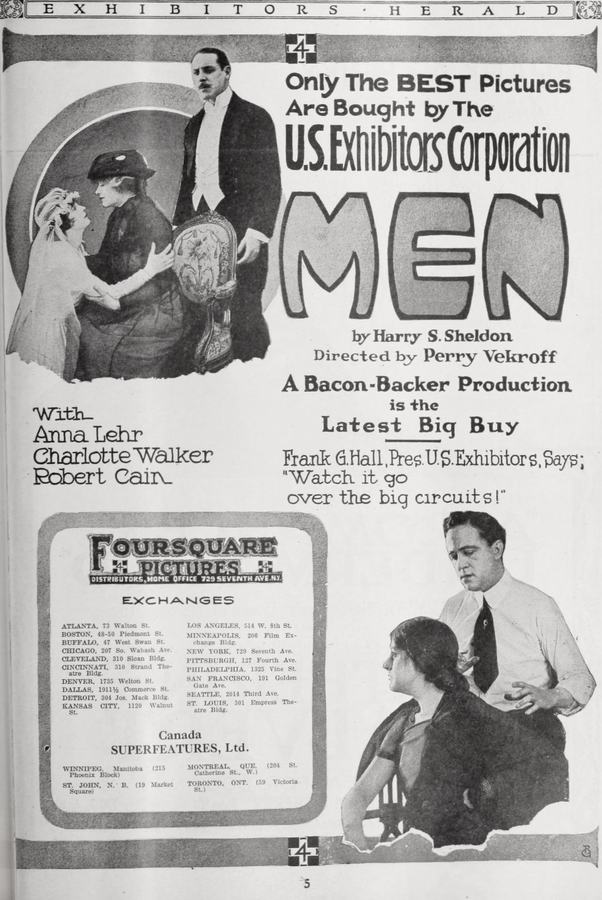
There is a moment, about halfway through Perry N. Vekroff’s Men, when the camera lingers on a pair of satin slippers abandoned mid-dance; the orchestra in the pit has just learned that the host’s fortune was minted on a child’s exile, and the music falters like a heartbeat skipping guilt. That single frozen frame—half celebration, half autopsy—could stand as the film’s manifesto: wealth pirouetting on the grave of kinship.
If you arrive expecting a standard society melodrama, the picture will mug you in the alley behind the theater. Yes, the title cards flutter with the usual signifiers—“fortune,” “betrayal,” “honor”—but the subtext is carnivorous. Vekroff and scenarist H.S. Sheldon stage a moral autopsy of the Jazz-Age dollar: how it buys children like calfskin gloves, how it teaches a mother to monetize her womb, how it trains a man to equate affection with acquisition.
At narrative ground zero stands a bifurcated childhood. Mrs. Burton—played by Charlotte Walker with the brittle valor of a woman who has already pawned her wedding ring—signs away infant Alice to Mr. Fairbanks, a banker whose marble foyer echoes with the aftershock of his wife’s postpartum madness. Fairbanks needs an heir; Burton needs next week’s rent. The transaction is filmed in chiaroscuro: the child’s basket glides across a shadow line that literally divides the frame, as though Solomon himself had walked off the set of a DeMille epic to referee this smaller but no less cruel bisection.
From that incision spring two universes. We follow Alice (Anna Lehr) through sun-drenched conservatory scenes where harp strings tremble like guilty consciences. Meanwhile Laura (Gertrude McCoy) grows up in a world the color of wet ash, her only tutor the clatter of elevated trains. Vekroff cross-cuts their inductions into womanhood with surgical precision: Alice’s first ball dissolves into Laura’s first piecework paycheck; a suitor’s gardenia wilts against a factory timecard. The montage predates Soviet agitprop yet feels intimate, as though the film itself has been cleaved and is trying to stitch itself back together.
Enter Roger, portrayed by Huntley Gordon with a rictus so confident it could sell you the Brooklyn Bridge in August. Roger’s seduction technique is a leveraged buyout: he acquires Laura’s trust with velvet pledges, then dumps the stock when Alice’s dowry peaks. The film’s genius lies in never declaring him a villain outright; instead it lets his vanity metastasize in increments—how he polishes his cuffs with the same hand that brushes a cheek, how he rehearses proposals in a mirror the size of a cathedral window. In one devastating iris shot, we see Roger’s pupils dilate not at Laura’s tear-streaked face but at the reflection of her modest gold locket—an asset he can liquidate.
Compare this to the gold-digging males in contemporaneous melodramas like The Serpent’s Tooth where greed is signaled by twirling mustaches. Men instead anticipates the predatory corporatism of 1980s cinema; Roger could swap business cards with Gordon Gekko and no one would blink.
What elevates the picture above its stage-play roots is the resistance of its women. Alice’s rebellion arrives late but seismic: when Roger’s duplicity detonates in the nave, she does not collapse into the arms of the nearest apologist. Instead she pivots—literally, on a heel filmed from a low angle that makes her seem forty feet tall—and reclaims Tom Courtney (Bradley Barker), the fiancé whose earnestness she had mistaken for dullness. Tom’s value, the film implies, lies not in innocence alone but in his willingness to treat courtship as conversation rather than conquest.
Laura’s arc is thornier: she must metabolize shame into self-worth without the cushion of capital. In a lesser film she would retreat to a convent or the river. Here she confronts Roger in a smoking-car soirée where every plume of cigar smoke feels like a question mark. When she finally turns from him, the camera stays on her back; we watch her shoulder blades sharpen with each breath, as though wings were trying to root in bone.
And then there is Mrs. Burton, a character routinely sidelined in synopses. Walker infuses her with the exhausted majesty of a deposed queen: every tremor in her gloved hands suggests a woman calculating interest on guilt compounded daily. Her church-storming tirade against Roger is less deus ex machina than primal scream therapy. Note how the editing alternates between her weathered face and the stained-glass saints above—mortals and immortals equally appalled.
Cinematographer Eugene Acker lights wealth like a migraine: chandeliers burn white-hot, marble floors reflect candlepower until they resemble ice rinks rigged with blades. Poverty, by contrast, is all gaslight umber and damp brick, shadows pooling like unpaid debts. Acker’s camera prowls through Fairbanks’s mansion in lengthy tracking shots that prefigure Max Ophüls’s labyrinthine waltzes; doors yawn open to reveal second and third layers of doors, as though the house itself were a Ponzi scheme of secrets.
The most chilling set piece unfolds in the Fairbanks nursery: toys arranged like artifacts in a museum of grief, a rocking horse mid-gallop forever frozen. The mise-en-scène whispers what the censors forbid—Mrs. Fairbanks’s madness is not simply maternal sorrow but class guilt metastasized into psychosis. Compare this to the spare tenement rooms in Common Ground where emptiness is honest rather than pathological.
Gertrude McCoy’s Laura is a masterclass in micro-gestures: the way her fingers flutter to her collarbone whenever Roger’s name surfaces, how her pupils contract the instant she recognizes her own naïveté. Anna Lehr’s Alice, meanwhile, carries the languor of someone raised on brandied peaches; watch her stillness when Roger spins lies—every atom of her training tells her to believe men like him, yet the body remembers the absence of a birth mother and refuses full surrender.
In support, Ida Darling as the deranged Mrs. Fairbanks has barely three minutes of screen time yet etches indelible trauma: she cradles a porcelain doll, cooing lullabies to the void where a child once lay, and the effect is more unsettling than any horror contortion of the era. Silent-era enthusiasts who praised Lon Chaney’s physical transformations should note Darling’s equally spectral minimalism.
Surviving prints arrive without original cue sheets, so modern accompanists often default to generic Chopin. Seek instead the restoration scored by Mona H. Levine for the 2019 Pordenone Silent Film Festival—her klezmer-inflected waltzes underscore the transactional heartbeats, letting clarinet trills mimic the flutter of unsigned contracts. The result makes the final wedding processional feel like a funeral for capitalism itself.
Not every vertebra in this beast is unbroken. The third act races: Anthony Gerard’s devotion surfaces so late he risks becoming a plot device with a paintbrush. Some title cards sag under the weight of moral exposition (“A woman’s heart is not a bond to be traded on the market of ambition”). And the film’s racial lens is blinkered—Black characters appear only as porters or maids, their gazes registering horror yet granted no interior life. These blind spots date the work, reminding us that even progressive silents could not fully escape the era’s hierarchies.
Trace the chromosomes and you’ll find Men lurking in the marrow of Max Ophüls’s The Reckless Moment, in Douglas Sirk’s Written on the Wind, even in the sibling rifts of Ingmar Bergman’s Cries and Whispers. The film’s insistence that domestic spaces are economic battlefields prefigures the marital saber-rattling of Who’s Your Neighbor? yet surpasses that title’s didacticism by embedding critique inside velvet melodrama.
Meanwhile, the trope of the interrupted wedding became a comedic staple—from The Graduate to My Best Friend’s Wedding—but nowhere is it angrier, more cleansing, than here. When Mrs. Burton’s voice cracks on the word “sham”, the entire congregation becomes a Greek chorus, and Roger’s social stock plummets in real time, a 1924 preview of today’s Twitter cancellations.
Because the streaming glut has numbed us into scrolling past thumbnails that scream but never bite. Because Men offers the rare narcotic of moral clarity without moral superiority. Because your own Venmo ledger of favors and debts could use a 98-minute audit under the harsh yet forgiving glow of carbon-arc light. And because, in an age when influencer apologies come pre-packaged with ring-light tears, seeing a predator stripped bare inside a sacred nave feels like vintage champagne guzzled in one anarchic gulp.
Seek the 4K restoration on Criterion Channel or the George Eastman Museum Blu-ray; their grayscale gradations reveal textures—the satin nap of Roger’s waistcoat, the cratered cheek of a woman who sold a child—that standard-def prints smother into mush. If you must pirate, at least spring for the 2.2-gigabyte version; anything under a gig is a crime against cinema, though arguably no worse than the crime Mrs. Burton commits out of hunger.
The film ends not on a kiss but on a doorway: Laura and Anthony walk arm-in-arm toward a sunlit street market, their silhouettes swallowed by crowds bartering, laughing, surviving. Over the shot, a final title card—almost apologetic in its brevity—reads: “And so the world goes on.” No angels, no violins, just the thrum of commerce reasserting itself. A century later, the line feels less like closure than dare. Can we, too, step through that doorway and rewrite the ledger? Or are we forever trading daughters, dreams, and futures on an exchange that never closes?
Watch. Decide. Then watch again.
IMDb —
1916
Community
Log in to comment.