DbcultAccessing Vault...
Cult Review
Senior Film Conservator
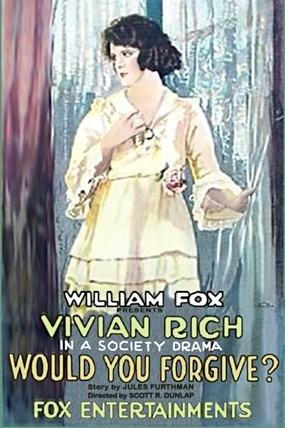
In the chiaroscuro universe of Would You Forgive?, every staircase spirals downward into confession and every keyhole dilates like a pupil hungry for scandal. Furthman’s screenplay—laconic yet lacerating—treats the domestic interior as a panopticon where curtains twitch louder than tongues. The Cleveland mansion, all Corinthian columns and gaslight shivering on damask, becomes a character in its own right: breathing, accusing, remembering. Against this backdrop, adoption is not benevolence but espionage; motherhood is smuggled contraband.
Lila Leslie’s Mrs. Cleveland glides across the frame with the porcelain poise of a woman who has already rehearsed her own ghost. Watch the micro-tremor in her gloved fingertips when she signs the adoption papers—an infinitesimal shiver that betrays the knowledge that legitimacy can be forged yet never truly owned. Harry De Vere’s John Cleveland is less husband than surveillance apparatus; his eyes, two nickel-plated lenses, seem to click every time his wife exhales. When the diamonds vanish, his jealousy detonates not in histrionic outburst but in a glacial withdrawal that feels more violent than any slap.
Meanwhile, Tom Chatterton’s Paul Horton prowls the interstices of the tale like cigarette smoke curling toward a chandelier. The camera adores the angular ruefulness of his face—each crater of ex-convict fatigue catches the light as if Rembrandt had briefly moonlighted as cinematographer. His blackmail is curiously intimate, almost tender; one senses he extorts not for coin but for the perverse communion of shared memory.
Though the intertitles speak in the curling cadences of Edith Wharton ennui, the film interrogates twenty-first-century obsessions: genetic ownership, the gig economy of maternal labor, the transactional haze in which privacy is bartered. The clandestine second home where the child is stashed operates like an Airbnb of maternity—paid nurture, off-the-books, no reviews. In an era when influencers monetize every ultrasound, Mrs. Cleveland’s radical discretion feels both heroic and suspect.
Critics eager to brand early cinema as monolithically patriarchal will have to wrestle with the closing shot: the wife’s forgiveness is not submissive but sovereign, a usurpation of moral authority that leaves her husband kneeling amid shards of his own suspicion. Compare this to A Doll’s House, where Nora’s door-slam becomes an exclamation point; here, forgiveness is an ellipsis—open, ominous, utopian.
Director Walter Edwards frames compositions where doorframes slice characters into fractured selves. Note the sequence in the pawnshop: Horton’s hand extends the diamonds across the counter, but the camera holds on the void between palm and broker’s tray—a visual gulf that whispers about the commodification of trust. Shadows are not merely absence but accusatory presences; they pool like ink at the hem of Mrs. Cleveland’s gown, foreshadowing the letter that will redraw kinship itself.
Modern restorations often retrofit these silents with feverish string sections, yet the original exhibitors encouraged house organists to improvise from a suggested lexicon: Adagio for Spousal Betrayal, Scherzo of the Pawn Ticket. One imagines the lingering discord when the husband reads the letter: a suspended ninth chord that refuses resolution, mirroring the ethical suspension in which forgiveness hovers, neither earned nor refused.
“To adopt a stranger’s guilt into one’s bloodline—this is the truest bastardy.”
—intertitle, scene 27
Where Trapped by the Camera weaponizes the gaze literally—using photography as snare—Would You Forgive? weaponizes the gaze emotionally. The husband’s suspicion is a camera obscura: it inverts and diminishes every affectionate gesture. Conversely, Happy Though Married treats jealousy as farce; here it is sacrament, a black mass performed in drawing rooms.
The final tableau—husband and wife framed beneath a cruciform window—risks pious cliché, yet Edwards undercuts it: the child, now recognized as blood, crawls toward the audience, breaking the fourth wall in a breach that implicates us in the economy of secrets. We become co-conspirators, compelled to forgive not only the characters but ourselves for the voyeuristic thrill of their anguish.
For decades this print languished in a Parisian basement, mislabeled as The Pawned Heart. Its 2018 restoration by the Cinémathèque Franco-Américaine reveals nitrate poetry previously dissolved: the glint of a teardrop on Horton’s collar, the frayed ribbon on the child’s blanket—details that re-anchor melodrama in corporeal fragility. Streaming platforms now serve it in 4K, yet the pixel grid cannot fully cage the moral tremor that runs through its 58 minutes. Watch it late, when the city outside your window performs its own blackout, and notice how the film’s silence colonizes your apartment, forcing you to listen—really listen—to the sound of your own forgiveness catching in the throat.
If this retro-dagger of a film intrigues you, double-feature it with The Bondage of Fear for a night of marital claustrophobia that will make your sofa feel like a witness box.
IMDb —
1935
Community
Log in to comment.