DbcultAccessing Vault...
7/10
Senior Film Conservator
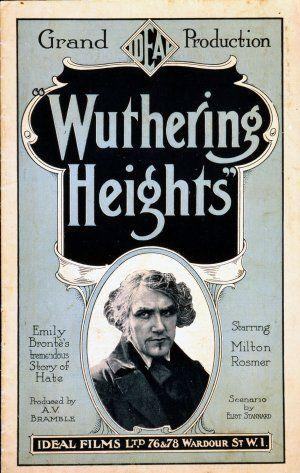
A definitive 7/10 rating for a film that redefined the boundaries of cult cinema. Wuthering Heights remains a cornerstone of transgressive art.
To approach the 1920 adaptation of Wuthering Heights is to step into a liminal space where the nascent techniques of silent cinema collide with the ancient, brooding energy of the English landscape. Directed by A.V. Bramble and featuring a screenplay by the prolific Eliot Stannard, this version serves as a stark reminder that the essence of Emily Brontë’s work lies not in its dialogue, but in its atmosphere—a quality that silent film, with its reliance on physiognomy and shadow, is uniquely equipped to capture. Unlike the more polished, sanitized versions that would follow in the mid-century, this silent iteration feels uncomfortably close to the soil, capturing a raw, atavistic quality that modern audiences might find startlingly modern.
The casting of Milton Rosmer as Heathcliff brings a peculiar, haunted intensity to the screen. Rosmer does not play the character as a mere romantic hero, but as a man possessed by a singular, destructive purpose. His performance is a masterclass in the economy of movement; every furrowed brow and clenched jaw resonates with the weight of years of systemic abuse and social ostracization. Opposite him, Colette Brettel embodies a Catherine Earnshaw who is both ethereal and dangerously grounded, a woman caught between the civilizing influence of the Grange and the wild, chaotic pull of the Heights. Their chemistry is not one of soft focus and swelling violins, but of a shared, desperate hunger that threatens to consume the very frames of the celluloid.
In the broader landscape of 1920s cinema, this film occupies a fascinating niche. While contemporary productions like Britain Prepared focused on nationalistic vigor and industrial prowess, Wuthering Heights turned its gaze inward, exploring the darker recesses of the British psyche. It stands in sharp contrast to the more lighthearted fare of the era, such as Easy to Make Money, opting instead for a somber, almost nihilistic tone that mirrors the post-war disillusionment of the time. The film’s visual palette, though restricted by the technology of the day, utilizes a primitive form of chiaroscuro that highlights the isolation of its protagonists.
The cinematography captures the moors not as a picturesque backdrop, but as an active antagonist. The wind seems to howl through the intertitles, and the stark contrast between the claustrophobic interiors of the Earnshaw residence and the vast, unforgiving expanse of the hills creates a sense of inescapable fate. This is a world where the social structures explored in films like The Politicians are rendered irrelevant by the sheer force of nature and human emotion. The film understands that the tragedy of Heathcliff and Catherine is not merely personal, but environmental—they are products of a landscape that permits no softness.
One of the most striking aspects of Stannard’s adaptation is its commitment to the second half of Brontë’s novel, a section often excised by later filmmakers for the sake of brevity. By including the story of the younger Catherine and Hareton, the 1920 film emphasizes the cyclical nature of trauma. We see the sins of the father—and the mother—visited upon the children with a cold, clinical precision. This thematic depth aligns it more closely with psychological dramas like The Broken Commandments, where moral transgressions have long-lasting, tangible consequences.
The transition from the first generation’s wild passion to the second generation’s tentative hope is handled with surprising nuance. The film utilizes visual motifs—locked gates, open windows, the recurring presence of the gravestones—to link the two eras. It suggests that while Heathcliff may have sought to demolish the families that spurned him, he ultimately becomes a prisoner of his own vengeance, a theme echoed in the darker undertones of Vengeance. The resolution is not one of easy catharsis, but of an exhausted peace, as if the land itself has finally tired of the Earnshaw-Linton feud.
Beyond the central duo, the supporting cast provides a sturdy foundation for the film’s emotional weight. Cecil Morton York as the elder Mr. Earnshaw brings a brief moment of warmth that quickly dissipates, leaving a vacuum that Heathcliff and Hindley (Warwick Ward) fight to fill. Ward’s portrayal of Hindley is particularly effective; he is not a caricature of a villain, but a weak man whose cruelty is born of insecurity and grief. His descent into alcoholism and gambling is depicted with a gritty realism that wouldn't be out of place in a social drama like Sold.
The Linton family, represented by Cyril Raymond as Edgar and Dora De Winton as Mrs. Linton, provides the necessary foil to the Earnshaws. Their world is one of refined manners and soft fabrics, a stark juxtaposition to the mud and stone of Wuthering Heights. This class conflict is central to the film’s tension, reflecting the societal anxieties seen in international works such as Marionetki roka or the Polish drama Topiel. Heathcliff’s return as a wealthy gentleman is not a triumph of character, but a cynical adoption of the very tools used to oppress him.
For a film produced in 1920, the technical sophistication is noteworthy. The use of tinting—subtle ambers for the hearth-side scenes and cold, sea blues for the night-time moors—adds a layer of emotional resonance that transcends the absence of sound. The editing, while slower than modern standards, allows scenes to breathe, building a sense of dread that is almost palpable. It lacks the frantic energy of contemporary thrillers like Price of Treachery; Or, The Lighthouse Keeper's Daughter, opting instead for a deliberate, lugubrious pace that mirrors the slow erosion of the characters' souls.
There is a poeticism in the way the film handles the supernatural elements. The ghost of Catherine appearing at the window is not a jump-scare, but a profound expression of grief. It is handled with a restraint that makes it more haunting than many modern CGI-laden efforts. This spectral presence suggests that the love between Catherine and Heathcliff has become a permanent scar on the landscape, a theme that resonates with the melancholic beauty of Embers. The film understands that the most terrifying ghosts are those we carry within ourselves.
As an artifact of film history, the 1920 Wuthering Heights is invaluable. It represents a moment when British cinema was beginning to find its unique voice, moving away from simple stage adaptations towards a more cinematic language. While it may not have the international fame of the 1939 version, it possesses a grit and an honesty that is perhaps more faithful to the spirit of Emily Brontë’s prose. It doesn't shy away from the ugliness of the characters; it doesn't try to make Heathcliff a hero. It presents him as a force of nature, as inevitable and as destructive as a storm over the Pennines.
In comparing this work to others of its time, such as the Danish Solskinsbørnene or the Norwegian Dolken, one sees a universal preoccupation with the themes of inheritance and the struggle against social confinement. Yet, Wuthering Heights remains distinct in its sheer, unadulterated passion. It is a film that demands much from its audience—patience, empathy, and a willingness to stare into the abyss of human obsession. It is a testament to the power of the source material that even a century later, these silent images can still evoke such a profound sense of desolation and beauty.
Ultimately, this 1920 adaptation is a haunting triumph. It captures the essence of a "star-crossed" love not as a pretty tragedy, but as a tectonic shift that levels everything in its path. From the meticulous set design that reflects the decaying grandeur of the Earnshaw estate to the expressive, often agonizing performances of the lead actors, the film is a cohesive, singular vision of Brontë’s masterpiece. It stands alongside other significant dramas of the period, such as The Martinache Marriage or the wartime reflections of With Serb and Austrian, as a crucial piece of the cinematic puzzle of the early 20th century. For those willing to look past the lack of sound and the flicker of the film stock, there is a vibrant, beating heart to be found in these old shadows—a heart that, like Heathcliff’s, refuses to be silenced by time or death.
A final note on the legacy of this work: while many have sought to replicate the magic of the moors, few have captured the sheer, unbridled ferocity of the original text as effectively as this silent gem. It remains a essential viewing for any serious student of the gothic or the history of the moving image.
IMDb 6
1934
Community
Log in to comment.